


It is almost an inevitability that biopics of artistic icons will fail to do them justice. The whole reason these figures are worth celebrating to begin with is their uniqueness — their peerless brilliance or their shocking originality. By definition, the vast majority of other (even very skilled) storytellers attempting to memorialize them cannot measure up.
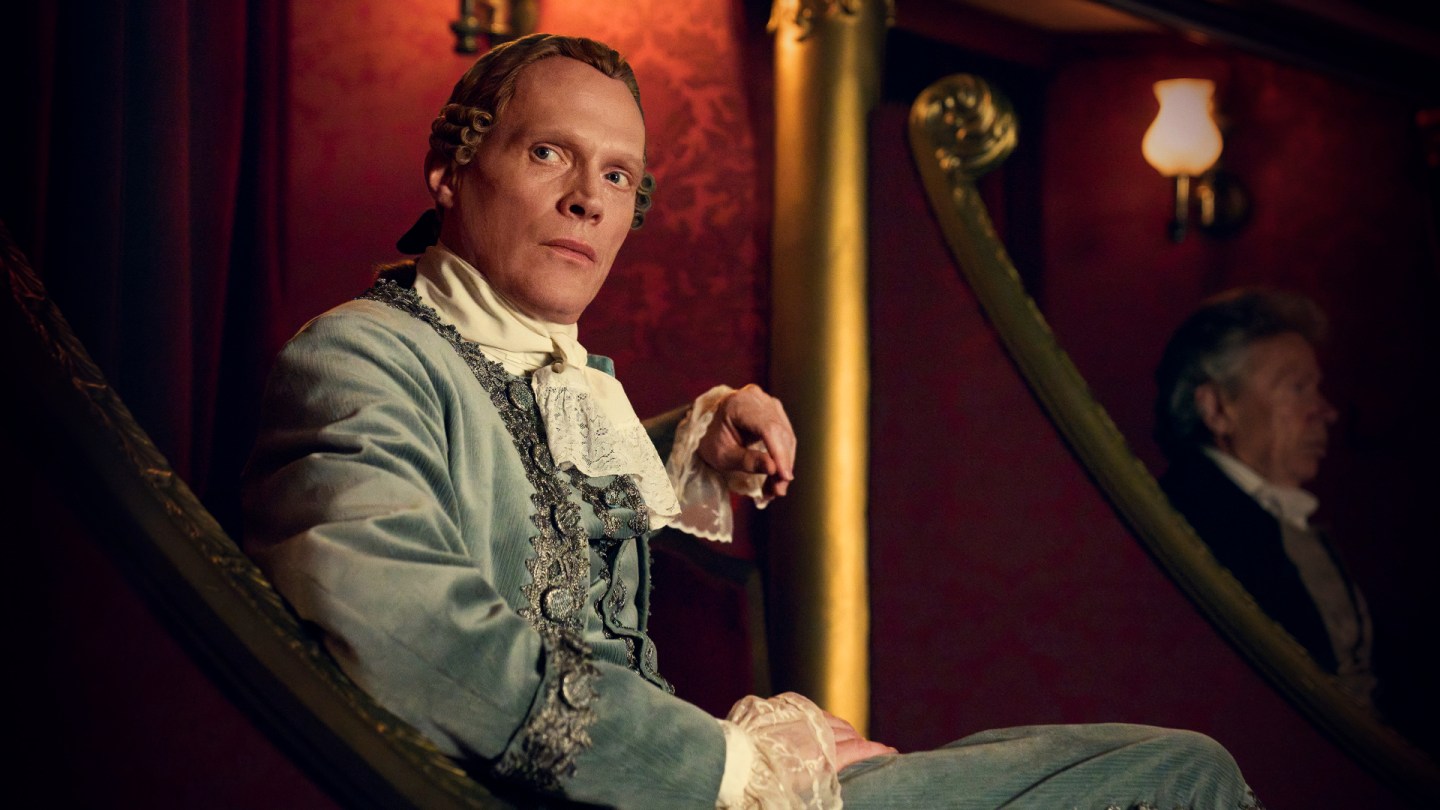
The sly twist of Amadeus, then, is that it does not pretend otherwise. The impossibility of grasping, let alone explaining, true genius is built into the very premise of the Starz drama, framed as the end-of-life confession of a good composer (Paul Bettany’s Antonio Salieri) condemned to exist in the shadow of a great one (Will Sharpe’s Wolfgang Amadeus Mozart). If it comes nowhere close to achieving the immortal transcendence of the latter, its understanding of how maddening that failure can be is thrilling on its own terms.
Amadeus
The Bottom Line
A thrilling symphony of genius and jealousy.
Airdate: 8 p.m. Friday, May 8 (Starz)
Cast: Paul Bettany, Will Sharpe, Gabrielle Creevy, Rory Kinnear, Jonathan Aris, Ényi Okoronkwo, Hugh Sachs, Viola Prettejohn, Jyuddah Jaymes, Jessica Alexander
Creator: Joe Barton, based on the play by Peter Shaffer
Amadeus is no original — this version is created by Joe Barton (Black Doves) and based, like the 1984 Milos Forman movie, on Peter Shaffer’s 1979 play, which was based on Alexander Pushkin’s 1830 one, which was loosely based on real history. But it does what every worthwhile adaptation does (and what so many other recent re-adaptations have failed to do), which is make the story feel complete unto itself.
In late 1824, an aged Salieri (Bettany in atrocious old-age makeup) has summoned Constanze Mozart (Gabrielle Creevy in an even less convincing face) to make a confession. It was he who cut down her husband in the prime of his life, he says, though how and why he will take his time revealing. Like all attention-starved people, he can’t resist dragging out his moment in the spotlight as long as possible, to the tune of five hourlong episodes.
In his telling, Salieri was getting along well enough in 1781 Vienna as a respected composer with a few big hits under his belt and the favor of Emperor Joseph II (Rory Kinnear). The only thorn in his side is a creative block that has him glaring at a blank page when he’s not begging God on his knees for inspiration. (Girl, been there.)
Which means it’s the worst possible time for Mozart, a brash young Salzburger overflowing with big ideas, to roll into the city. Initially, Salieri’s ready to dismiss this upstart as has so many others before: “I’ve met my fair share of prodigies in my time,” he sniffs. “Can’t say I remember many of their names now, though.” From the moment he hears Mozart touch a keyboard, however, he senses this one is different. This one is going to endure, in a way Salieri will not.
Bettany plays the artist even in happier early days as having a chilly, watchful remove from his own life. Salieri is never not conscious of his relative status in any given room (a job requirement, really, as the Court Composer), and never not calculating ways to maintain or advance that position. Only when he’s listening to music does he come fully alive — which is why it kills him that God has evidently seen fit to shower this coarse, immature young man with all the gifts He’s so cruelly withheld from the pious Salieri.
But if Salieri can only see Mozart’s ingratitude and arrogance, Amadeus strays just far enough from his perspective to paint a fuller portrait. Sharpe slightly overplays Mozart’s rock-star man-child energy to start, but he also brings an understated vulnerability that — as we delve deeper into the sources of his pain, like the daddy issues dramatized in a few too many dream sequences — eventually festers into an open wound.
Where Salieri can only seethe at the way Mozart’s creativity brings him closer to God, Amadeus also sees how it separates him from fellow mortals. The sounds of real life turn to symphonies in his mind, which in turn drown out the sounds of real life. His matter-of-fact “This is how I talk” when someone suggests it might be easier to talk to his wife about their problems than write an opera about them emphasizes that the only language he can fully express himself in is one no one else speaks as fluently.
Amadeus can’t make new again arias and sonatas so deeply embedded in our culture that they register, most of the time we encounter them, as background music. But in the full-body passion with which Mozart conducts the orchestra, or in Salieri’s pained expressions of ecstasy as he listens, it offers a taste of how thrilling it must have been to hear these notes for the first time. (That it mostly avoids the music-biopic trap of drawing too neon a line between Mozart’s inspirations and the output, give or take a groan-worthy zoom-in on the book The Marriage of Figaro will be based on, is an additional blessing.)
At the same time, Amadeus acknowledges that even the sublime has limits — it cannot, in and of itself, pay the bills or keep a home happy or thwart a tragedy. Its best vehicle for bringing Salieri’s vendetta back down to earth is not the rebellious Mozart but Constanze, perceptive and pragmatic in a way the men, protected by their talent or their institutional power, have not had to be. Creevy’s flinty performance makes her such a force to be reckoned with that she almost, but not quite, escapes the thankless trope of the long-suffering wife to a troubled genius.
As Mozart cranks out one immortal classic after another, unhindered by professional disappointment or personal grief or even, as he grows ill, the needs of his own body, Salieri is there at every turn to truncate his shows’ runs, whisper in the Emperor’s ear, manipulate the younger man into offending the wrong people. It’s a sick thrill to watch Salieri display what turns out to be his true virtuosity, a nigh-divine ability to mold another man’s life through sheer force of petty will.
That is, if you believe him. The elderly Constanze is not so sure she does. There’s something too giddy in the way he recounts his past sins, too desperate in his insistence that he is the true author of her husband’s story. If this is Salieri’s last-ditch attempt to secure a lasting legacy for himself, he succeeds; as a playful epilogue reminds us, the very fact that Amadeus lives on all these centuries later is proof of that. Antonio Salieri does indeed endure in our imaginations — not for the great man he was, but for the one he definitively was not.

