


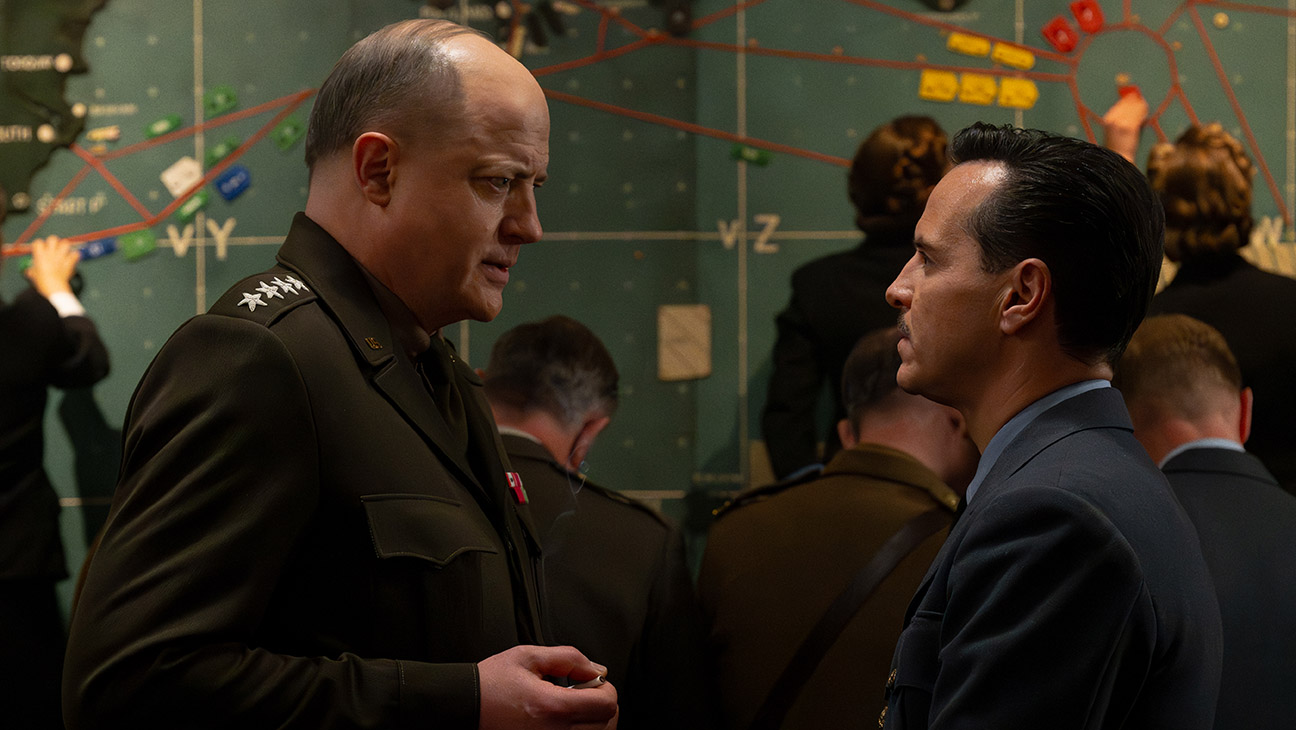
You’d think that every story to be told about World War II would have been told by now. But the new film by Anthony Maras excavates a fascinating, little-known episode involving the preparations for D-Day and the all-important weather forecast that would determine the success or failure of the invasion. Featuring an award-worthy performance by Andrew Scott in the lead role and solid supporting turns by Brendan Fraser, Kerry Condon and Chris Messina, Pressure lives up to its title with its expert ratcheting up of sustained tension.
Based on an acclaimed stage play by David Haig, the film is set in the 72 hours leading up to D-Day. The story begins with the arrival to the Allied Headquarters at the historic 19th-century manor Southwick House of Scottish meteorologist Dr. James Stagg (Scott), who had been assigned to head up the weather forecasting team for the invasion. Although proud of his new position, he’s not particularly happy to be here, since his pregnant wife Liz (Tamsin Topolski) is on the verge of giving birth.
Pressure
The Bottom Line
Weather forecasting makes for a surprisingly edge-of-your-seat thriller.
Release date: Friday, May 29
Cast: Andrew Scott, Brendan Fraser, Kerry Condon, Chris Messina, Damian Lewis
Director: Anthony Maras
Screenwriters: David Haig, Anthony Maras
Rated PG-13,
1 hour 40 minutes
He’s also not pleased with what he sees of the operation currently headed by American meteorologist Irving Krick (Messina), who had successfully worked with General Eisenhower (Fraser) before on several military operations. Stagg quickly comes into conflict with Krick, who relies on historical weather patterns gleaned over decades for his forecasts. Stagg considers the data irrelevant and depends on his own science-based technique instead. He also upsets Eisenhower by telling him that long-term forecasts aren’t reliable, and that “anything over 24 hours is a long-term forecast.”
Eisenhower and his team of generals, including the hot-headed British Bernard “Monty” Montgomery (Damian Lewis, leaning into his blustery turn with gusto), have planned the invasion for June 5, 1944, a date to which Krick has given his blessing. But Stagg insists that the weather will be extremely rainy and windy that day and will result in the invasion’s failure. It’s a prospect that Eisenhower dreads, especially since he’s emotionally traumatized by his role in planning Exercise Tiger, a rehearsal for the invasion that went disastrously and resulted in the deaths of hundreds of soldiers.
Stagg recommends that the invasion be postponed for a couple of weeks, but maintaining secrecy for that long would prove virtually impossible. The resulting clash of wills between Eisenhower, Krick and Stagg forms the heart of the drama, with Ike’s devoted personal aide Kay Somersby (Condon) attempting to bring down the level of anger. The film also depicts the closeness between Ike and Somersby, although without intimating the alleged affair between the two.
The stage origins of the film are evident in the minimal number of settings and long dialogue exchanges, much of it stuffed with dense meteorological jargon. But Maras, working from a screenplay co-written with the playwright, has done a marvelous job of opening up the action to make it feel cinematic, including the judicious use of archival footage from the era. Running a fleet 100 minutes including credits, the film proves compelling throughout even though we obviously know the outcome. As with such films as All the President’s Men and Apollo 13, it’s the depiction of the process involved, never feeling dumbed-down, that holds our attention.
To say that Scott gives a superb performance is by now redundant, but he outdoes himself here, not bothering to render the prickly, officious Stagg likeable but making us fully identify with him nonetheless. The way he subtly reveals deep emotion without resorting to histrionics is a marvel, especially in a scene in which Stagg hears potentially devastating news on the phone. Maras keeps the camera tightly on the actor as he barely seems to react while quietly asking a few brief questions, but the anguish he conveys is palpable.
Fraser at first seems miscast, not bearing much of a resemblance to Eisenhower other than his shaved head. He also comes across as too emotional at times for the Supreme Allied Commander, who was known for his controlled temperament. But he’s effective nonetheless, movingly conveying the pressure that Ike was facing at this key moment in the war.
Condon, projecting the same assured confidence that she did as the racing engineer in F1: The Movie, gives the film a quiet emotional ballast, while Messina does his usual solid work as the meteorologist who eventually comes to accept the fact that he’s been outclassed.
Maras’ previous film, Hotel Mumbai, was a nerve-jangling thriller about a real-life terrorist siege. He’s obviously working in a more cerebral way here, but Pressure is no less riveting.
