


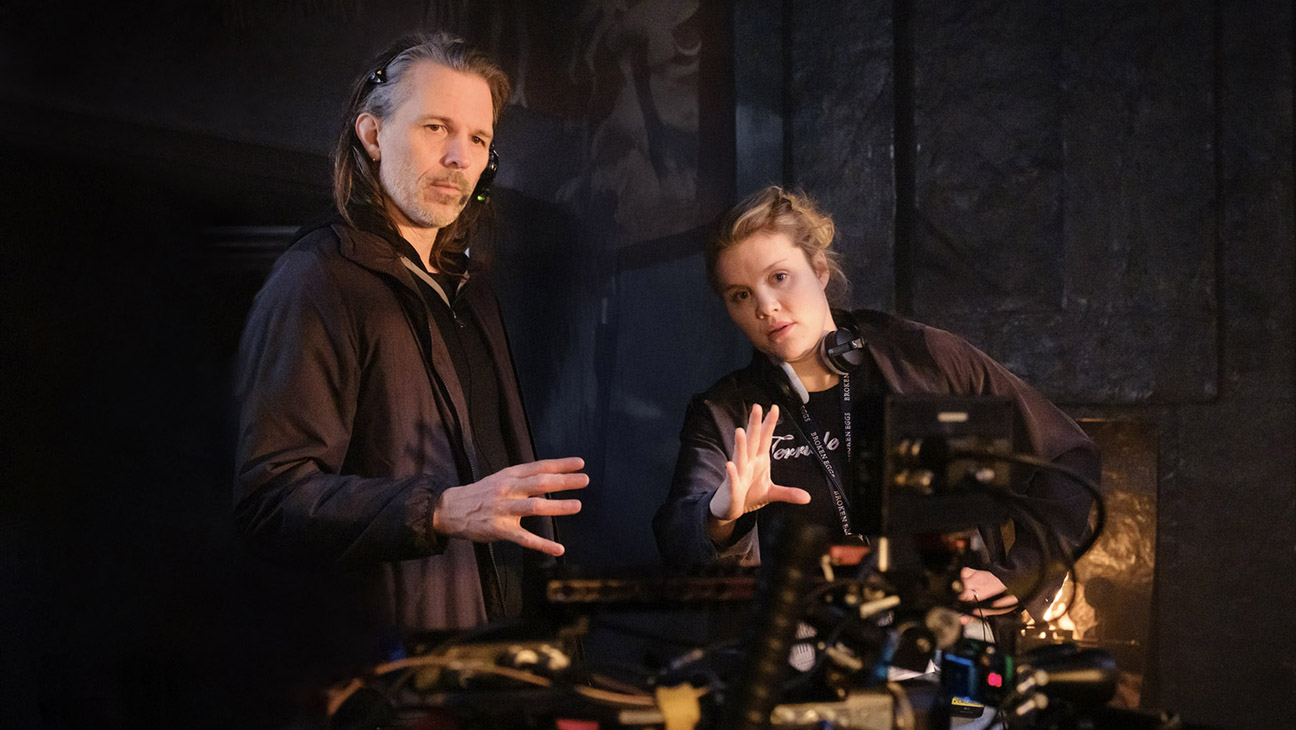
Wuthering Heights cinematographer Linus Sandgren lets the story dictate the format.
As much as the Swedish DP may enjoy shooting in IMAX, Emerald Fennell’s vision for her reimagining of Emily Brontë’s seminal novel had a different ambition than the one he fulfilled for Denis Villeneuve on Dune: Part Three. The writer-director wanted her tragic period romance starring Margot Robbie (Cathy Earnshaw) and Jacob Elordi (Heathcliff) to have a tactile, impressionistic quality, hence the decision to shoot the majority of the piece on standard 35 mm film.
When it came to landscape shots of the Yorkshire Moors — as well as wide interior shots involving Edgar Linton’s (Shazad Latif) decadent manor — the filmmakers sought a higher resolution for the sake of detail, but without sacrificing film grain. Neither standard 65 mm nor IMAX were going to uphold both of those requirements. Thus, Sandgren and Fennell opted for VistaVision, a large 35 mm film format that presents high resolution and just enough grain to maintain continuity with the rest of the film’s 3-perf 35 mm.
“Each format will affect the emotions, and there’s a huge difference to me within the film formats. We tested 65, but Emerald was missing the grain, so we went for 35 to see the grain,” the Oscar-winning Sandgren tells The Hollywood Reporter in support of Wuthering Heights’ 4K release. “Our technical reason for VistaVision was to capture the landscape shots in a high resolution [with a finer grain] because they include small details that you want to see better. Basically, all real exteriors and wide-shot interiors were VistaVision.”
This particular system had a dominant run in the 1950s, but then it fell by the wayside until Brady Corbet’s The Brutalist seemingly brought it back in 2024. Since then, VistaVision has been used in Paul Thomas Anderson’s Oscar-winning One Battle After Another, Yorgos Lanthimos’ Bugonia and upcoming films from Alejandro González Iñárritu (Digger), M. Night Shyamalan (Remain) and Greta Gerwig (Narnia: The Magician’s Nephew). In a time where moviegoing is on shakier ground, VistaVision, like IMAX, offers a marketable large format that promises a unique moviegoing experience compared to the majority of today’s films and series shot on digital.
According to Sandgren, its image clarity is a key selling point for filmmakers who’ve become enamored with digital’s sharpness. “People started shooting digital, and they got used to the sharp quality of the image. So directors who like the sharpness of shooting on digital cameras can maintain that very sharp image with film formats like VistaVision,” Sandgren says.
As for December’s Dune: Part Three, Sandgren did opt for strategic use of IMAX cameras to achieve the scope and scale that Villeneuve envisioned for his trilogy capper. He’d previously applied the camera to select sequences in First Man and No Time to Die. Compared to VistaVision, IMAX provides a larger and even clearer image, but it generally lacks the texture that comes with the former.
Sandgren has provided a great deal of feedback to IMAX as part of their ongoing efforts to refine its technology, but he’s yet to use the modernized camera system that Christopher Nolan and DP Hoyte van Hoytema deployed for the entirety of their upcoming epic, The Odyssey. The historical knock against the IMAX camera is that it’s heavy and noisy, preventing use during dialogue scenes. However, IMAX finally solved the problem ahead of The Odyssey’s shoot by surrounding the camera with a sound blimp or a box-like encasement. Sandgren admits he’s intrigued by the possibility of shooting an entire film with an IMAX camera, but he will still let the script govern all format decisions.
“I absolutely love films that are epic and big and use IMAX correctly. Some films shouldn’t be IMAX, and some films should be IMAX. We used it a lot on Dune: Part Three,” Sandgren says. “Of course, you want those IMAX cameras to be quiet, and we have all offered input on their new cameras to try to make them quieter. Still, a blimp is needed, and it’s as cumbersome as it looks. It’s a complicated device. Maybe there are AI ways of somehow filtering [the noise], but you want the authenticity of the audio as well.”
Like Nolan and van Hoytema, Sandgren champions celluloid, having used it across all his other feature films that preceded Wuthering Heights. He’s open to digital if the situation calls for it, but most of all, he just wants filmmakers to have every tool available to them. Shooting on film can often be a tough sell to studios and financiers given the additional expense and processing time involved. The director of photography alludes to one instance where he was put through the wringer to secure film stock, but he’s largely been lucky to have supportive collaborators. When the subject of cost comes up, he indicates that there are creative ways to pull it off if the desire is there.
“I’ve been in situations where I had to pitch to the studio, by myself, why we should shoot on film and not digital. Once, I had already talked with the director and the studio about shooting on film, and then suddenly they pulled that back. So it felt like a breach of contract, in my opinion,” Sandgren shares. “Obviously, you need to compromise to make the budget work. But if you open your eyes across all departments, then perhaps there’s a way to save the money that film costs in production.”
Sandgren’s parting words restate his philosophy that a film’s format should be driven less by marketing opportunities and more by the root of the entire enterprise.
“The format doesn’t decide what the format should be. It’s the story that asks for a format. It’s a tool to serve the story.”
***
“Wuthering Heights” is now available on 4K.

Jacob Elordi as Heathcliff in Wuthering Heights
Courtesy Warner Bros. Pictures

Margot Robbie as Cathy in Emerald Fennell’s Wuthering Heights.
© Warner Bros. /Courtesy Everett Collection

Jacob Elordi as Heathcliff in Emerald Fennell’s Wuthering Heights.
Courtesy of Warner Bros.
Alison Oliver as Isabella Linton and Margot Robbie as Catherine Earnshaw in Wuthering Heights.
Courtesy Warner Bros. Pictures

