


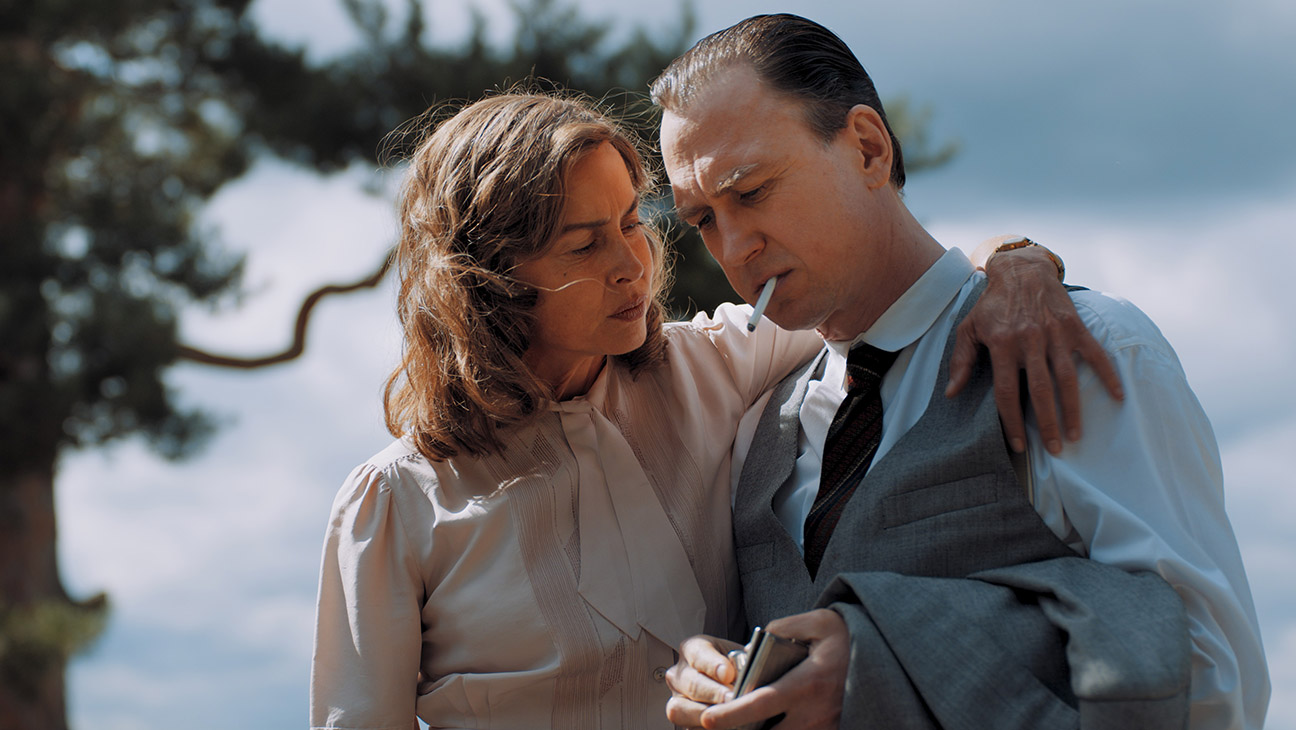
Adapted from Jenny Erpenbeck’s acclaimed novel Heimsuchung and directed by legendary auteur Volker Schlöndorff (The Tin Drum), Visitation encapsulates a hundred years of German history by focusing on events unfolding in just two buildings on adjoining plots of lakeside land near Berlin.
While snippets of archive footage show the rise and fall of the Third Reich and then the rise and fall of the Communist-controlled German Democratic Republic, this economical yet expansive microcosmic narrative features an especially strong cast that includes Martina Gedeck (The Lives of Others) and Lars Eidinger (Dying) as some of the visitors and residents who pass through all four dimensions of the story. Like two of Schlöndorff’s greatest works, The Tin Drum and The Lost Honour of Katharina Blum, this manages to show how political forces directly impact personal lives, but achieves that without ever feeling preachy, emblematic or obvious — evidence of the refined cinematic and literary taste that’s always run through his work.
Visitation
The Bottom Line
A return to form.
Venue: Cannes Film Festival (Cannes Premiere)
Cast: Martina Gedeck, Lars Eidinger, Susanne Wolff, Ulrich Matthes, Detlev Buck, Michael Maertens, Maria Matschke Engel, Angela Winkler, Josefin Platt, Ludwig Trepte, Matthias Hungerbühler, Stella Denis-Winkler, Wigand Witting, Ava Weisbrod, Pelle Bo Winkler, David Bennent, Nina Lilith Völsch, Sara Bartknecht, Romy Miesner, Asta Willmine Winkler, Sean Douglas, Camille Moltzen, Yvon Moltzen
Director/screenwriter: Volker Schlöndorff, based on a novel by Jenny Erpenbeck
1 hour 58 minutes
Much of the film, which in narrative terms observes a near-Aristotelian unity of space if not time or action, was partly shot in and around Albert Einstein’s actual summer home in Caputh. It’s an elegantly spare Bauhaus-style structure (the real architect was Konrad Wachsmann), to which the physicist took his own family for summer vacations before they were forced to flee the Nazis and emigrate abroad. That adds a whole extra-textual layer to the story, because in Visitation, Einstein’s house is a home built by Eidinger’s Nazi architect. (He’s described simply as “The Architect” in the credits, and is one of several characters who have similarly generic handles, while others get proper names.) The architect manages to put the deeds in the name of his stylishly trousered socialite fiancée (Susanne Wolff), a legal maneuver that has significant repercussions later on.
Meanwhile, a German Jewish cloth manufacturer (Ulrich Matthes) has a much more modest, traditional-looking summer hut built just a few meters down the shoreline from the architect’s modernist spread. At first, this puts the manufacturer, his wife (Josefin Platt), his daughter Elizabeth (Stella Denis-Winkler), her husband Dr. Ernst Kaplan (Matthias Hungerbühler) and their daughter Doris (played first by Pelle Bo Winkler and then Ava Weisbrod) on near-equal footing with the Nazis next door. You can tell from the just slightly sinister, serpentine smile of politeness on the architect’s face (beneath what is truly one of cinema’s most hideous bowl haircuts) that he’s not happy about this. Lucky for him, the “Aryanization” laws come into effect in 1933 and he’s able to buy the neighbors’ land cheaply when all their property is expropriated by the state.
Schlöndorff, guided by his source material, which in turn draws on found letters by a real girl named Doris Kaplan, handles the tragedy of the manufacturer’s family with dignified pathos. First Doris’ grandparents are sent back east with a strict packing list and a small suitcase, never to be heard from again despite the fact that Doris sends them letters as often as she can, each one with a carefully placed stamp showing Hitler’s face. Then Doris and her family are sent off on the train, swallowed whole by the Holocaust. A more sentimental narrative might have at least one character show up again later, but instead there are only echoes of them here, ghostly reminders of their existence in twinned shots of characters affixing stamps to letters years later.
That lack of sentimentality persists throughout — through the war wherein the architect gets shipped to the Eastern Front and his wife must find a way to survive an occupation in her house of Soviet soldiers, and right up to the final section. In this last act, an acclaimed left-wing writer (Gedeck) works her party connections to be get sole access to the house for herself, her journalist husband (Michael Maertens), her son (Ludwig Trepte) and daughter-in-law Erika (Nina Lilith Völsch), and their young daughter Marija (played by three young actors, Sara Bartknecht, Romy Miesner and Asta Willmine Winkler at different ages).
It’s Marija who finds Doris’ letters hidden in the crumbling cottage next door, and her consciousness mostly dominates the last stretch of the film — which, as is not unexpected for anything set in GDR, is a bit more boring than the action beforehand. A sweet summer child who loves to jump into the lake with her hunky local son-of-the-soil boyfriend (Yvon Moltzen, Camille Moltzen, and finally Sean Douglas) and quietly question Eastern Bloc authority, Marija will be the one to see the house finally slip through her family’s grasp when the wall comes down, preparing for an ending that’s aptly downbeat and faintly flat, like the sound of masonry crumbling to dust.
As the credits roll, the impression forms that this may not be the 87-year-old Schlöndorff’s best film ever, but if he chose to retire now it wouldn’t be a bad note to bow out on. It’s a work of worthy craftsmanship and seriousness.
