


It’s hard to imagine anyone could have a better year than Sandra Hüller did in 2023. The German actress starred in Justine Triet’s Palme d’Or-winning Anatomy of a Fall and Jonathan Glazer’s Zone of Interest — two best picture Oscar nominees that would catapult her to international fame.
But Hüller’s 2026 might just be giving that year a run for its money. In February, she was awarded the Berlinale’s best actress prize for her performance in Rose. March brought the release of Project Hail Mary, opposite Ryan Gosling, which has become one of the most critically and commercially acclaimed films of the year so far. She’s here in Cannes with Paweł Pawlikowski’s Fatherland, in which she pulls off a stunning performance as the daughter of Thomas Mann, and in October will share the screen with Tom Cruise in Alejandro González Iñárritu’s Digger.
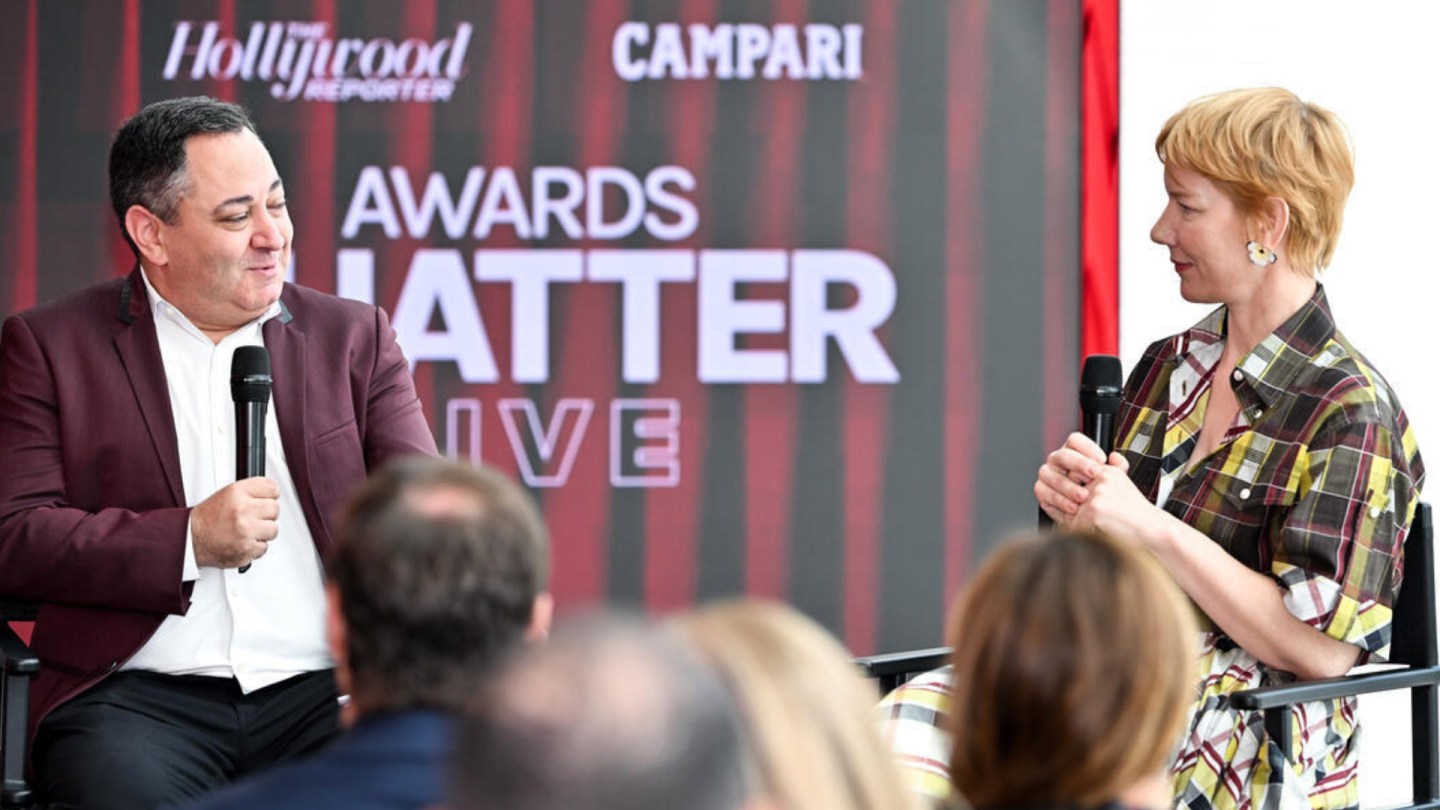
Indeed, Hüller is reaping the rewards of 2023 — a year that caught her the attention of Hollywood — and dove into it all in an exclusive conversation Friday morning with The Hollywood Reporter’s executive awards editor Scott Feinberg for his award-winning podcast, Awards Chatter, at the Palais’ Campari Lounge in Cannes. The scene was set with floor-to-ceiling Campari bottles and glimmering red mirrors.
The retrospective conversation began with Hüller talking about her upbringing in Friedrichroda, a small town in eastern Germany. It was here that — as other artists are — she was inspired by a teacher who saw something special. “My English and German teacher […] if she’s listening right now, I still love you,” said Hüller, prompting chuckles from the audience. “She opened up a drama club in school, and I wasn’t a child of many hobbies or anything. I mostly read and watch TV. It sounds sad, but I liked it to be in other worlds and to fantasize about people and to watch people, and she told me that this could be a good place for me to be, and I’ve never stopped since — to watch people, to portray people, to find out about humans. So I’m very grateful to her.”
Hüller graduated from Berlin’s Ernst Busch Academy of Dramatic Arts in 2003. Even after that experience, she never considered film an option for her. “I consider myself being a theater actress still,” she told Feinberg. “It’s just a coincidence that I’ve somehow got into film, and this is not [me] fishing for a compliment! I still don’t know the rules of filmmaking,” she admitted. “[I’m] always astonished how everything is working, and I also look at my colleagues who are so professional with camera angles and preparations and all of that stuff, it’s like a whole different genre [to the] genre that I have been educated in.”

Scott Feinberg and Sandra Hüller at THR x Campari ‘Awards Chatter’ during the 79th Cannes Film Festival.
THR/Earl Gibson
But three years out of drama school, the actress found herself in Hans-Christian Schmid’s Requiem, where, aged 27, she played a woman whose violent epileptic seizures led her Catholic family to suspect her being possessed by a demon. Now, 20 years later, her Rose win in Berlin was a full circle moment: Requiem also earned her best actress at the German film festival. “That was a good start,” she began. “They weren’t looking for perfection… The team was very kind and warm.”
Over the next few years, Hüller worked in theater and increasingly in films, making a name for herself as one of Europe’s brightest talents with her acting prowess. The U.S. offers were yet to pour in, but then she came to Cannes with a generational two-hander: Jonathan Glazer’s The Zone of Interest and Justine Triet’s Anatomy of a Fall, two of the greatest films to grace the Croisette in recent years.
Feinberg and Hüller began with The Zone of Interest. Famously, the actress played Hedwig Höss, wife of Rudolf Höss, commandant of the German Auschwitz concentration camp. When asked about her own personal relationship to the story and the research that went into her family history, Hüller responded: “You have to look at where you come from and what things resonate in your body without your knowledge. I really wanted to know, so I asked all my grandparents about their connections to the Nazi system, and I didn’t find anything. Maybe they lied, I don’t know. I’ll find out when they’re gone,” she added, prompting more laughter from listeners.
“That was one of the reasons that it was possible for me, but it really had to do also with the way [Glazer] wanted to tell it, and we talked a lot about the inside — the death of those people [doesn’t make the Nazis] feel anything… He really wanted to show people who basically have it all, but don’t have anything and don’t know how to be happy, and so I really liked this approach.”
When it came to Triet’s film, in which her character is a German writer living in France accused of killing her French husband, Feinberg told Hüller that Triet said she had no second choice for the part. “She sent the script to me, and she put me under pressure, saying, ‘I wrote it for you,’” remembered the star. “And then I read it, and it was absolutely clear, from the first pages, that this is so special, and I really wanted to participate in it.”
Feinberg also asked her whether or not she thinks she committed the act her character is accused of, and if Triet ever revealed the answer. “In the beginning, I thought I needed to know, and I was thinking about her as an innocent person,” said Hüller. “I was very much defending her in my thoughts and in the whole development of the work, and I think two days before we started filming, I called Justine, and I thought, ‘What if she actually tricks me into something?’ So I had, kind of, a trust issue two days before, and I asked her if she is really innocent or if she’s just playing with me and in the end she turns everything around — which would have been the end of our friendship — and she said, ‘I cannot tell you, I don’t know, but I want you to play her as if she was innocent,’ and that made it even worse for me. So, I had two days to decide what I’m gonna do, and I realized it’s really not so important if she is a murderer or not. It’s really about what other people think of her.”
Then, Feinberg asked her to reflect on that wild year. “To recap,” he said, “the first person to ever receive two nominations in the same year for the best actress European Film Award, BAFTA nominations for best actress and best supporting actress in the same year, the best actress Oscar nomination, star of two best picture Oscar nominees…”
“It was everything all at once,” replied Hüller. “I really have to thank the people who put the schedule together, my German press agency, because it was really difficult to balance the dates with the two films. So they did all that. I don’t know. You go through these things, it’s an experience, you try to adapt to everything, you try to see the beauty in everything, you meet people, you learn a lot about yourself in those environments — it’s a lot of honor. It’s a lot of love coming [my] way.”
Soon, they came onto Project Hail Mary, where Hüller played Eva Stratt, head of the international task force attempting to save humanity from extinction. When asked about embracing commercial projects on a larger scale after years spent in the arthouse genre, she replied: “Well, there is something like scale, and then there’s something [of] quality on that scale. I didn’t necessarily want to do something really big, because it can be so bad. I’m not good at a lot of things, so I have to find something that I can actually do without feeling terrible all the time, so this was an opportunity, because I love the films of Chris Miller and Phil Lord and, of course, I adore Ryan Gosling. What can you say? I just had to do it.”
She continued: “When you play with someone like Ryan Gosling, you don’t try to compete. I can never be as fast as him, as inventive. I can just be there and try to find an end to the scene, and then everything else will happen on its own, probably.”
Hüller said she doesn’t like to prepare too much beforehand for a role. “No matter what anybody says, being away from the set, being away from the people, away from my partner, coming there and fulfilling my own vision… That’s not what I think makes work fulfilling. I like to collaborate, and so I don’t do so much of preparation.”
It was Gosling who suggested that endearing karaoke scene — it wasn’t in the initial script — and Hüller’s instinct was to reject it. She soon came around. Seeing audience reaction has also helped. “Honestly, it was just such fun to sing it,” she said. “It is kind of a twisted thing if people like her because of that, because of course I would have wished them to just like her [before]. But I’m happy the scene made it in.”
THR‘s awards editor then came onto Fatherland, which premiered just last night to a reverent ovation here in Cannes, and Hüller said: “I think I learned the most [on this film] than any other film.” When Feinberg asked about her character’s repression and, at times, explosive nature — Erika slaps her ex-husband, Nazi-aligned actor Gustaf Gründgens — “I’m familiar with that… There are always restrictions. We go through the world and there are rules and there are personal choices we make, and then they sometimes force us to just endure stuff until we can take it anymore. I, personally, like to walk away, if I can’t stand something.”
Finally, Feinberg teased out of her what we can expect from the hotly anticipated Digger with Tom Cruise: “I am nearly bursting wanting to talk about this movie,” she said. “I can’t. I legally can’t. I can say that I saw a version [of it] that’s maybe not the final version, and that it impresses me beyond anything I’ve ever seen. And that’s all I can say. I think it’s going to be a remarkable film.”
Sandra Hüller at THR x Campari ‘Awards Chatter’ during the 79th Cannes Film Festival.
THR/Earl Gibson
Atmosphere at THR x Campari ‘Awards Chatter’ during the 79th Cannes Film Festival.
THR/Earl Gibson
Sandra Hüller at THR x Campari ‘Awards Chatter’ during the 79th Cannes Film Festival.
THR/Earl Gibson
Scott Feinberg at THR x Campari ‘Awards Chatter’ during the 79th Cannes Film Festival.
THR/Earl Gibson

