


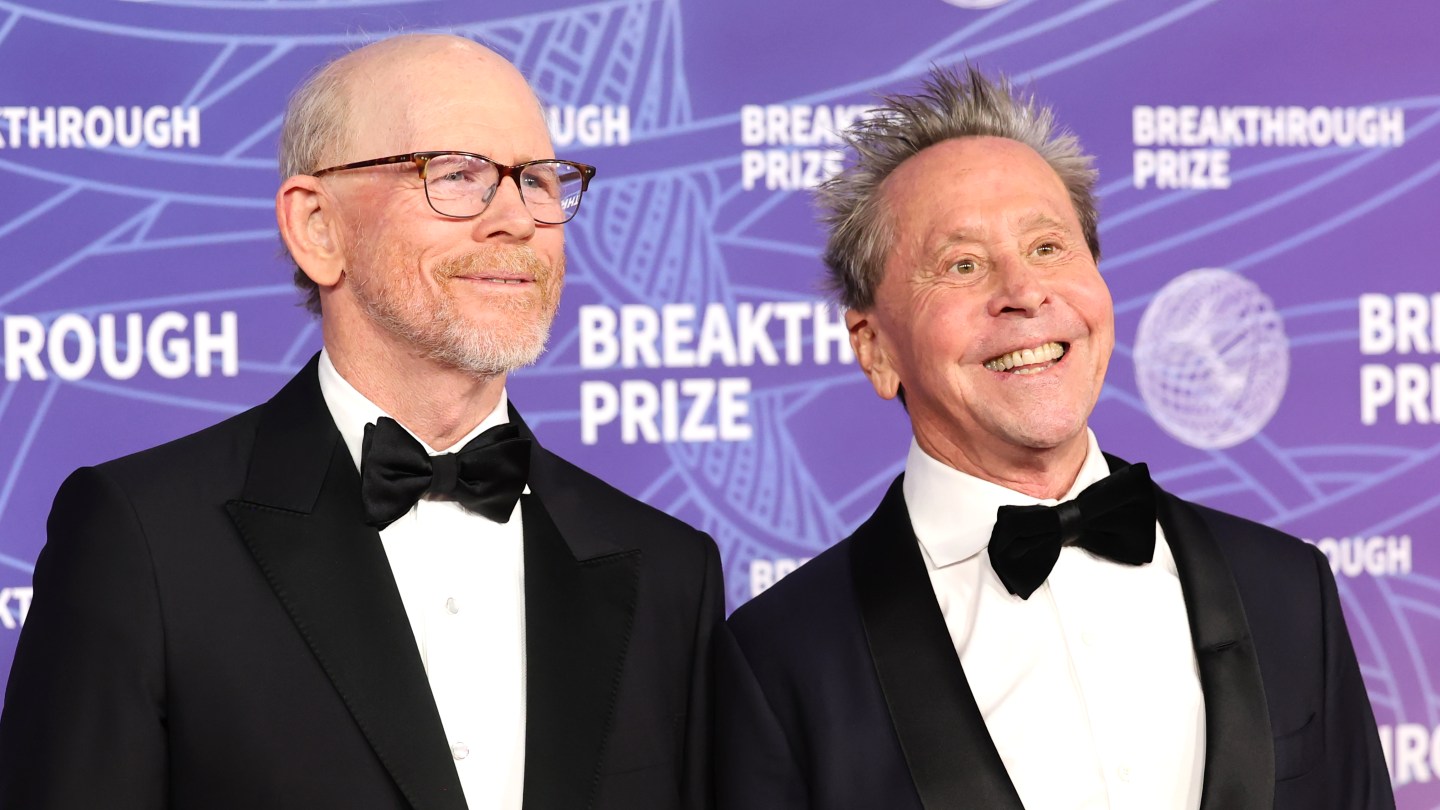
Fresh off the news that Ron Howard and Brian Grazer are developing a sequel to their 2000 hit How the Grinch Stole Christmas, the pair sat down for a wide-ranging conversation at the UCLA Entertainment Symposium, where they gave a little tease of the new film.
Speaking to The Hollywood Reporter editor-in-chief Maer Roshan on Thursday, Howard — who is returning to direct Jim Carrey in his role as the classic Dr. Seuss character the Grinch — said the sequel is “something we’ve thought about for a long time, and you know what, it’s an idea that got all five or six of the brain trust excited. So it’s worth a try.”
Carrey is looking to return despite famously struggling through the production, as Grazer and Howard — who have been partners in production company Imagine Entertainment for 40 years — recounted how two weeks into filming the star told them he could no longer endure the extensive makeup and contacts needed to become the Grinch and would return his $20 million salary, with interest.
Grazer explained that he told Carrey to take the weekend to think about it before formally quitting, and in the meantime, “I had met somebody that teaches State Department people how to survive torture.” The expert flew out that weekend to meet with Carrey, which seemed to do the trick. “I did try things before that, like having comics come and talk to Jim and try to amuse him,” Grazer noted, but after the meeting, “on Monday he said, ‘No, I’m gonna stick with it.’ They developed a method for Jim to diffuse the pain.”
Howard added, “Mostly he just toughed his way through it and he also wouldn’t downgrade the costume, or wouldn’t not wear those contact lenses; that was before CGI could easily replace and color his eyes and things like that. He did go through this, he did learn a lot from this expert, talked a lot about it and relied upon those techniques, and really muscled through it. And by the way, I’ve never been more in awe of an actor creating a character and performance in any film I’ve done.”
Elsewhere in the chat, the duo reacted to the recent success of Obsession, Backrooms and the young YouTube filmmakers behind them.
“I think right at this moment we’re having a kind of an Easy Rider moment,” said Howard, noting that he had begun working with young YouTube auteurs years before they were in vogue. “I think there’s a generational shift that’s happening right now — a couple of great examples of YouTube-born, talented filmmakers and the people they choose to cast and the kinds of scenes they choose to write, and the cultural tone they achieve, that is incredibly effective, organic to them, and exciting.” He continued, “It happened for Brian and I and a whole generation of Baby Boomers — there was a moment when the industry sort of turned to people our age and said, ‘We need you, you know something we don’t quite know.’”
Grazer was a bit more skeptical, insisting that Hollywood simply chasing after YouTubers “won’t work” and “the format is not that different than other things that have happened generations before, it’s just a newer version.” Howard added, “The people who are breaking through right now are people who’ve done hours and hours and hours, talk about your 10,000 hours. They’ve been filming — they have chops but the big question is, are they going to choose the right stories?”
The conversation also touched upon what stars can still make or break a movie (with Grazer shouting out Leonardo DiCaprio and Zendaya as two standouts), the challenges from the streamers’ risk-averse business model and the U.S. government’s sluggish response to the industry’s economic troubles. Roshan asked if Trump has more power over the industry than Ted Sarandos, to which Grazer responded, “Currently,” and rapped the administration for not doing more to help Hollywood out of its current woes.
Both men said they regarded AI as an inevitability that has the power to help Hollywood as well as harm it. “I use AI to build stories, and that actually speeds things up so much. So if I have an idea for a movie — I started as a writer, Ron did as well — you can build your idea with Claude, you can build the whole thing into an incredible outline,” Grazer said. “You still need a screenwriter — I always believe you need a screenwriter 100 percent, but to get a screenwriter on just an idea where you’re pitching it could take a year; for you to build it to a point where you can actually show it to a screenwriter could take one week.”
Howard noted, “There’s a lot of promise out there, and right at this point, I’m not seeing a lot of efficiencies that you can really apply to a project today… it’s also our job to look at the ethical use of these tools and best practice and be responsible about it.”
The pair — who claim they have never once yelled at each other in their four decades of partnership — also revealed they have no plans to retire, as Grazer emphasized, “If the business stops, then I stop, but for me it’s almost — we made five or six movies this year, but I feel like it’s a hobby. I like it, I like puzzle solving, and that’s what this.”
For his part, Howard added, “The one thing that I’ve always told myself is a lot of people want my job, and if I get to the point where I’m blasé about it, I’m phoning it in, I’m lazy, I don’t want to face it, then I’m going to let them have the job. But right now I don’t mind getting up at five in the morning and dealing with the cast. Those are adventures for me. They’re life experiences, and I enjoy the collaborations above all else.”

