

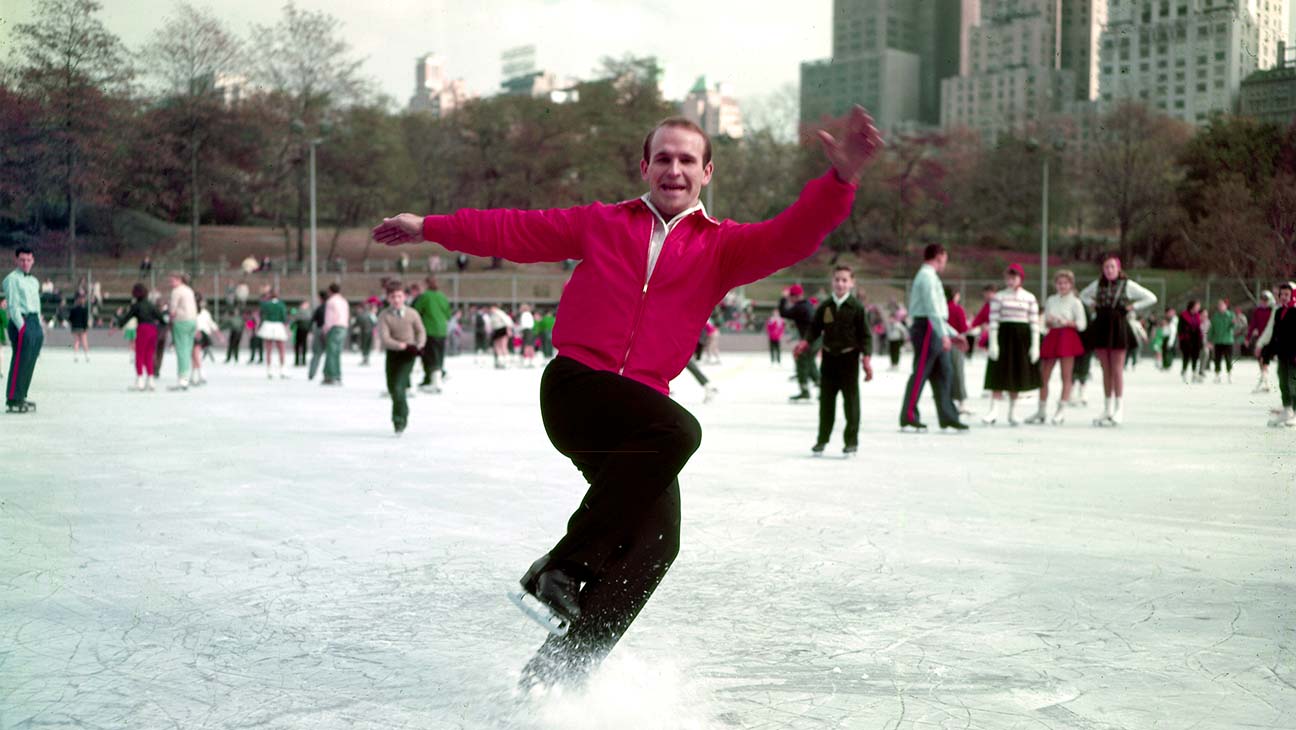
Dick Button, the two-time Olympic champion who revolutionized figure skating by completing the first triple jump in competition, then spun TV ratings gold with his pithy, Emmy-winning commentary, died Thursday. He was 95.
Button died in North Salem, New York, his daughter, actress Emily Button, told The Washington Post.
Armed with an encyclopedic knowledge of his sport — as well as degrees from Harvard College and Harvard Law School — Button displayed a tart wit and passion that defined figure skating on network television for more than five decades, starting in 1960 on CBS with the Winter Olympics from what was then known as Squaw Valley, California.
Moving to ABC in 1962 — where he would remain for the next 40-plus years — Button presided over a new age in media and skating. With telegenic stars Peggy Fleming, Janet Lynn, Dorothy Hamill and Tai Babilonia and Randy Gardner rising on the world stage during the 1960s and ’70s, Button pushed for airtime and production values that made figure skating the lucrative centerpiece of the Winter Games.
Schooling TV audiences on the nuances of judging, “classic lines,” airy jumps and speed, Button also taught viewers (much to their delight) how to spot the awful. Flailing arms, bent legs, tasteless costumes and choppy music edits received his unapologetic ire.
Of one particularly jarring musical selection, Button said, “There seems to have been a mix-up in the recording studio.”
While he spent most of his career as an analyst at ABC, often alongside Jim McKay on the Saturday afternoon anthology series Wide World of Sports, Button also worked for decades with Fleming and later with Terry Gannon at ABC and NBC.
“He kept me on my toes,” Gannon said in 2014. “He’s one of those guys born without a filter between his brain and his mouth, which is what makes him a great analyst.” Listen to some of his commentary here.
A reality TV visionary, Button created the long-running ABC kitsch competition The Superstars in 1973, pitting athletes from disparate sports against one another in splashy decathlon-style meets.
A 1976 spinoff, Battle of the Network Stars, rose to iconic status during its original 12-year run, with its competitions featuring actors such as Robert Conrad, Farrah Fawcett, Gabe Kaplan, Penny Marshall and Hal Linden hosted in self-mocking style by Howard Cosell. Several revivals over the years included one as recently as 2017.
Through his aptly named Candid Productions, Button expanded financial opportunities for skaters, creating the World Professional Figure Skating Championships and the Challenge of Champions as well as TV specials for stars such as Hamill, who at the height of her fame was one of the top-earning athletes in the world.
“Dick made the words ‘lutz’ and ‘salchow’ part of everyday vocabulary,” said 1988 Olympic champion Brian Boitano, who helped Button promote his 2013 book Push Dick’s Button, an insider’s conversation about figure skating.
Richard Totten Button was born on July 18, 1929, in Englewood, New Jersey. He became serious about skating at age 12, a bit late in the game. Yet within five years, he was the U.S. champion, a title he would win seven consecutive times.
In 1949, he received the Sullivan Award, which recognizes the top U.S. athlete in all of amateur sport.
Button remains the only American skater to twice capture Olympic gold. At age 18 at the 1948 St. Moritz Games, he landed the first double axel (2 1/2 revolutions) in competition to become the youngest male figure skater to ever win; in 1952 in Oslo, Norway, he pulled off his historic triple loop (while wearing a stylish white mess jacket, to boot). He also invented the flying camel spin.
As noted in Mary Louise Adams’ 2011 book, Artistic Impressions: Figure Skating, Masculinity, and the Limits of Sport, “Button ushered in a new athleticism in figure skating … His jumps were higher and longer, his spins faster than those of his competitors. He termed his approach to skating aggressive, exuberant and American.”
From Davos to Paris, Button also won men’s singles at the World Championships for five straight years (1948-52), a feat he completed while attending Harvard undergrad. He then retired from competition to take on a pro career, touring with the Ice Capades during campus vacations from his law studies.
He was a member of the first class inducted into the World Figure Skating Hall of Fame in 1976.
In the broadcast booth, he could be as emotional as he was cutting. In 1996, as Rudy Galindo scored one of the greatest upsets in the sport’s history, winning the U.S. title after years of wrenching setbacks, Button could barely contain his exuberance — or his tears.
When the Winter Games jumped to CBS in 1992 and then to NBC in 2002, Button remained with ABC, calling competitions through the aughts, even after a fluke fall on the ice at age 70 left him with a skull fracture, concussions and hearing loss.

Dick Button and Peggy Fleming covered the 1984 Sarajevo Olympics for ABC.
ABC/Photofest
Through the decades, he remained skating’s conscience, openly criticizing a revamped judging system (forced after a scandal at the 2002 Salt Lake Games) that incentivized paint-by-numbers programs, eroding the sport’s elan and television appeal.
Button notably stayed out of the media frenzy surrounding Tonya Harding’s 1994 attack on rival Nancy Kerrigan. “I found it disgusting,” he said of what turned out to be one of the biggest scandals in sports history.
In 2006, Button returned to Olympic coverage for the first time in 18 years, working on loan to NBC at the Turin Games. His limited role was so well-received, NBC expanded his duties on the spot — a relationship that carried through to the 2010 Vancouver Olympics.
Embraced by a new generation on social media for his shade-throwing, Button’s live Twitter commentary of the 2014 and 2018 Games was, as always, exultant and devastating.
“Truly dislike gushy crying finishes … what is this?” he tweeted during the Pyeongchang Games about skaters dramatically feigning shock over performances that were just so-so.
Even in his 90s, Button never relinquished his role as guardian. In 2020, he used U.S. Figure Skating’s work-from-home challenge to chide the International Skating Union for encouraging convoluted excess on the ice.
He returned to ABC in 2010 as a a judge on ABC’s Skating With the Stars.
In addition to his daughter, survivors include his son, Edward; both are from his 1973-84 marriage to figure skating coach Slavka Kahout, who guided Lynn and other champions.
When asked by The New York Times in 2014 if he ever tired of talking about figure skating, Button said no.
“Never,” he said. “Skating encourages you to learn about so many art forms: dance, performance, athleticism, history, choreography, even haute couture. How could anyone tire of it?”
Deborah Wilker is a professional figure skater.
