


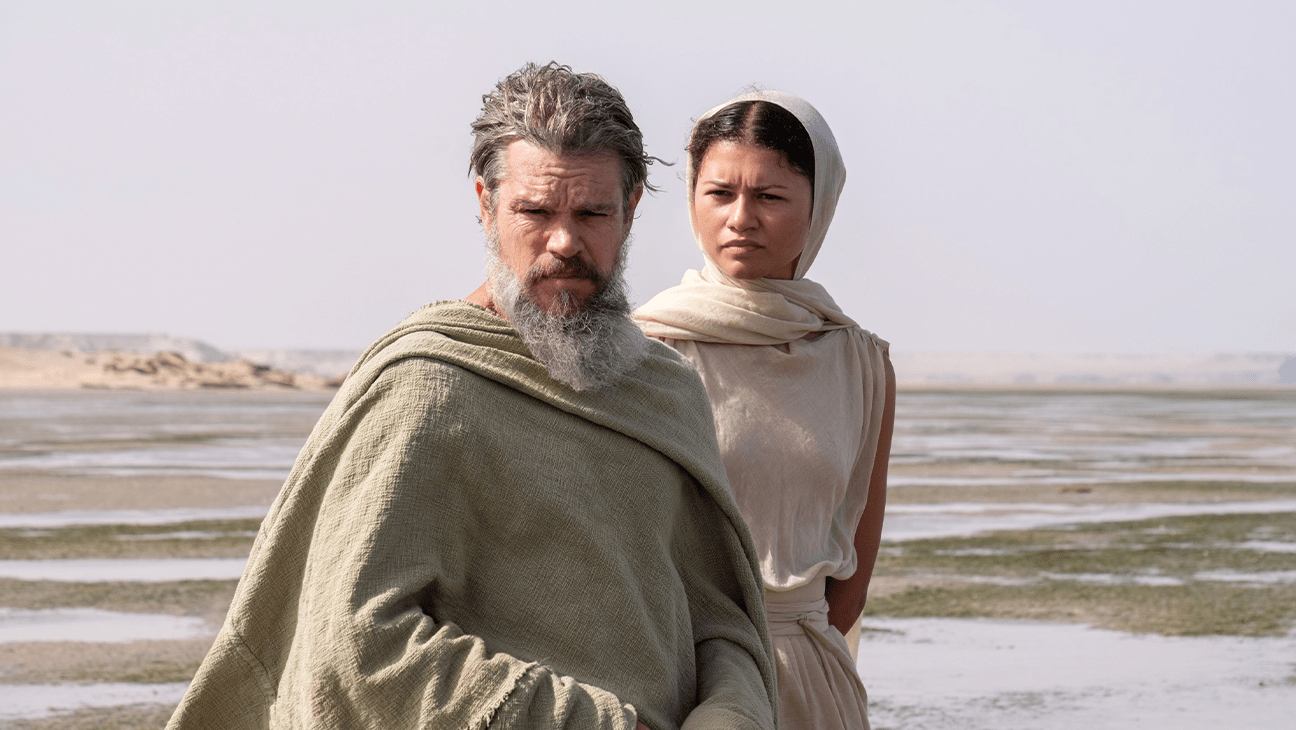
Christopher Nolan’s passionate love affair with the Premium Large Format moviegoing experience peaks with The Odyssey, a gigantic undertaking that marks the first feature shot entirely with IMAX Film Cameras. The result is a meditative action movie both immense and intimate, albeit one whose flow is impeded by the inherently episodic nature of the nonlinear source material and some questionable casting choices. Still, audiences hungry for the kind of brawny all-star spectacle now largely confined to sci-fi and comic book tentpoles should turn out for this bold retelling of Homer’s epic poem.
It’s ironic, given the foundational influence of the text on modern Western storytelling, that there has never been an indisputably great screen version of Homer’s Odyssey, though Nolan, who also penned the adaptation, gets closer than some. The poem built the template for the Hero’s Journey, shaping literature’s approach to character, adventure and conflict in a narrative that encompasses mortals, gods and monsters, history and mythology, tests and triumphs.
The Odyssey
The Bottom Line
Go big or go Homer.
Release date: Friday, July 17
Cast: Matt Damon, Tom Holland, Anne Hathaway, Robert Pattinson, Lupita Nyong’o, Samantha Morton, John Leguizamo, Zendaya, Charlize Theron, Jon Bernthal, Himesh Patel, Bill Irwin, Elliot Page, Benny Safdie, Corey Hawkins, Mia Goth
Director-screenwriter: Christopher Nolan, based on Homer’s Odyssey
Rated R,
2 hours 52 minutes
But it’s less surprising when you consider Homer’s disjointed structure, starting in medias res then folding in flashbacks while stringing together isolated encounters over a 10-year period, like stories within a story.
Then there’s the protagonist, Odysseus — played here with introspective intensity by a commanding Matt Damon — whose internal transformation, from a hubristic warrior to a man humbled by trauma and loss, is as near to a continuous plotline as the movie gets. It’s hard to effectively dramatize someone piecing together memory fragments on a gradual path to moral, spiritual and existential awakening.
Harder still when much of that process happens in a dream-like haze on an island beach, where the nymph Calypso (a distractingly contemporary Charlize Theron) is keeping Odysseus as her lover, feeding him lotus petals to ease the pain in his body and prevent him from remembering the loyal men he lost along the way — even if it’s ostensibly to spare him that psychological torture. These dull interludes stop the narrative dead in its tracks, recalling Sean Penn’s purgatorial wanderings in Malick’s The Tree of Life.
When the movie’s engines are fired up, however, it’s muscular filmmaking, freely folding in elements from Homer’s preceding epic, The Iliad. Accessible even when the plot requires untangling, the action chronicles Odysseus’ 10-year journey home to his kingdom, traveling across the Mediterranean to the Greek isle of Ithaca, after another decade away fighting the Trojan War for Agamemnon (Benny Safdie), king of Mycenae.
In his fifth consecutive collaboration with Dutch cinematographer Hoyte van Hoytema, Nolan starts from the striking image of the massive Trojan Horse half-buried in sand on a beach — like the Statue of Liberty at the end of the original Planet of the Apes. The siege that followed, once the soldiers of Troy had hauled the horse inside the city gates with Odysseus and his men hidden inside waiting to attack, is at the heart of what haunts the title character. Call it Ancient Greek PTSD.
Back in Ithaca, Queen Penelope (Anne Hathaway) is plagued by a house full of freeloading suitors, the most conniving of them Antinous (Robert Pattinson) and Polybus (Corey Hawkins). They grow increasingly impatient with her delay in conceding that Odysseus must be dead after 20 years’ absence and will not be returning. The royal couple’s son, Telemachus (Tom Holland), is ready to claim the throne and while Antinous assures Penelope he will respect the line of succession if she agrees to marry him, Telemachus is smart enough to know he has a target on his back.
Guided by the goddess Athena (Zendaya), who informs Telemachus that his father is alive and trapped on an island, he sets out to find proof. The first sign of it comes via an audience with Agamemnon’s brother Menelaus (Jon Bernthal), king of Sparta, whose rage over the the abduction (or flight?) of his wife, the fabled beauty Helen (Lupita Nyong’o), was the root of the allied Greek army’s war against Troy.
Nyong’o also plays Helen’s twin sister Clytemnestra, wife of Agamemnon, but these scenes feel cursory, which is not the only time the dense script buckles under the weight of everything Nolan tries to cram into it.
One of the issues is that the writer-director never finds much balance between the parallel journeys of Odysseus and Telemachus, making the movie feel structurally clumsy. It doesn’t help that Holland, while always an appealing screen presence, is wrong for the role. Like Pattinson, the Brit actor plays his character with an American accent. But he comes across as, well, Peter Parker in a tunic, sapping the gravitas from Telemachus’ path to maturity.
Classicists might grumble about key incidents from Odysseus’ voyage home being skipped or given such hasty treatment that they carry no weight. Blink and you might miss Scylla, the six-headed sea monster that Odysseus and his men dodge while steering their long boat around a whirlpool. And only audiences with excellent recall of their high-school English studies are likely to have much idea what’s going on when the man-eating giants called Laestrygonians make a rampaging appearance.
On the other hand, several key episodes do build tension. The dramatic escape of Odysseus and his men from the cave dwelling of the sheep-herding one-eyed giant Polyphemus (physical performance specialist Bill Irwin, somewhere in there) is a horror-tinged nail-biter, which has consequences for the voyage given that the enraged Cyclops is the son of vengeful sea god Poseidon. There’s eerie poetry in the crew’s fear as they pass the island inhabited by Sirens whose songs lure sailors to their death on the rocks, with Odysseus in agony as he’s tied to the mast to resist their call.
The standout interlude is the soldiers’ visit to the island domain of Circe, a treacherous witch played with deceptive calm and a misleading air of distraction by a bone-chilling Samantha Morton. Starved for provisions, the men make the initial foray to Circe’s home, where she feeds them a stew that turns them into gluttonous animals. When they fail to return to the boat, Odysseus intervenes, drawing on the wiliness of his years in battle to convince Circe to reverse her dark magic.
The climax that ties together the almost 3-hour film comes when Odysseus at last makes it back to Ithaca, disguised as a beggar both to test Penelope’s love and to throw off Antinous and others who want him dead. Van Hoytema’s cameras seem to be everywhere at once when Odysseus launches into a visceral clash, aided solely by Telemachus. It’s exactly the kind of large-scale set piece at which Nolan excels, a high-stakes melee in a confined space, triggered by a test set by Penelope, whose sharp wits make her a good match for her husband.
It’s here too that the movie’s themes finally acquire potency — about the sobering disillusionment that follows war; the fragility of heroism; defiance of the gods; the uncertainties of homecoming after a long absence. The most resonant theme is conscience, as Odysseus weighs his achievements against his sacrifices, from the drowning of his men to the slaughtered Trojans, tricked by a gift to the gods in violation of all that is considered sacred. One death especially, that of his young cousin Sinon (Elliot Page), troubles him most of all.
Nolan’s intentions are clear, tracing man’s instinct for war back to the Bronze Age but making it relevant to today by eschewing classical speech and leaning into the cadences of modern conversation. Even so, I winced at anachronistic language like Penelope telling her rowdy suitors, “I’ve listened to you party,” or Telemachus referring to his father as “dad.”
While The Odyssey is uneven, and no match for the sure-footedness and intellectual complexity of Oppenheimer, it’s elevated by the blindingly charismatic ensemble. (I refuse to get into the tiresome online controversy about Nolan’s unconventional casting choices; since nobody here is Greek or Turkish, complaining about one or two actors dismissed as “DEI hires” is absurd.)
Damon is superb, going to dark places seldom if ever explored in his previous roles; Hathaway is a model of steely self-possession masking vulnerability; Pattinson bites into his character’s villainy with gusto, showing Antinous to be a cowardly conspirator, loyal only to himself.
Even actors whose roles have limited scope, like Zendaya, Nyong’o, Hawkins and Mia Goth as Penelope’s duplicitous maid, register as vital presences. Perhaps the best of the secondary players, alongside Morton, are Himesh Patel as Eurylochus, Odysseus’ second-in-command, steadfast until even he loses faith in the captain’s recklessness; and John Leguizamo, affecting as Eumaeus, Odysseus’ servant and friend, a swineherd whose blindness does not hinder his powers of observation.
Work on the craft side unsurprisingly is top-notch. Van Hoytema fills the giant frame with imposing images shot in evocative international locations, grand and powerful in scale. Sequences of the long boats at sea are stunning, even more so during a fierce storm. While Nolan often wrangles what seems like a cast of thousands, the look departs from the Old Hollywood vision of the sword-and-sandal epic, creating something equal parts majestic and strange, as befits a story peppered with fantastical elements.
The push for in-camera spectacle over digital fakery wherever possible pays off in terms of dropping the audience right into the middle of the action — particularly in the intricately choreographed final battle back in Ithaca.
Production designer Ruth De Jong’s colossal sets (the city of Troy is especially impressive) and Ellen Mirojnick’s costumes, drawn from both history and myth, add to the immersive feel of the storytelling. And Ludwig Göransson’s shape-shifting score fuels a turbulent soundscape, notably in percussive passages when it builds into the pounding drums of warfare, a motif of contemporary life just as it was 30-plus centuries ago.

