


The retrospective at this year’s Locarno Film Festival feels particularly timely, maybe even scarily so. Red & Black – Hollywood Left and the Blacklist promises to put the spotlight on “one of the most turbulent and politically charged periods in the history of American cinema,” including the “Red Scare” and the infamous Hollywood blacklist of the McCarthy era.
After all, during the period from 1947 to the early 1960s, Hollywood professionals suspected of communist ties faced a crackdown. The Swiss festival’s cinematic look back will provide “a complex portrait of an era in which creatives were confronted by unprecedented abuse of state and industry power and which they met, courageously, with fierce artistic resistance,” Locarno highlighted. Red & Black – Hollywood Left and the Blacklist will “re-examine this repressive yet defiantly creative era, which mirrors the political attacks on free speech and artistic freedom seen again today.”
Produced in partnership with the Cinémathèque Suisse and with the support of UCLA Film & Television Archive, the Locarno retrospective was once again curated by Ehsan Khoshbakht.
He has compiled a program of more than 50 films – fiction, documentaries, and shorts – and newsreels featuring such directors, writers, and stars as John Garfield, Joseph Losey, Dalton Trumbo, Dorothy Parker, Richard Wright, and Charlie Chaplin. It will explore various works to shine a spotlight on a time of polarized politics, allegations of communist infiltration of Hollywood in the Cold War, and the Hollywood blacklist that upended careers and forced artists to adopt pseudonyms or go into exile overseas.
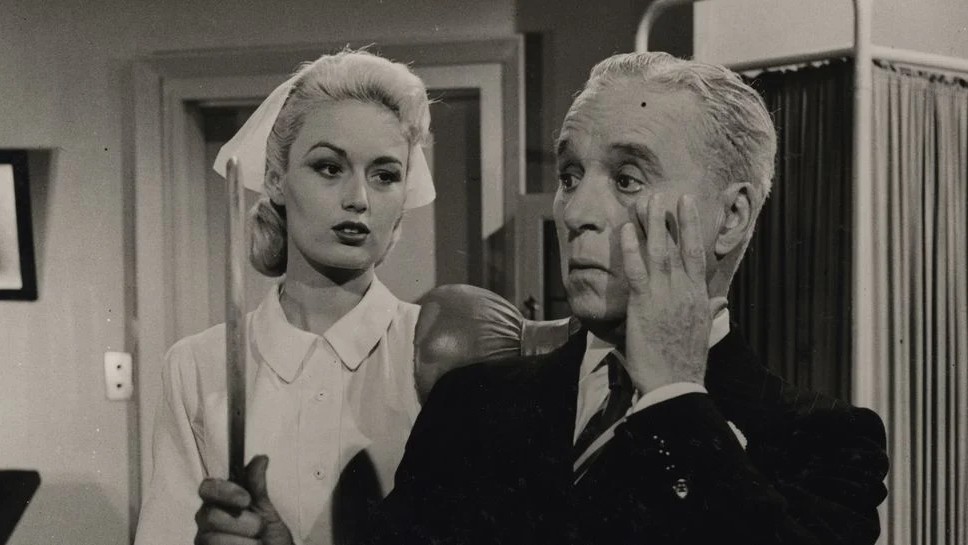
Among the films featured in the retrospective are the likes of Lewis Milestone’s The North Star (1943), None But the Lonely Heart (1944), directed by Clifford Odets, Crossfire (1947) from director Edward Dmytryk, Bernard Vorhaus’ Amazing Mr X (1948), Abraham Polonsky’s Force of Evil (1948), The Sound of Fury (1950), directed by Cy Endfield, Fred Zinnemann’s High Noon (1952), Charlie Chaplin’s A King in New York (1957), Hollywood on Trial (1976) by David Helpern, Martin Ritt’s The Front (1976) with Woody Allen, and 1996’s Red Hollywood, directed by Thom Andersen and Noël Burch. The 79th Locarno Film Festival runs Aug. 5-15.

‘The Front’ film still, courtesy of Park Circus/Sony Pictures
Khoshbakht talked to THR about Red & Black – Hollywood Left and the Blacklist, why it is “the timeliest” retrospective he has ever worked on, Hollywood’s role today, and the role of Charlie Chaplin and other stars in the showcase.
Have you been working on this retrospective for Locarno for a long time, and how easy was the decision that the time was ripe for it?
I had this project lined up for the future because it needed some proper research, but all of a sudden, I thought it was for now, because it’s about what’s happening right now. Even some of the terminology from back then is back in use. For instance, if you see press releases from the White House, there are some headlines with phrases that come right out of the McCarthy playbook, which is quite astonishing. They mention “the radical Left” and “radical propaganda,” among other things.
But what is so interesting is that now both Left and Right, and the Center, have appropriated the terminology of that era to their own advantage. For instance, there was this Wall Street Journal headline saying basically: “McCarthyism is back – this time it’s woke.” So you can define McCarthyism as well, either as woke or anti-woke is McCarthyism. It’s just this confusion about the meaning of words and phrases that, back in the day, at least had some clear meaning – most of it completely wrong, but they were used in a very specific way.
Curating retrospectives takes a lot of work and research. Can you share some insight into how long you researched this topic and these films?
I had seen almost all of the films, so I knew my films, and that’s the most important part. But this is one of those subjects that comes with hundreds of books, and new books are being published every year. So, you want to catch up with the literature. There is also some other really interesting stuff, such as the declassified FBI files. That makes it far more exciting to dive into this episode in the history of American cinema.
‘Force of Evil’ film still, courtesy of Park Circus/Paramount
There are also the oral histories and books that the victims of the blacklist, especially The Hollywood Ten, wrote from the late ’70s onwards about their own experience. There are contradictions, there are paradoxes, I guess a bit of egocentrism, but when you put them together with the rest, it gives you a relatively accurate picture of how things unfolded from ’47 onwards.
I love the title you guys picked for the retrospective, Red & Black – Hollywood Left and the Blacklist. How long did you think about what to call this showcase?
Many good titles have been used by writers of books. One of those titles I love very much is Tender Comrades[: A Backstory of the Hollywood Blacklist]. I thought the title should make clear that this is about not one subject, but actually two subjects. One is red, and one is black. Red is a reference to the Hollywood Left, which was active before the blacklist was introduced in 1947, and then black is for the blacklist. This is a program that actually studies the journey of the Hollywood Left from the early ’40s until the late ’60s.
When Locarno unveiled this latest retrospective, you said this is the most timely retrospective you have put together. This is your third one for the Locarno festival, but you have done so much other work. How is this one different?
It is my most timely retrospective so far, and it is something very special. The fact that we are talking about this is also special, because, sadly, The Hollywood Reporter was one of the key players in the blacklist episode, playing the role of a cheerleader for the FBI and for the [House of Representatives’ investigative committee known as the] House Un-American Activities Committee.

‘Native Son’ film still, courtesy of Kino Lorber
If you asked me, if you put a gun to my head, why the blacklist happened, and I had to give you only one reason, I would tell you that it happened because of the union wars, because writers were successful in establishing the Screen Writers Guild, which Hollywood disliked very much, and which The Hollywood Reporter disliked. They didn’t want the writers to be powerful. The Hollywood Reporter didn’t miss any chance to attack the writers who were involved in the foundation of the Screen Writers Guild to the extent that in its reviews, when listing the cast and crew, it refused to list the name of the writer of the film, if it was someone like Dalton Trumbo. Some of these writers were making big money for Hollywood, like Trumbo, for instance, who was very well paid, and Ring Lardner Jr.
In an attack directed at Lester Cole, they even published a front-page editorial by the editor of The Hollywood Reporter. And in that editorial, they mentioned his Communist Party membership number, which was secret information that even Cole didn’t have, because you didn’t really need that number. But the FBI had some spies in the Communist Party, and they had stolen that information, and that information was used. But it was not just The Hollywood Reporter. You had Catholic groups and others also campaigning behind the scenes.
You have mentioned Trumbo and others. Some of the other faces and names that audiences will come across in the retrospective include the likes of John Garfield, Dorothy Parker and Charlie Chaplin. Can you talk about some of the big names and what roles they played?
We have three different groups. One group is non-Americans, such as [German playwright] Bertolt Brecht, who testified [before the House Un-American Activities Committee], and the day after, he left the country for good. Otherwise, it would have been the Hollywood Eleven instead of The Hollywood Ten. But they couldn’t do much with him anyway because Brecht was not American, so the best they could have done was to deport him. But he was clever and said to hell with you, I’m going to go back home.

Ehsan Khoshbakht, courtesy of Margherita Caprilli
Courtesy of Margherita Caprilli
Chaplin falls into that same category, because Chaplin was also not an American citizen. He was a British citizen. But the case with Chaplin is so unbelievably complex. Chaplin, even before the Communist Party of America started to gain more membership, was the subject of FBI surveillance. There are extensive records of him, and we are going to publish some of them in the book. They followed every movement of this man, because they were so afraid of him, in a sense, because he was perhaps the most popular and the most recognizable human figure on Earth. And he was very progressive.
America was neutral at the beginning of the war, and the America First groups wanted to stay out of the war, but Chaplin, being British, was actively campaigning for the war. And then when America entered the war, Chaplin was campaigning for the Soviet allies, because that’s what President Roosevelt asked people to do to promote goodwill, because the U.S. needed the Soviets, and without them, they wouldn’t be able to win this war. And he was, you know, logistically, technically, absolutely right. So, so you have this group of non-Americans, and Chaplin is the most extreme case. The obsession with Chaplin, the anti-Semitic stories being circulated by the Hearst Media and the FBI about this man. Everything about him is so complex.
Then you have a second group, which includes not the standard Hollywood people, but people who are also affected. This is the first time I’m showcasing the work of these people, too, such as [poet and writer] Dorothy Parker. She is not exactly a Hollywood person, but a celebrity, a writer, someone who stepped into Hollywood occasionally, but her world was mostly outside.
I also have Richard Wright, the great African-American writer, in the program, and even Artie Shaw, the great jazz musician and bandleader. These are people who were affected by the blacklist. Artie Shaw, for example, went into self-imposed exile in Spain.

David Halpern’s ‘Hollywood on Trial,’ courtesy of Corinth Films
Courtesy of Corinth Films
Finally, the third group has the very famous Hollywood people who were affected, the Hollywood Ten and beyond. It is much more than the Hollywood Ten in this program, because I think some of the people who were not part of the Hollywood Ten were actually far more interesting than some of its members.
Film programs in the past refused to show works of people who named names, meaning people who eventually lost their integrity and became collaborators. But this program features works of such people as well because they were also believers. I think every program so far, perhaps unwittingly, has celebrated the idea of political martyrdom. I don’t believe in that, and I’m just interested in the Left, whether they stayed believers until the end or they just couldn’t take it anymore. One good example is Ben Maddow, one of the finest writers in Hollywood. After a while, he just couldn’t accept the fact that all these greatest scripts that he was writing were appearing on screen with the name of someone else. So he named names.
I noticed that your retrospective is mixing genres and types of media, including not just films, but also old newsreels…
Yes, I am trying to paint a more diverse but also broader and more accurate picture of the left and the blacklist in Hollywood. That’s why I decided to include many things, thanks to the UCLA Film & Television Archive, which is a partner in this. They have the best collection of material you can get on this subject. They have recently scanned original newsreels by Hearst Media, which was, in terms of media support of the witch hunt, at the forefront. Hearst Media produced many anti-communist newsreels and very harshly worded ones, in particular about the Hollywood Ten. I’m showing six of them.
It’s very interesting because today, the word terrorist is used for anyone who is ideologically disliked and commits acts of violence. It should be easier to be able to say this person is a terrorist, and that person is “just” a criminal. And the term terrorist was used against communists in the ’40s, as we see in the news reels. It’s very interesting how these phrases sort of get recycled, and anyone opposing something you see as a person who poses a threat to your ideology. The word “terrorist” has been a standard term in American politics during the Trump administration.
‘The Hollywood Blacklist: The Survivors Tell Their Stories,’ courtesy of Cloud Studio SAS
Your retrospective also mixes fiction and documentary features. What docs can audiences expect?
There are going to be world premieres of two new documentaries. One is a documentary, driven by Eddie Muller, the writer and film noir expert. It is about Abraham Polonsky, who wrote some of the greatest films for blacklisted artists, but directed only one film, Force of Evil, before he was blacklisted. He couldn’t make another film until 20 years later, when he made Tell Them Willie Boy Is Here with Robert Redford. Eddie Muller believes he’s the greatest American writer. So there is this new feature documentary about him that has many great people, including directors and other Hollywood figures, talking about him. This film is called Dangerous Citizen: The Life and Times of Abraham Polonsky. The title comes from one of the declassified FBI files that said he was a very dangerous citizen.
There’s also another documentary based on footage shot by a student during a party in Los Angeles in the early ’80s, where all the surviving members of the blacklist got together. This French woman, Marie- Dominique Montel, shot this footage and didn’t do anything with it until now, which is quite exciting. She’s been turning it into a documentary in color. So it will show us unseen footage of many of those Hollywood 10 people who were still alive then. The title is La Liste Noire d’Hollywood: Par ceux qui l’ont vécue, [or in English:] The Hollywood Blacklist: The Survivors Tell Their Stories.
You mentioned the political situation and division in the U.S. of our day. How much political consciousness and activism do you see in current Hollywood?
I have not seen every single film coming out of Hollywood, but some of the major titles that I have seen, for instance, Paul Thomas Anderson‘s One Battle After Another, are open about it. I think he actually likes to study the period of the blacklist, because the film shows one of the many reincarnations of that culture of radical politics morphing into disillusionment and, in this case, political violence.
‘Dangerous Citizen: The Life and Times of Abraham Polonsky’ film still, courtesy of Black Pool Productions
The Hollywood Left never transformed into something violent. And this is, I think, one of the great advantages that that movement had. If you compare films like Force of Evil, in which everybody and everything is corrupt from bottom to top, you will say, “Oh, Hollywood is very lame these days,” because nobody dares to paint a picture as bleak as some of these artists painted, especially in film noir and in crime thrillers.
I think no period in Hollywood was as politically involved, within the confines of mass entertainment, as the ’30s and ’40s. However, you have far more political films made in Hollywood in the ’60s and ’70s. But the difference is that in the ’30s and ’40s, they were in the very heart of Hollywood, big titles that were making a case for change. in the ’60s and ’70s, when the definition of art house cinema became more prominent, it became something more niche, something for a specific group.
Have you come across any particularly over-the-top, maybe even funny anecdotes in your research?
In the FBI reports, they were also studying John Huston’s film The Treasure of the Sierra Madre, for which Huston won the best adapted screenplay and director Oscars, and his father, Walter Houston, won the best supporting actor Oscar. The FBI report says there’s one scene in the film in which Walter Houston [explains the value of gold using Marxist economic theory from Karl Marx’s Das Kapital, without directly mentioning it]. And they said you have to be very aware of these subversive messages.
Don’t forget that these filmmakers came out of the Great Depression and saw people in kilometer-long queues for food, a cup of coffee, or a piece of bread. They saw abject poverty, broken families, suicide, and massive joblessness. And they were responding to that. That socialist attitude was in direct response to the way the capitalist economy failed in America, as well as elsewhere, in the early ’30s. You had a sort of activism not only in Hollywood but everywhere in that period when people were directly engaged with politics, joining the picket lines. Robert Rossen, the winner of the best film Oscar in 1949 for All the King’s Men, was on the frontline of any picket line during the strikes of the early ’40s.
‘None But the Lonely Heart’ film still, courtesy of Park Circus/Warner Bros.
Did Hollywood studios have actual concerns with the creatives on the blacklist?
Studios didn’t really believe that these writers were a threat. They gave in only when there was a huge amount of pressure from the outside. Their desire is to continue with these people because they are bringing money into the business and writing great scripts, for example, Trumbo and Lester Cole are very successful. They need them. They want them. So when the blacklist comes into effect, everything goes sort of underground. They continue writing, but under assumed names, and they keep winning Oscars. Trumbo is a great example of that. He won the Oscar twice after he got blacklisted [, namely for 1953’s Roman Holiday, initially credited to a front, and 1956’s The Brave One, credited to a pseudonym, Robert Rich], and one of those films is one with plenty of political messages.
Do you maybe have an example of a film in the retrospective from creatives who named names, as you mentioned earlier?
The most notorious of them is the 1954 film On the Waterfront. Three of the major talents involved in the making of that film are people who named names. There is Elia Kazan, the director who became a collaborator. There is Budd Schulberg, the screenwriter, who was a collaborator. And there is Lee J. Cobb, one of the actors in the film. This is a key film that, like many, used McCarthyism as the background for exploring fear, paranoia, and segregation in American society. The most famous example is High Noon, which is also in the program.
Is there anything else you’d like to mention or highlight?
We have a Western written by a woman, Karen DeWolf, in the retrospective. The film is called Silver Lode, which is similar to High Noon. It’s about a man who is about to get married, and then he’s accused of something, and he has to clear his name. He’s alone, and the whole town turns against him. These have all been seen until now as allegories of McCarthyism. But one of the reasons I’m doing these programs is that there are all these ideas. Now watch a film and see whether you see it as an allegory of McCarthyism or something else. It could be something else. The positive thing about the retrospective is that you have the chance to test certain ideas, to examine them again and see how accurate they are.

