


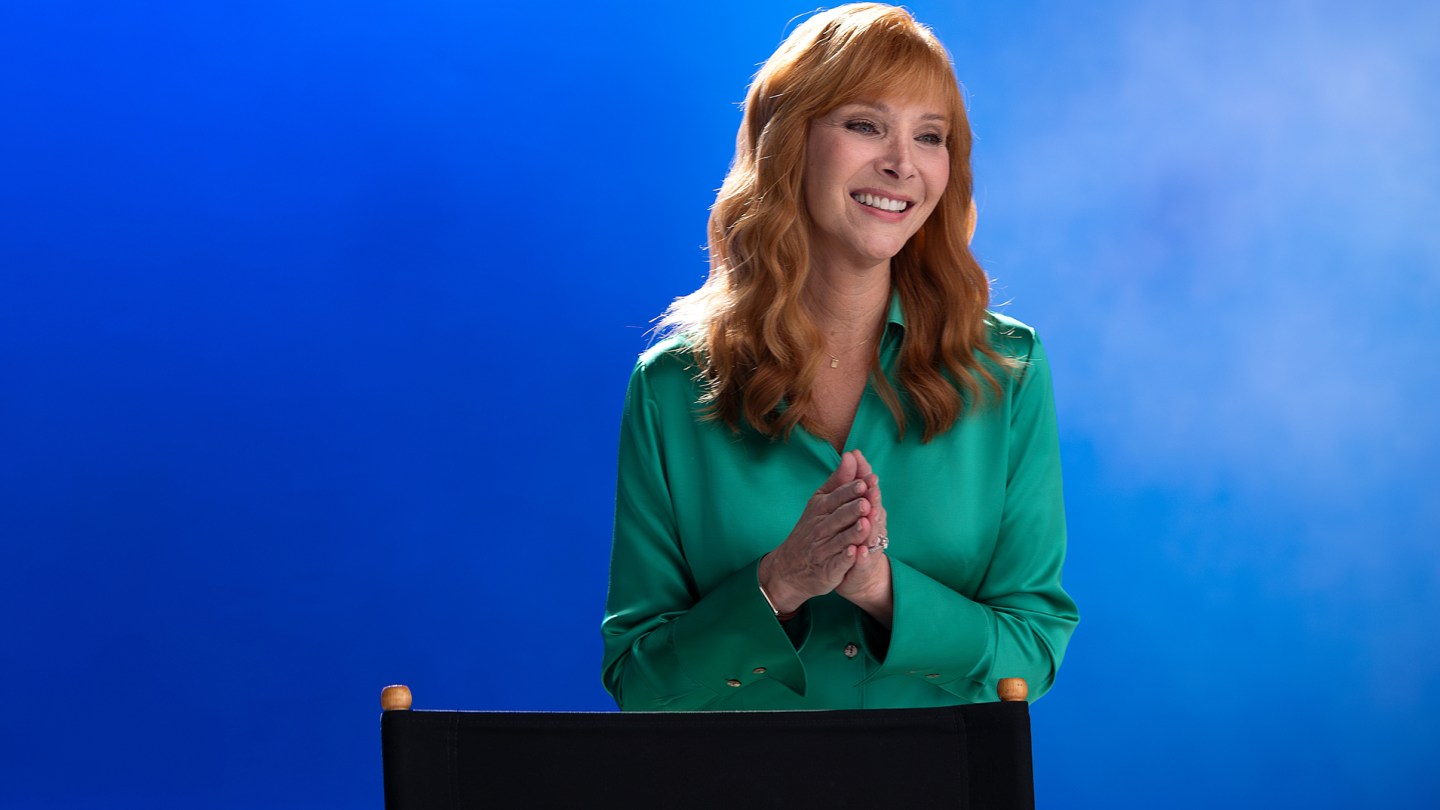
[This story contains major spoilers from the season 3 and series finale of The Comeback.]
That’s a wrap on Lisa Kudrow as Valerie Cherish — forever.
The Comeback aired episode 8 of the HBO Max’s third and final season Sunday night as Cherish bowed out at the end of an eventful episode that welcomed surprise guest stars Bradley Whitford, Adam Scott and Justin Theroux and saw Cherish tangle with NuNet boss, played by Andrew Scott, over the future of her career and the fate of her show How’s That?!
It was an eventful and historic run, too, as The Comeback is the only show in TV history to have three seasons each separated by a decade. “The most respectful thing we can do for the audience and for the character is make it a three-part story. It’s a trilogy, and this is the end,” Kudrow told The Hollywood Reporter earlier this year when she sat for a cover story ahead of the return. That ending was an emotional one, too, as Kudrow said goodbye to The Comeback and to Cherish on the Warner Bros. lot just steps away from Stage 24 where she had filmed Friends and became a household name. “The fact that both things ended there feels momentous and touching,” she said.
It’s likely that fans will use similar adjectives in describing the finale episode that closes with Laura Silverman’s Jane and Cherish on a soundstage filming a final moment of Jane’s years-long documentary. Laura praises Cherish for how much she’s changed over the 20-ish years, especially after being humiliated so much. Cherish objects to that characterization. “I think you have to agree to be humiliated and I never signed up for that,” she says in how she was able to adapt and roll with the punches. “I did the best with what I was given. Isn’t that what being a human being is?”
Laura then tells Cherish she feels like she was seeing her “for the first time” in the show’s last moment. Below, Kudrow opens up on that final scene, what got cut from the episode, how they snagged guest stars Whitford, Scott and Theroux and why she and her The Comeback collaborator Michael Patrick King felt it important to point out that “no AI was used in the writing of this series.”
In the previous episode 7, Valerie had drama at a coffee shop when she was confronted by angry writers for starring in an AI sitcom, and she gets coffee thrown on her. The finale starts more calmly as Valerie and Mark are at home watching her show when an AI version of Valerie appears onscreen. It becomes an key plot point. Tell me about the scene and how it sets up what’s next?
She went in for color timing and got scanned, and Jane was very suspicious. As you know, Valerie is her usual rose-colored glasses self so she assumes it’s for stunts. Then we find out that they are using a digital Valerie to promote or sell subscriptions for NuNet. Valerie says it’s alright because they’re just using her as a spokesperson and that would be OK. But we find out later that because she had signed a DocuSign, it gave them permission to use her image any way they like. She didn’t know that it was a legal contract. Depending on who you are in the audience, you may agree with her or you might say, well that doesn’t seem right.
There’s a moment in the scene when Mark gets up to go to bed and tells Valerie not to look at any of the reaction to her episode or to read any of the comments. She agrees but it takes her only a few seconds before she starts to read some comments. What’s your relationship to online discourse and comments. Do you read?
Sometimes I read the comments, yeah. Not a lot. I mean, I really stopped for the most part during Friends, and after the first season because there were all these internet discussions happening in chat rooms and such. I looked then and saw some unpleasant things being shared and I thought, well, that doesn’t serve me. At all. What I don’t know really doesn’t hurt me at all. When it comes to performing or any kind of art, you need a certain level of confidence and the ability to relax your brain to do what you do. And all of that negativity doesn’t help.

Kudrow and Damian Young in the third season of The Comeback on HBO Max.
Erin Simkin/HBO
The next scene is a group scene with Valerie and her cast mates from How’s That?! She brings her Emmy in for inspirational reasons only to see it break in an accident. This is where we see some growth for Valerie again as she says that she was ready to let it go anyway.
Right, yeah, and it’s her justification for turning a 180 by saying she was ready to let it go “and that’s what’s important.” You’ll cry later. But also she was being nice because the actor who broke it was so upset and hysterical about it. She focused on the task at hand to calm him down.
The scenes with the whole cast are fun. What was it like to be on the soundstage with the actors from the show within the show?
Oh so fun. They’re all so great. The only thing that bums me and Michael out is all the stuff that got cut for time. There were a couple moments with [Brittany O’Grady, Zane Phillips, Tim Bagley and Barry Shabaka Henley] that got cut for time. That stuff bugs me because they’re really good.
Anything in particular you can share?
Zane’s character, Dean, is talking about AI and says that he doesn’t see what the big deal is because he uses AI all the time for meal planning, fitness training, writing letters to his mom, spiritual stuff and things like that. I liked the “spiritual stuff” line, that was really good. Brittany’s character, Gabrielle, says that her boyfriend really loves the show, and “so does his wife.” Those little things add so much texture to the characters.
We had to cut a line at the end of the episode from Julian [Stern, Kudrow’s real-life son] where Valerie tells him that he’ll get to join the Writers Guild for coming up with a line for the show. She tells him that if he needs help paying for his initial dues, she can help with that. But then he says, “Oh, that’s okay, I get paid a fuck ton to run [the AI assist program].”
Julian Stern, Mike Mitchell and Tony Macht in a scene from the third season.
Erin Simkin/HBO
The cast then finds out some great news that they are being picked up by NuNet for a season two. Immediately after that Valerie is summoned for a meeting by a great TV writer Jack Stevens who confronts Valerie about her show’s use of AI with the help of two other writers. It was a big surprise to see Bradley Whitford, Adam Scott and Justin Theroux in the scene. I know you guys were teasing some big guest stars, how did it end up being these three?
Luckily, they are fans of the show. I’m sorry to say but it was very easy. Easy and thrilling. They were everything we had hoped and thought they would be, full stop. They’re so good. I mean, they are so intimidating and charming at the same time. Adam Scott is so perfect and disarmingly funny. You know, they’re telling her that the history of television depends on what she does. With Justin, the look and delivery of how he says, “We need you to say AI doesn’t work,” and then he can send over some talking points or bullet points. It’s perfect.
I don’t know if it was sexual tension or good natured ribbing but Adam Scott’s character is repeatedly saying to Justin Theroux’s character how handsome he is. Was that inspired by real-life writers and how they talk to one another?
It’s just observation and our intention was not sexual tension as much as it was to show a comedy writer who has always been insecure about their looks. They’re the ones not usually voted the most handsome, right? Justin Theroux, clearly, is remarkably attractive. We may have cut this line when Adam Scott’s character says, “He’s so handsome and he also has guns. I don’t have any guns.” Justin then says, “Knock it off,” and slaps him like a puppy.
Let’s talk about Andrew Scott. When we first spoke for the cover story, you told me that you cried when Andrew agreed to do the show. Seeing this episode made me think about that moment because you guys have a very sweet moment when he’s cowering in the corner and she’s consoling him. But then a few minutes later, we realize he’s the villain. What was it like to work with him across these climactic moments?
It runs the gamut, those scenes, because she’s learning so much in one encounter and then in the next, he says he felt ambushed and she felt betrayed. It makes me think of a scene in Terms of Endearment with Jack Nicholson and Shirley MacLaine. He’s saying that they will still need auteurs and geniuses to do the culture-defining work while people like Valerie can do the other shows, like the stuff people just keep on in the background. How’s that? They go back to his office under the guise of him wanting to give her a candle — a gift that she had already given him — and he says he felt ambushed while she felt betrayed by what had happened. She says that she really needs a show runner and a writer for the second season because she doesn’t want to kill herself with the workload again. And he says that they don’t need it to be great, just good enough. They just need it good enough to be on in the background while people are on their second screens, which is a real strategy these days.
Andrew Scott’s NuNet boss delivers the good news about a second season for How’s That?!
Photograph by Erin Simkin/HBO
It felt like in that moment you were trying to offer a commentary on show business and how sitcoms are treated?
Yeah, but it’s also about Valerie saying what she wants to do and how she wants the audience to be able to fall in love with a sitcom, something that’s been getting harder and harder to do. They’re straddling a line between theatrical and grounded comedy. It’s tough to pull off. There are older shows you can watch that feel like they are from another time, almost like an alternate reality. Our bottom line here is that the audience will always let you know what they want to see. But Andrew Scott’s character is saying that it was never in the plan for this show to be great but Valerie didn’t know that. They picked her for an AI sitcom because they needed serviceable and she wasn’t expensive. It’s a huge revelation and insulting.
So she says that she can’t do that. She’s not going to take it anymore. She’s got leverage because it’s a show written around her character. But he says, “We don’t need you. We have your DocuSign.” That gave NuNet her digital image and she didn’t realize that it was legal for them to take the approval.
Do you worry about your own digital image?
Yeah, I do. But I don’t know. It’s a tool but generative AI technology is a different thing than people playing around and making fan art or fan fiction. The problem becomes when they can monetize it and create something that can be used however they want. Or when studios decide they can use your image however they want. But they need permission from the estate if someone passes away. It makes me nervous. It does.
Kudrow in The Comeback
Erin Simkin/HBO
The final scene is a full circle moment for Valerie. It finds her and Jane together in an intimate shot for the documentary with Jane telling Valerie how much she has changed and she should know from documenting her over 20 years. Jane has had the closest eye on Valerie of anyone and when the subject of humiliation comes up, it becomes a conversation about who Valerie is and what she’s been through. What was it like to perform that final scene and what did you want to say?
Yeah, Valerie is saying that you have to sign up to be humiliated and she never signed up for that. Very early on we knew that is what we wanted to say because it has been something that has been brought up since season one. Actors and people who watched the show would always say to me, “Oh my god, it must have been so hard for you to film those scenes. How painful! How did you do that?” And I always pause, like, blink, blink, blink, and say, “What?” No pain because Valerie spins everything. As I’ve gotten older, I realized it’s called coping and creating your own reality to adapt. A lot of the work can be tough but it doesn’t have to be tough if your attitude is just go with the flow. People can be mean to Valerie and yeah, she clocked it, but because it doesn’t serve her, that’s their problem, not hers.
In the moment with Jane, she is saying something like, “I’ve watched you and I’m so proud of you and you’ve been so humiliated all these 20 years.” Jane has always seen Valerie as a witless victim, and she’s not a victim. I mean, she wouldn’t be able to do what she does if she felt like a victim. That’s when Valerie says the whole thing about humiliation. As human beings, don’t we all adapt? I thought it was a big word for Valerie but, you know, that’s what we all do. We make the best of it. We keep going. Jane says, “Wow, I feel like I’m seeing you for the first time.” And she is. Then the one thing that we knew we needed in there was for her to say that she’s been telling the wrong story. Now tell the one about Valerie Cherish as a survivor.
Laura Silverman as Jane and Kudrow as Valerie Cherish in the series finale’s final scene.
Photograph by Erin Simkin/HBO
You previously told me how emotional it was filming the final scene. Now with some distance from wrapping, any revelations from processing the end?
It was really hard. That last scene was the last thing we shot, and I knew from rehearsing it how hard it was going to be. I had my hair and makeup done and we were ready to shoot. I couldn’t even get through the rehearsals because I was breaking down, especially in the parts when Valerie says, “Sure was fun, thanks everyone.” I sort of went, well, now what are we going to do because I was feeling too much like Lisa in that moment and I needed to get myself out of there so I could just be Valerie. It was too real. I had to take a walk. I felt like there were too many words and I tried to say the same thing over and over in different ways. But luckily, as it turned out, one of the takes worked and looked the way it was supposed to look. I actually think it was the last take we shot, too. In the writers room, it all felt really light and good but when we got to set, it all felt so heavy. I said, “Michael, what’s going on?”
We were also under pressure because we were shooting on Bolex and we only had two more takes left so we had to figure out how to get the right angle or something to cut too so we had the shot. That’s when Elie Smolkin, our genius director of photography, saw the lens of Jane’s camera and when you clean it, it looks like a perfect mirror. We shot another with that angle and didn’t need to push in. It turned out even though Michael and I missed it but it was right there the whole time.
King and Kudrow at the premiere of the third season in Beverly Hills, Calif. on March 19, 2026.
Photo credit: David Jon Photography
When Michael yelled “cut” and called a series wrap on Lisa Kudrow, what happened next?
There was a get together, some pictures and people had things to say. The crew was unbelievably talented. Oh my god, we had the best people. Everything is easier when you forget about yourself and focus on other people anyway. That was not hard to do on this because everyone was so good. Elie saved everything. He was extraordinary. The camera operators, artists, crew, everyone was so great.
There’s some text that flashes up on screen that reveals what happens next for Valerie with her new show, Judge’s Table, and for How’s That?! But there’s also a line that says, “No AI was used in the writing of this series.” Why was that important for you and Michael to say?
Because no AI was used in the writing of this series. We wanted to make sure people knew that. As we were going through this, people were always asking us about the future and what will happen with AI. And some suggested we try using AI to write this show and we said no. We didn’t want a shred of AI on this show. Because, look, I honestly don’t know what’s going to happen in terms of writing but it seems to be last wall between us and AI as an industry. There are programs that are better than anything we’ve ever seen. Every script has been fed in there already, Friends, Cheers, Shakespeare. You can’t get the toothpaste back in the tube. We know they are already using AI for certain things, like commercials or non-union projects, maybe some reality shows, I don’t know. But if we felt strongly about saying that we didn’t use it because we didn’t.
What does Valerie Cherish mean to you?
She means a lot to me. I’ll miss her. I know she’s here, I have access to her, but it’s sad. I know she’s not me but I do feel like there is this other person that exists. We have some things in common. When I think about her, I’m also thinking about all the people who have loved and appreciated this show. I almost feel like I’m saying goodbye to them, too. And all the people who worked on the show. It’s, like, we won’t be meeting anymore in the realm that is The Comeback. But what feels great is the people who loved the show, and that’s who we had in mind the whole time we were writing it. It was almost like an intimate conversation we were having with people who love the show. Our tension around it is whether or not they would like it. I hope they like it. I hope they don’t feel like at the end we just say that Valerie was adaptable and that’s how it was. There are some who saw her as really strong and others who didn’t, which is fine. Art is like a Rorschach test. You see in it what speaks to you, wherever you are in that moment. What you get or what you see in Valerie is fair enough.
Interview edited for length and clarity.
Kudrow as Cherish in the final scene on The Comeback
Photograph by Erin Simkin/HBO
