


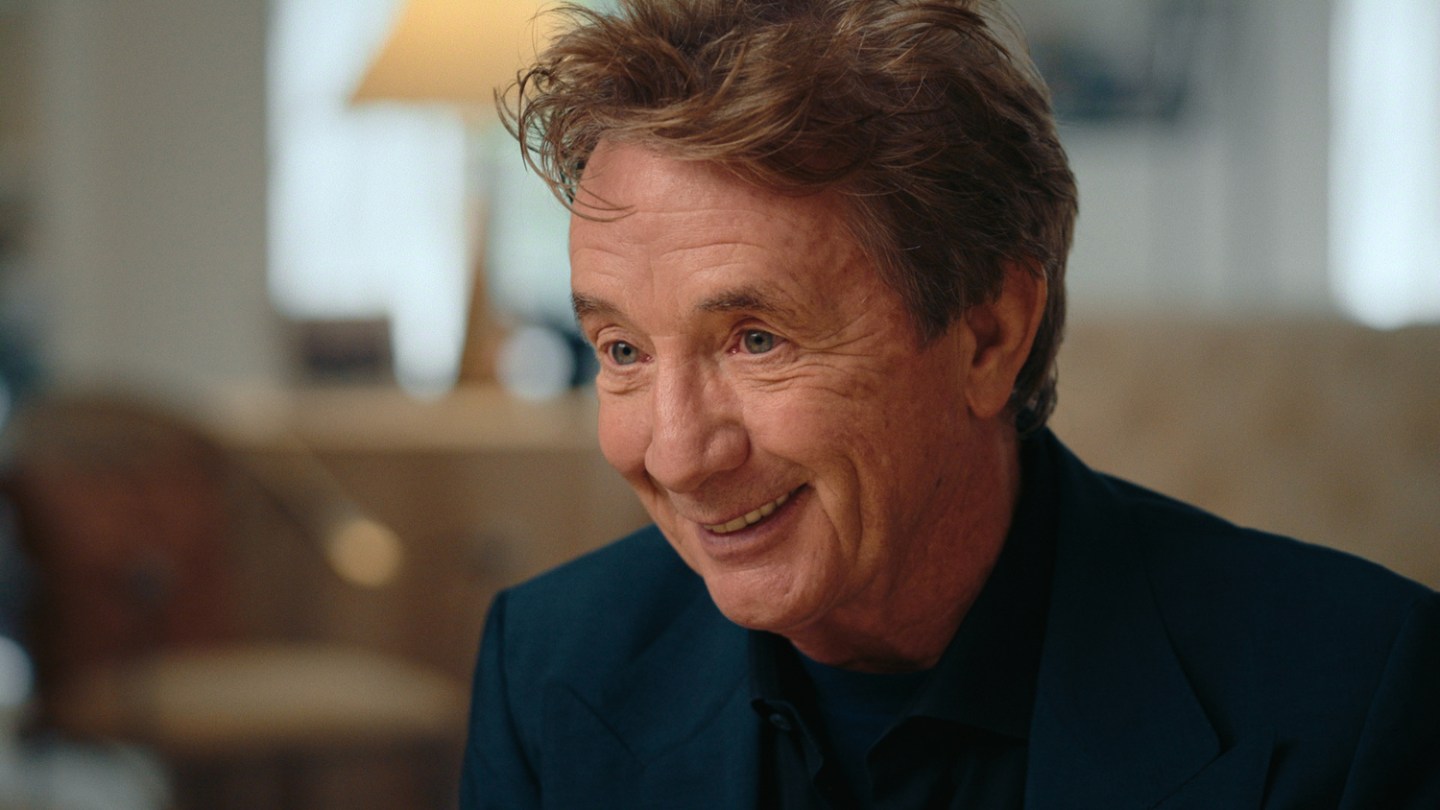
The tone of Lawrence Kasdan‘s Marty, Life Is Short, a 101-minute tribute to and celebration of Martin Short, is captured in the final minute before the closing credits.
First, Jiminy Glick, Short’s latex-buried alter ego, scoffs at the mere idea of a documentary about Martin Short.
Marty, Life Is Short
The Bottom Line
A sad and funny portrait and love story.
Airdate: Tuesday, May 12 (Netflix)
Director: Lawrence Kasdan
1 hour 41 minutes
“They’re making a documentary on literally every human being that existed,” says the reliably buffoonish Glick, who in this instance is far from incorrect. Kasdan’s Netflix documentary overlaps with so many different recent docs, including clip-heavy showcases for Steve Martin, Chevy Chase and all things Saturday Night Live, that one can imagine his biggest hurdle was avoiding accidentally getting a different documentary’s crew in the back of his shots.
Just seconds later, Kasdan closes with title cards in loving memory of Short’s longtime collaborator Catherine O’Hara, who appears throughout the documentary, and his daughter Katherine, who does not.
It’s a whiplash emotional response, from giddiness to gravity, that typifies the journey Kasdan traces in Life Is Short and one that has typified Short’s life, marked by triumph and spikes of personal tragedy.
I’m sure there’s a dry, professionally distanced documentary to be made about Short’s career, his varied professional arc and his myriad achievements, but Life Is Short mostly isn’t that documentary.
As Kasdan and Short discuss, they have a lengthy personal relationship, and the director approaches this project much more as a curious and affectionate friend than a rigorous scholar of Shortology. This, in turn, leads to a documentary that’s much less Martin Short: Versatile Comic Genius and much more Martin Short: Lovably Damaged Celebrity Party Host. The initial sense that this might be selling Short’s gifts, well, “short” passes in a hurry. “Martin Short” seems to be a state of mind, one that isn’t as remote and inaccessible as you might think from the outside, and one we would all benefit from tapping into.
Marty, Life Is Short is, as much as anything, a documentary about not being defined by failure or tragedy.
“I would say my career has been 80 percent failure and I think those are pretty good odds,” Short says early in the documentary. Later, he ups that number to 90 percent. Recounting wisdom that Short gave him, John Mulaney quotes a “98 percent” failure figure. That’s not the way I think of Martin Short’s career, but if you actually go through his credits…he isn’t wrong.
Kasdan and Short’s relationship dates back to Cross My Heart, a Kasdan-produced romantic comedy that I think of as successful because it was all over HBO in the late 1980s, along with Three Amigos and Innerspace. I think of all of those movies as hits, but they were not, nor were Pure Luck, Three Fugitives, Captain Ron or Clifford. (There are clips from Mumford, which Kasdan directed and Short co-starred in, but they don’t discuss that collaboration. I do not think of Mumford as a hit.)
But if you live with enough joy and pick your projects based upon characters you want to play and people you want to work with, maybe the failures don’t linger in the same way as they might for somebody whose work-life balance teeter-totters toward the “work” side. And milking the joy out of every moment of the “life” side makes it easier not to dwell on the bad things that happen. And surely Short’s ledger has enough sad data points — a brother and both parents died within an eight-year period in his youth, his wife of 30 years died in 2010, his daughter died earlier this year — to predominate, except that they appear not to. (Neither O’Hara’s death nor the death of his daughter are discussed in the documentary.)
As a documentary subject, Short occasionally spends more time goofing off about the process than being serious, forcing Kasdan to use more reflective, probably more staged, conversations that Short has had over a career as a ubiquitous talk show guest. What Kasdan gets more frequently is Short happily re-enacting a breakfast that he explains he’s already eaten or extending his on-stage bantering with Steve Martin into the makeup trailer on Only Murders in the Building.
What’s odd is that even when he’s kidding around, Short doesn’t exactly come across as being “on” for these conversations, especially since we know from those decades of ubiquitous talk show appearances how manic and unpredictable an “on” Martin Short can be. He’s just good-natured and good-humored — a contrast to the variably prickly approaches his Three Amigos co-stars took to the directors of their recent docs — trying to balance snarky asides and personal recollections. Here, it’s like Kasdan is the guest and Short is endeavoring to make him comfortable.
The better stories from Short’s past often come from those who are closest to him, including Eugene Levy, Andrea Martin and O’Hara, who recount anecdotes going back to college, the astonishingly star-packed original Toronto cast of Godspell, SCTV and more. An even more rounded picture is delivered by people as differently related to Short as his son Oliver, his brother Michael and the A-list ensemble on his Christmas party and summer lake cottage invite list, a group that includes Tom Hanks, Steven Spielberg and more.
The home movie footage from those gatherings is astonishing, capturing both Short as zany host and Short as general facilitator of zaniness — including a priceless moment in which Short and Hanks recreate the last scene of Butch Cassidy and the Sundance Kid, filmed by Spielberg as the overqualified master of the camcorder.
Short’s stories and the stories captured in the home movies are, amount, more than anything, to a love story, focused on a relationship with Nancy Dolman that lasted from that 1972 Godspell production — featuring Short, Levy, Martin, Victor Garber, Gilda Radner and Dave Thomas, it will be the subject of its own upcoming documentary — until 2010. As was also the case with Judd Apatow’s recent Mel Brooks two-parter and its treatment of the Brooks/Anne Bancroft marriage, Kasdan’s film emphasizes the nourishing value of a special relationship over the devastation of loss. While Short is, in many ways, indisputably remarkable, his love story is presented as at once special and fundamentally ordinary. And his life and career are treated the same way.
That’s why the one-two punch of the Jiminy Glick joke and the double-dedication hits as hard as it does. Kasdan includes material that touches on the origins of Short’s comic voice — there’s a repetition to how the documentary treats his youthful biography that I found perplexing — and the voices of characters like Glick and Ed Grimley, but it isn’t a dissection of the professional life of a wacky actor. Some viewers might wish for more of that, honestly, but there’s a quiet and effective potency to the story that Kasdan wanted to tell.

