


In 1980, I was offered the opportunity to direct Richard Pryor in a dramatic movie based on a James Kirkwood novel called Some Kind of Hero about a returning Vietnam veteran re-adjusting to society, but first I had to be interviewed by Mr. Pryor himself, who had director approval. I was a white, Jewish male from a left wing political artistic family from the upper West Side, and for some reason the late Don Simpson, the head of production at Paramount studios at the time, thought we might be an interesting match. He wasn’t wrong.
Simpson was a risk taker, later becoming one of the industry’s most successful movie producers, partnering with Jerry Bruckheimer, with dozens of successful Hollywood films; Beverly Hills Cop, starring Eddie Murphy, being the most inspired. I, however, had just finished directing Boulevard Nights, a film about gang violence in the Los Angeles Chicano community starring a cast of entirely Latino actors. That film was released at a time when gang movies were popular, amid a rash of violent outbreaks at movie theaters. Soon after release, Warner Bros. pulled the film from theaters. It was critically well received, but a total financial disaster. Just last year (2025) it was “re-discovered” as they say, and named one of the 25 films for preservation by the Library of Congress.
So, in mid-December of 1979, I flew to Hawaii where Richard Pryor was recuperating after almost burning alive during a free-based fueled accident. He hadn’t worked in a year and this was to be his return to filmmaking. He had a home in Hana, Maui, where he interviewed me on a private dock looking out over the Pacific Ocean. It would be another year before he was able to make fun of himself in his famous Live on the Sunset Strip concert film where he lit a match, moving it across the stage saying, “You see this? This is Richard Pryor running down the street.”
But that was later. Now, he was incredibly vulnerable and emotional, and I was very nervous to meet him. We both hardly spoke for at least a few moments, until he looked at me straight and said, “Why do you want to make this movie?” I responded with, “It’s an important story to tell.” He confessed that he feared that the studio would try to turn it into a silly war comedy. I promised him that if he and I were to agree to make a drama, I would honor that promise. He then asked, “Who have you talked to about me? Have you checked me out?” I wasn’t prepared for the question, but it was the moment that sealed our working friendship. “No one”, I said. “I thought we would find out if we like each other and go from there.”
I think he was surprised either by my honesty or my naivete, and he liked it, and gave me his trust, and I gave him mine.
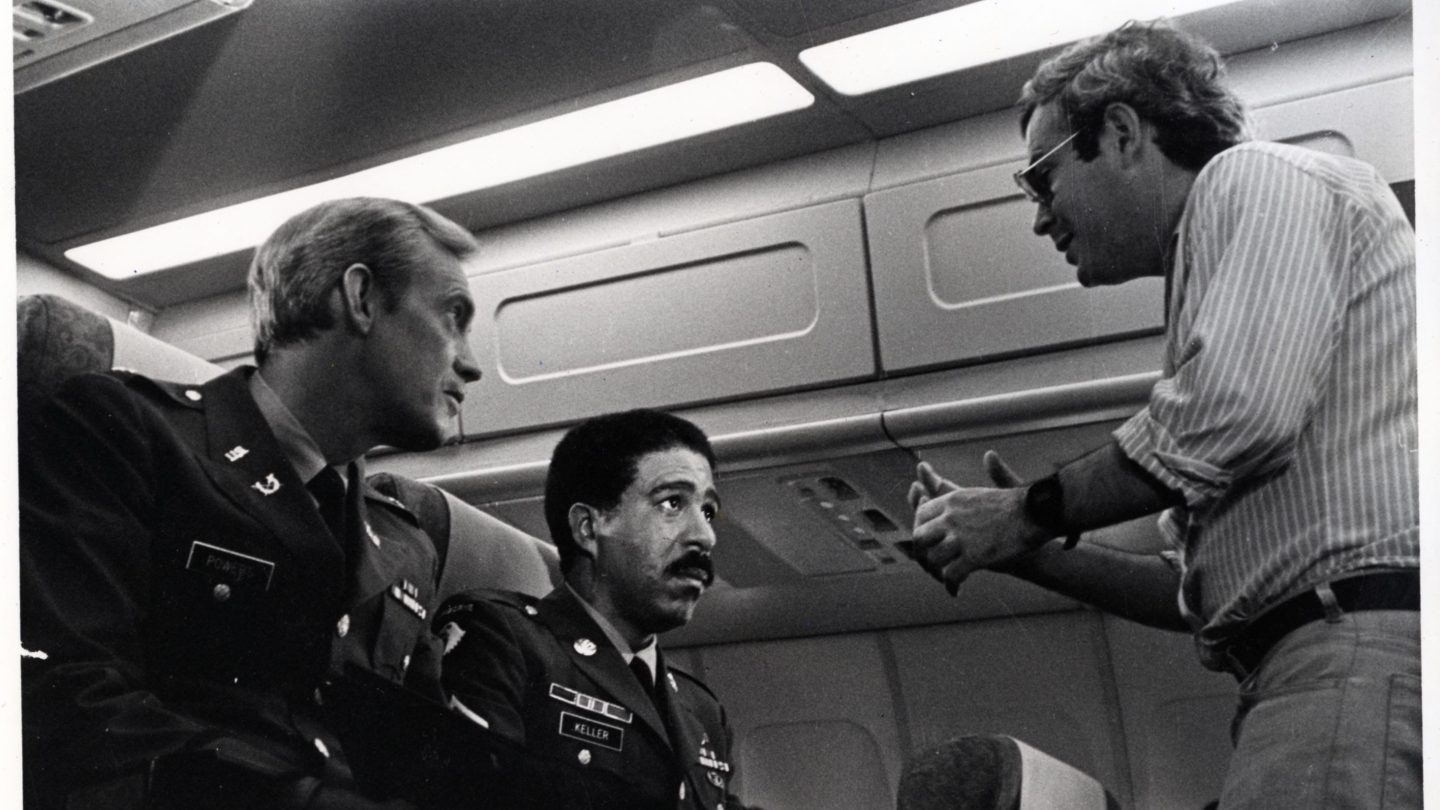
After two hours of talk about life and relationships, I found a connection that solidified one of the most amazing and intimate working relationships I’ve ever had. I treated him as a serious actor, not the comic genius he was and was regarded as, which he clearly appreciated. We even rehearsed for a week before shooting, which was entirely unusual for him. Directing Richard Pryor was magical. He always followed the script, but there was always a sense of the unknown in his performance. I was never quite sure how he was going to play a particular moment or say a line of dialogue. I learned from him the power of creative spontaneity. We got along and shared the same sensibilities.
At one moment during production Richard said to me, “I think you are a genius.” It was a crazy thing to say because he was the genius and I was just a young director finding my way. “Why do you say that?” I asked, and he looked at me, and said, “Because you are the worst f***ing dresser I’ve ever seen.”
Despite the camaraderie and trust we developed, though, the film’s fate was upended by the institutional racism inhabiting the highest levels of the studio system.
The adapted screenplay for the movie featured an intimate sex scene between Pryor and his co-star, the lovely actress Margot Kidder, that the three of us felt was important to be graphic to convey how love can develop from a night of sexual intimacy. We spent the whole day shooting one very long sex scene that went from a living room to a bathtub to a bedroom. It was a closed set and none of us, Richard, Margot, or I, shied away from anything. That’s the modest way to put it. But it was completely professional and it was actually very hard work.
When Don Simpson saw the dailies the next day he freaked out. He didn’t allow the footage to be seen by anybody else, and he wrote a long letter to both Richard and me chastising us for veering off from “the intent “of the movie he greenlit.
It was a scathing letter filled with racial concerns cloaked in political studio speak (“The last thing he would want would be for Richard Pryor to lose his audience.”) Richard showed up to work the next day, and I was worried that he was going to quit. I asked him if he got the letter and he casually laughed and said, “I started to read it, laughed, threw it away and then got laid.”
Okay, I thought. We continued our work, without interruption.
Then came the studio screening of the director’s cut and I found out from sources that as soon as the Black man started to make love to a white woman, the screening room went dead silent. And to make matters worse, the scene went on for at least five minutes. At the end of the picture, Pryor and Kidder rode off into the sunset together in a sports car. When the lights came up after the screening, the first words out of the studio head was, “They can’t end up together. And cut out the sex scene.”
Well, Simpson was wound up in knots. He was head of production, and scared for his job, but was also a supporter of the film. He told me the changes, and it became clear to me that no one at the studio had even read the script. “But they end up together in the script! Why the change now?” I demanded to know.
“Well, now they don’t,” is all he said to me.

Pryor with Pressman on set.
Creative wars began and it got crazy. I told Richard everything that was going on and that I would fight it but ultimately they could take the movie away from us. I did the best I could, and I won some battles but I ultimately lost the war.
I did insist on my contractual right to preview my cut with the extended love making scene intact, and I was supported by the Directors Guild of America, and I won that battle. Then came the biggest moment of insanity. The studio agreed to book a sneak preview of the film but it was to be shown only in Anchorage, Alaska. “Are you kidding me?!” I yelled. I couldn’t process it. How many Black people live in Anchorage?
So, I flew to Anchorage with print in hand, accompanied by the film editor, the writer, and the producer Howard Koch who was already disheartened. I remembered turning to Howard as we were landing in a blizzard that if we flew another fifty miles we could screen the movie in Russia. He didn’t find it funny.
The screening was uneventful. There was a very small audience and when we returned, the studio cut the love making scene to shreds, and the ending was changed to have Pryor walk off alone into the sunset and the movie was sold as a silly war comedy and the audiences were disappointed and the movie was only a modest success.
The sad part was Richard Pryor knew it was coming. It didn’t surprise him. He knew racism and I didn’t. He didn’t blame me, but I was injured at the time because I wanted to show his audiences the ground he could break in race relations and the studio wouldn’t let him. His legacy as a stand-up comedian and comic actor was legendary, but sadly, he never got recognized for his talents as a serious actor. He was brilliant in Lady Sings the Blues and White Collar, but it didn’t matter.
But now I look back through a different lens. The white man had kept the Black man from showing his power. Richard was a controversial actor, and a true rebel and a street wise instinctive performer and had much more to give, but he was too dangerous for the white establishment. And to let Richard Pryor make love to a white woman on that silver motha-f***ing screen? Forget it.
I wonder if Richard Pryor were alive today what would he be telling us about the death of George Floyd and Black Lives Matter? I wouldn’t begin to guess, but I can assure you it would have been controversial, hysterical, and piercingly true.
Richard Pryor now lives in our memories, and his work can be re-discovered by a new generation. But in the case of Some Kind of Hero, there were only fifty people who ever saw that full un-edited performance, and they all lived in Alaska.
