


The Cannes Film Festival‘s Un Certain Regard section prides itself on showcasing discoveries of non-traditional cinema. What a fit for rising Austrian writer-director Sandra Wollner, who is making her Cannes debut in this year’s program with her third feature, Everytime!
Her debut feature, The Impossible Picture, showed the everyday life of a Viennese family in the 1950s as documented on 8mm film by 13-year-old Johanna, until the camera suddenly turns on her. Her sophomore movie, The Trouble With Being Born, was a drama about a 10-year-old android and her “Daddy.”
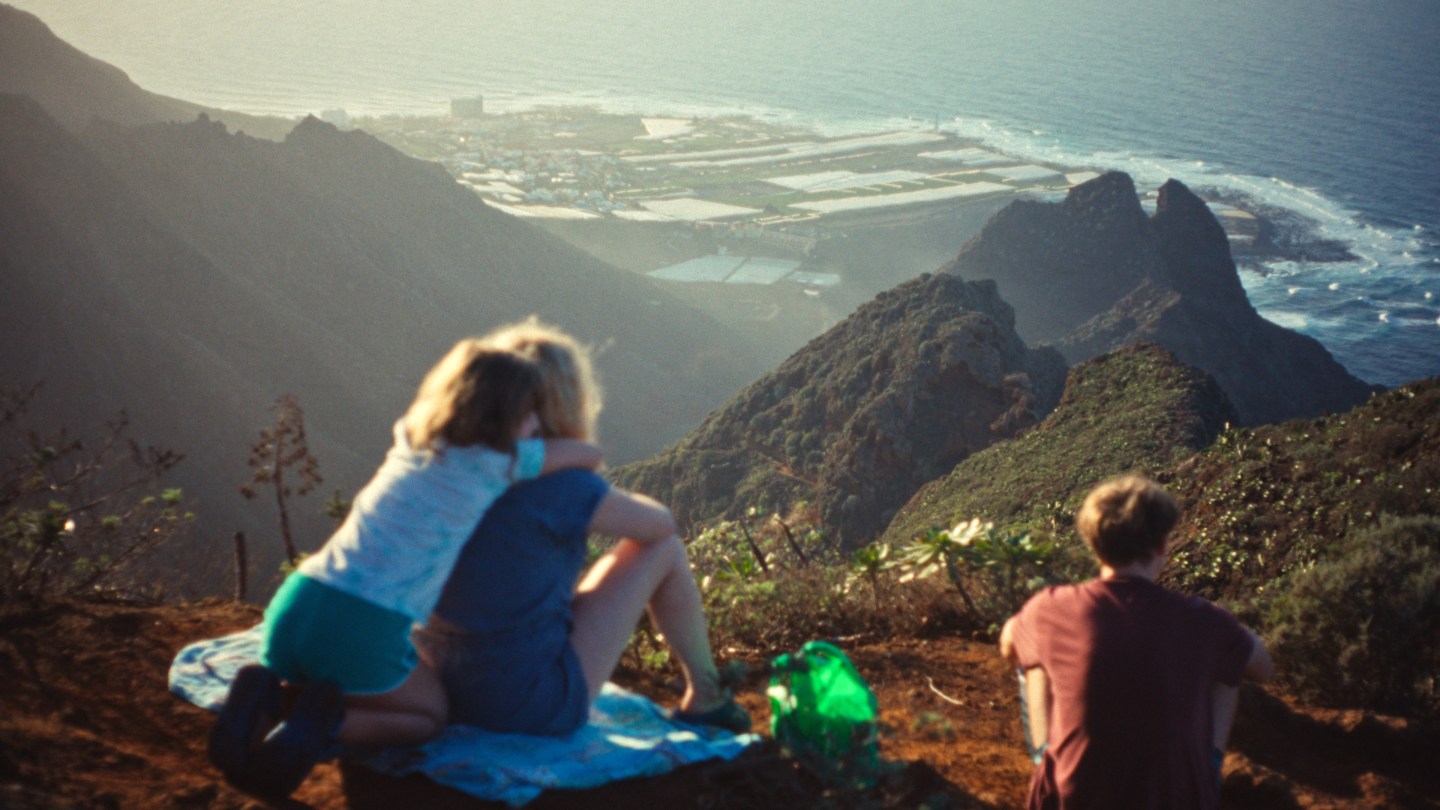
Now, Wollner is back with Everytime, which sees a tragic death bring a mother, her daughter, and a teenage boy, who everyone blames for the tragedy, together. The cinematic exploration of grief, blame and forgiveness takes the unlikely trio on a trip to Tenerife for “a family holiday that never happened,” as the auteur puts it. And under the glowing sun of the Spanish island, time, as well as reality and fiction, suddenly seem to start blurring.
If audiences, just like the writer of these lines, end up wondering “what the hell is going on!?,” Wollner is happy to hear it. “One experiences that feeling only rarely, and I really want to embrace that,” she tells THR. “I think it’s nice if you walk out of the cinema and you can’t completely grasp what you have just seen.”
Everytime, which features cinematography by Gregory Oke and editing courtesy of Hannes Bruun,
stars Birgit Minichmayr (The Blood Countess, The White Ribbon, My Wonderful Wanda), Lotte Shirin Keiling, Tristan Lopez, and Carla Hüttermann. Produced by Lixi Frank and David Bohun at Panama Film with Viktoria Stolpe at The Barricades, Charades is handling international sales.
Wollner talked to THR about the inspirations for the film, which premieres on May 18, and the themes it dives into, her creative process, the role of musical and video game aesthetics in Everytime, and how her documentary film studies play into her filmmaking.
What inspired Everytime?
“Why does the sun go on shining?” One would think that after a tragedy like the one that happens in the film, the world ought to have the decency to stop. A night out, two kids bursting with life, a wrong step, and a teenage girl dies. And life just goes on after that. The sun just keeps on hanging in the sky, shining with simple, oblivious innocence, as if nothing has changed, as if nothing has happened. The indifference of the universe, which doesn’t care about our pain – that’s what interested me.
The three protagonists of the film are based on people and constellations I have met at certain points in my life. But they are more “afterimages” of these people – they grew into themselves and took on a life of their own. I just had to follow them.
They form a bit of an unlikely trio. There is nothing they can say that will change what happened, nothing they can do that will overcome this immense loss. They are in an in-between state where they are not honest with each other. Everyone tries to do “the right thing,” like a decent person. But no one talks about their actual state of mind. The boy cannot say that he just wants forgiveness, and the mother cannot say that she cannot give it to him – because, actually, deep down, she does blame him somehow. It’s like in all complex scenarios – there are a variety of things that are true at the same time. And sometimes it’s hard to bear.
We follow this unlikely trio, and a lot is going on, but not in terms of big visible “action.”
They go on quite a journey in this film. But at first, we follow them through the stillness of everyday life, where everything feels suspended except for their grief, and the different ways they confront it, evade it, or find themselves unable to face it at all. That quiet tension is what ultimately propels them into a strange journey: a family holiday that never actually took place.
When everything is said and done, they have to face the fact that there is nothing they could do that would change what happened. Nothing can change the simple reality of death. Except in this film, reality itself is not such a simple thing.

Sandra Wollner
Courtesy of Robert Newald
It’s definitely not a classic hero’s journey, but I feel philosophical, maybe even religious, overtones…
Personally, I don’t believe in an afterlife. I grew up in a more traditional Catholic environment in Austria, where the rites only structured the year; they held no spiritual meaning for me. I was lucky that I was loved, I was fed, and I didn’t feel the urge for an afterlife.
But I always envied those who did, because it’s quite a fantastic idea that you can come back, or that you can meet people again after you leave this world. I do believe that the people we love somehow inscribe themselves into our inner world, like spiritual beings, like ghosts of the mind. We do have an inner world that coexists with the reality out there. And we can never step out of that. These spheres are always overlapping.
Anyone who has experienced the loss of a family member knows that you can recall memories that feel so vivid that you can almost step into those images. Ever since my father died, who loved to fish, I have seen him standing on this particular river bend when I come by there – or even when I don’t. The idea of stepping into that image is, of course, something that cannot happen in real life, because our reality is not built like that. It doesn’t allow something to come alive just because you picture it very clearly. Not quite. But, you know, that’s what the movies are for.
I have seen one of your other features, and memory and images sound like a recurring theme in your work.
We are not only thrown into the world, we also judge it, categorize it – constantly. We build our fictions all the time, we project our human meanings into a complex, sometimes chaotic world. And I think this is the core of what I’m interested in – the strange overlap of this inner thought world and our outer reality.
The film is leading towards the strange manifestation of a memory. It is as if you could step into an old video image that is quite banal, because it has no meaning – but you feel that it has value. And at the same time, there is something uncanny and tragic to it.
Since you like to surprise audiences and keep us on our toes, I wonder about your writing process. Do you know early on exactly where you want to go?
For me, when it comes to writing, I really want to allow myself to be surprised. Of course, you do the usual work of “where is the plot going” and “where are the characters standing”? But sometimes I write and just follow the sound of a sentence to see where it leads me. You have the rhythm of a sentence, and it leads you somewhere, and something unexpected can happen. I like to push the boundaries and not [just think] what would typically happen next. Otherwise, you’re trapped in tropes of human psychology. You must allow yourself to follow a more fluid process, which is something that I feel very strongly about and love.
I honestly didn’t know exactly what I was thinking and feeling when I wrote this film, specifically the final chapter, so to speak. But I was surprised myself. And I thought there was something interesting about it. If you don’t know exactly where it’s leading, and the ambiguity is heightened, still try to follow that!
‘Everytime,’ courtesy of The Barricades/Panama Film/Gregory Oke
I have seen Birgit Minichmayr in various films, and I always like her. But I didn’t know the younger cast members, who are also wonderful. Young Lotte Shirin has such charisma. What kind of safeguarding was needed to protect the cast, especially her, from some of the heavier themes, such as drugs and death?
I’m quite experienced when it comes to protecting and working with kids. And our team was always looking out to create a safe space on set and beyond. But especially with Lotte, who is extremely mature, it wasn’t hard. Of course, we talked about drugs, for instance, and what happens when they are taken, in a manner that is suitable for a child. You also really always cast the parents with the kid, and Lotte has amazing parents who are actors themselves. We talked quite a lot in the beginning. They also saw my last film – which is about a sex robot played by a 10-year-old, after all – and we talked about my methods, rules and boundaries. We all worked together really well.
How and when did you find the film’s title, Everytime?
I feel that Everytime is the cosmos in which all my work takes place. I made two films before – and one is about how a memory becomes a memory. The cosmos in which all these films are set is a place where the weird overlap of memory and imagination happens. It’s a place where the inner world meets the outer world. It’s not like there are ground rules to this world. It’s just a feeling that the films share.
We see the kids playing a video game, which adds another layer of reality or fiction to the film. Can you talk about this choice of featuring these video game scenes and the music that comes with it, which somehow gave me the feeling that I was being pulled into the screen?
Perhaps some of what we see in the film is the gaze of someone, something else – an entity, and not a very empathetic entity at that. Maybe it’s the universe itself, or god or whatever we want to call this entity. It is simply watching, and in watching, it doesn’t discern between the meaningful and the banal. I feel this is the misery we live in. Life doesn’t stop when a tragedy like this happens. It just goes on. And this entity takes the tragedy as seriously as the video game – the game that the dead kid used to play and that her sister is playing now. Therefore, there is an overlap of the music that comes from this video game with what happens later – it evolves into something different within the film.
Inherently, video games create inner experiences, but they are also complete worlds and realities in themselves. Again, the inner and the outer world. In this particular game, your hopes and intentions as a player clash with an immense, almost boundless world and its survival mechanics. But you can also fly, or create anything you want, or dig into the earth until it’s all black around you. It’s as uncanny as it gets. This is why, in the film, after you experience the tragedy, you’re suddenly thrown into a video game full-screen.
‘Everytime,’ courtesy of The Barricades/Panama Film/Gregory Oke
I read that you studied documentary filmmaking. Do you feel your doc background feeds into your work?
I did study documentary filmmaking – and then stopped making documentaries because I felt the burden of the truth, as it were. I wanted to be true to my protagonists, but also really wanted to follow my vision. So I stopped, because I realized that my urge to create was bigger than my urge to stay close to the facts. I suppose my love of writing is stronger than just filming the world as I see it.
At the same time, in this film, there is a subtle shift in tonality, almost a shift in genre – but this shift could only really be felt if you, as a viewer, completely trusted the reality of what’s on screen. This meant that for most of the film’s runtime, we needed the plot, the characters and the film’s texture to feel as authentic as possible – however frail that concept of authenticity might be.
Nearly everything is scripted, although there are some scenes where I just gave the actors a general sense and a sentence for what to do. But when things are scripted and choreographed in the writing process, I then look at it as if I was just there to document them in the filming – which is hard, because you are definitely forgetting that you are “just documenting,” you have to actually create it. After that, in the editing, once we have created this new authenticity, I really love to watch the whole thing like a documentary, to see how it speaks to me. Then we treat the material like it’s found footage.
Congratulations on your first-ever Cannes invite. How does that feel?
I’m excited about going to Cannes. I haven’t been there, and it’s quite an honor. I still cannot really believe it. I heard the cinema is really big, and I hope that a lot of the crew will enjoy the [experience].
Is there any new project you are working on?
I’ve started to write a film that explores the question of how the first ghosts came into the world. It is set in prehistoric times and follows a band of children trying to survive the strange environment around them. Let’s see where it goes.
