


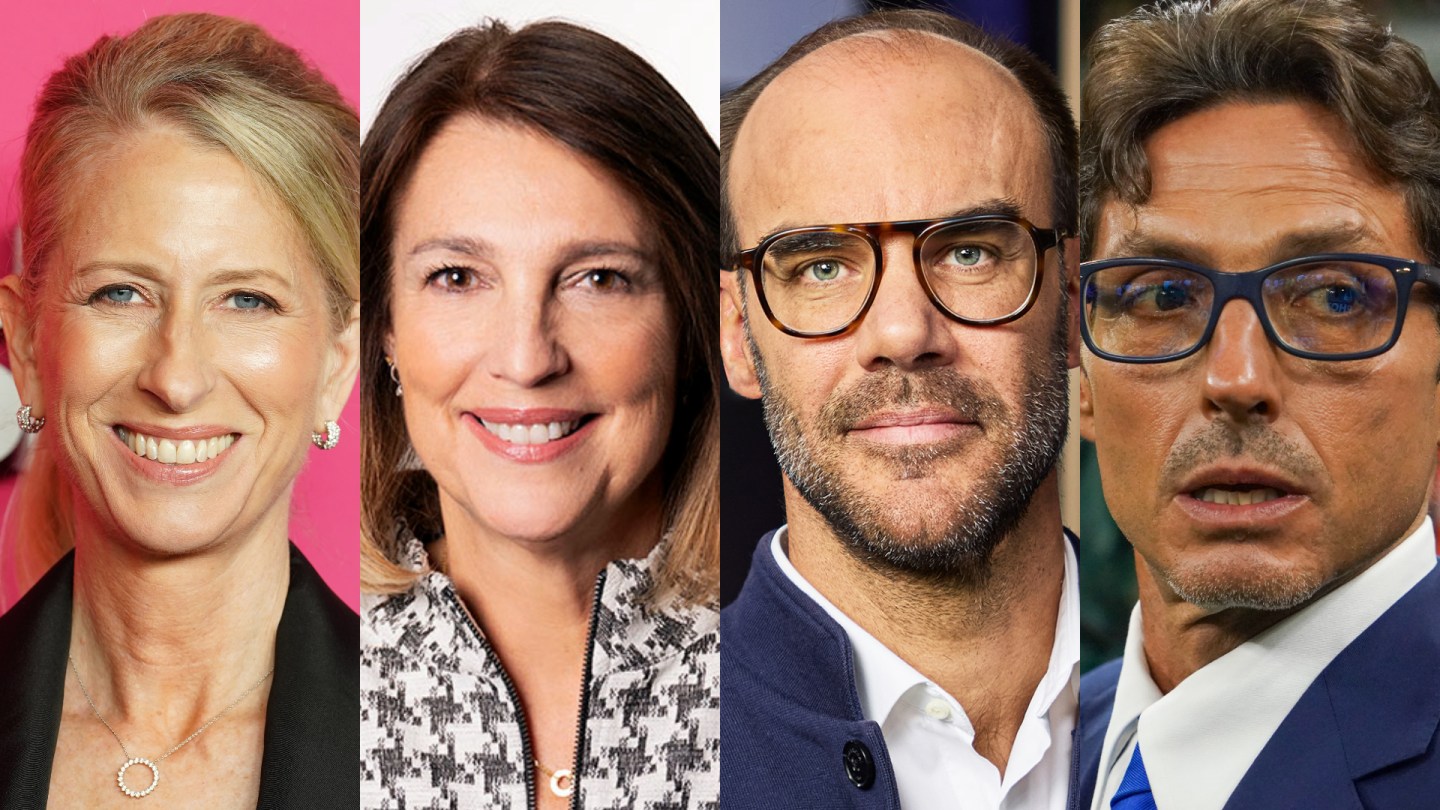
In little more than a year, Europe’s broadcasting sector has seen a burst of dealmaking that would have looked improbable a decade ago. Comcast-owned Sky has agreed to acquire ITV’s broadcast and streaming operations in the U.K. in a deal valued at $2.1 billion. RTL in Germany is combining its market-leading free-to-air broadcaster with the country’s No. 1 pay-TV group Sky Deutschland, recently acquired from Comcast. The Berlusconi family’s MediaForEurope (MFE) last year took control of Germany’s number two commercial network ProSiebenSat.1, adding it to MFE’s growing European stable that already includes Mediaset, Italy’s top commercial TV group, and Telecinco, Spain’s number two commercial network.
Regulators have so far prevented a similar tie-up in France — an attempt at a $4.1 billion merger between the top two commercial networks, TF1 and M6, was abandoned in 2022 — but the trend is clear. Europe’s broadcasters are trying to get bigger and fast.
The logic behind the wave of broadcast consolidation — and, to a degree, the parallel M&A boom in the European production sector, evidenced by the recent $8.5 billion mega-merger between Banijay (Survivor, Peaky Blinders) and All3Media (The Traitors, Call the Midwife) — is clear. Being big enough to compete against national rivals is no longer enough. European TV companies are now in a fight for eyeballs with Netflix, YouTube, Amazon, Disney, TikTok, Google and Meta, global platforms with global technology, global advertising infrastructure and balance sheets that dwarf even the largest European TV groups.

The Traitors
Euan Cherry/Peacock
“Broadcasters are no longer competing just with each other but also with global streamers, YouTube and social platforms for audience attention and revenue,” says Enders Analysis’ Cleodie Kilgour. “Broadcasters’ audiences are clearly declining, which puts ad revenues under pressure while production costs continue to rise. Consolidation is therefore a way to build scale, share costs and compete more effectively in a market increasingly dominated by global tech and streamers.”
The numbers explain the urgency for legacy broadcasters to get big fast.
Broadcast viewing remains large across Europe, but it is shrinking quickly, particularly among younger audiences. In the U.K., daily viewing of public service broadcasters on TV fell from 153 minutes per person in 2015 to 88 minutes in 2025. Among 16-34-year-olds, it collapsed from 95 minutes to just 21 minutes. In France, linear TV viewing among 25-49-year-olds has more than halved since 2015. In Germany, daily viewing among 14-69-year-olds has fallen sharply since 2019.
But content costs are moving in the opposite direction. In the U.K., the median budget per minute for high-end scripted television has risen by roughly two-thirds over the past decade. In France, the hourly cost of TV drama, excluding soaps, rose 66 percent between 2015 and 2024.
That leaves broadcasters squeezed from both sides: fewer young viewers, weaker advertising, higher production costs and global platforms bidding up talent, sports rights and audience attention. The old European model — nationally regulated broadcasters using linear advertising to support news, drama, entertainment, regional coverage and public-service obligations — was not built for this market.
“Consolidation is a rational response to the challenges facing legacy broadcasters,” Kilgour says. “European networks need scale within their own markets to fund flagship productions, accelerate digital transformation and secure critical prominence on CTV [connected TV] platforms. Partnerships alone are not enough. Broadcasters must achieve true scale to remain competitive.”
But Europe’s TV consolidation wave is not just one story. It is several. National broadcasters are merging to build scale at home; MFE is trying to build a pan-European advertising giant; and others are partnering with the global platforms they once saw as existential threats.
National Champions: RTL and Sky/ITV
In Germany and the U.K., RTL and ITV/Sky are betting that domestic champions, if they are big enough and combine pay and free TV, broadcast and streaming, can compete with the international invaders.
Already, the combined RTL+ and Sky Deutschland streaming platform reaches some 12.4 million paid subscribers across German-speaking Europe, making it the third-largest streamer in the region.
“This brings us within striking distance of Netflix and Amazon in this market,” RTL CEO Clement Schwebig told The Hollywood Reporter.
On the advertising side, RTL/Sky reach nearly 69 million German homes, 87 percent of the total population.

RTL Group CEO Clement Schwebig
Boris-Breuer
“Our strategy is to combine the strengths of free TV, pay TV and streaming, of advertising, subscription and distribution revenues into one powerful ecosystem with unmatchable reach,” said Schwebig.
A combined ITV/Sky play would copy this approach in the U.K., pairing Britain’s top commercial free-to-air broadcaster with the nation’s largest pay-TV operator. Sky also operates extensive broadband and mobile services, further extending its reach.
A recent report by Enders Analysis estimated that, combined, Sky and ITV would command around 31 percent of broadcast TV viewing in the U.K. and roughly 18 percent of total video viewing once streamers and YouTube are included. The merged group would reach around 20 million U.K. households weekly, compared with Netflix’s 16 million.
On the advertising side, Sky and ITV combined would account for an 18.3 percent share of U.K. TV and streaming viewing in May, according to BARB, the official ratings body. That’s just behind YouTube with 18.6 percent.
“We believe that having the combination of our two organizations in order to invest in better ad technology and better choice advertisers is good for brands,” Sky CEO Dana Strong said, announcing the merger in July. “Brands want digital, they want choice, they want more digital advertising capability powered by data.”

Sky CEO Dana Strong
Courtesy of Getty
The RTL and Sky/ITV “national champion” approach argues that being a big fish in a small national pond is better than being a slightly bigger fish in a global ocean. The contention is that European media and advertising markets remain stubbornly local, with audiences still devoted to domestic news, sport, soaps, entertainment and language.
“The future is not linear versus streaming,” said Schwebig. “The future is exclusive, local content distributed across every platform where our audiences want to spend their time … We have something that very few companies have: brands that speak to our local audiences and create an emotional connection with them — some of them even every day.”
For RTL, that’s shows like long-running soap Good Times, Bad Times or the Got Talent entertainment format from in-house production company Fremantle. Most of ITV’s local hits — Love Island, Britain’s Got Talent — are also produced in house, from production arm ITV Studios. The Sky deal does not include ITV Studios, which will be spun off as a stand-alone company, though it will still have a multi-year programming deal to continue to supply the ITV network.
MFE’s Pan-European Bet
MediaForEurope (MFE), the European TV group controlled by the Berlusconi family, also wants to get bigger, but its approach is entirely different. Instead of building one big national TV giant, MFE is attempting to create the first truly pan-European broadcasting group.
MFE now controls the No. 1 or No. 2 commercial network in three of the top five European markets: Italy (Mediaset), Spain (Telecinco) and Germany (ProSiebenSat.1). The ambition is to create a European ad platform large enough to sit across the table from Google.
“MediaForEurope says, ‘We want to gain scale across Europe, and then we will be able to pitch global advertisers on the same footing as Google,’” says independent analyst François Godard. “So they can tell these global advertisers: ‘We might not cover the globe, but we do most of Europe.’ And if we were in a single country, we wouldn’t sit at that table.”
MFE’s European network still has some major gaps, with no presence yet in the U.K. or France.
If M6, currently owned by RTL, is again put on the market in France, Godard says, “MediaForEurope will certainly be a candidate for buying it.”

MediaForEurope CEO Pier Silvio Berlusconi.
Photo by sportinfoto/DeFodi Images/DeFodi via Getty Images
If You Can’t Beat Them, Join Them
Consolidation is not the only response to platform power. Increasingly, Europe’s broadcasters are collaborating with the streamers that disrupted their business models.
Some partnerships are straightforward bundling or carriage arrangements. RTL+ bundles HBO Max and Disney+ with its German service. ITVX and Disney+ share select titles with each other in curated branded rails: “A Taste of Disney+” on ITVX, and a “Taste of ITVX” on Disney+. Public broadcaster France Télévisions last year agreed to let Amazon carry its streaming service france.TV on Prime Video in France.
More significant is the deal between France’s TF1 and Netflix. In the first-of-its-kind collaboration, rolled out this summer, Netflix in France carries live broadcasts and on-demand content from TF1 and its on-demand platform TF1+.
TF1 is the test case. If it works — and TF1 has already declared the deal a success — most expect it will be copied by Netflix across Europe.

TF1 is sharing its content with Netflix in France in a first-of-its-kind deal.
Courtesy of Netflix and TF1
“TF1’s partnership with Netflix goes deeper than typical streamer deals,” Kilgour says. “Unlike simply licensing a content library, integrating a third-party live channel into Netflix requires significant, expensive technical development. It’s an effort unlikely to be spent on a single deal.”
Broadcaster-streamer tie-ups excite and unnerve networks in equal measure. They offer legacy networks reach, especially among younger viewers who are switching off broadcast TV and reluctant to switch to network-owned platforms.
The risk is dependence. If European broadcasters become content suppliers inside global platforms, they may lose control over viewer data, monetization and brand identity, the very things they are trying to preserve through consolidation.
This is the central tension in European television’s new era. Broadcasters need global platforms to reach audiences. They also need sufficient scale to avoid becoming junior partners.
The Limits of Scale
The question is not simply whether European media companies should get bigger but how much concentration the market can absorb.
With production costs climbing and advertising revenue falling, many see a threat to local production. If commercial broadcasters decline too far, who will step up to fund local drama, entertainment formats, news and current affairs programming? A March report by Enders Analysis argued that broadcaster consolidation may be necessary to sustain high-quality local content and high-reach news as viewing shifts online.
It’s the counterargument to the one brought by opponents to the proposed Paramount-Warner Bros. Discovery merger, who see a danger in one company getting too much control over production and, with the combination of CNN with CBS News, too much sway over reporting the news.
While the European Commission has greenlit the Paramount-WBD deal, there has been opposition in the U.K. In an open letter, actors Benedict Cumberbatch, Alan Cumming and Benedict Wong urged regulators to block the deal, arguing that the merged company, which in the U.K. would include the news operations of Channel 5 and CNN International as well as the CNN and CBS news archives, posed a threat.
“One owner controlling this much of the news, and the truth, endangers the public in a way no ordinary consolidation does,” they wrote. “When separate owners run separate newsrooms, a story judged inconvenient by one can still reach audiences through another.”
Benedict Cumberbatch, Alan Cumming and Benedict Wong have called the Paramount-Warner Bros. merger “dangerous.”
Courtesy of Getty
That cuts directly against the case made by Europe’s broadcasters. For ITV, RTL, Sky and MFE, scale is framed as defensive: without bigger national or regional champions, European companies cannot fund technology, premium local content, sports, news or broadcaster streaming platforms.
Paramount-WBD shows where the argument becomes more complicated. At a certain point, scale stops looking like industrial survival and starts looking like concentrated cultural power.
The distinction will matter. Regulators may tolerate larger entertainment groups if they believe plurality safeguards are credible. They are likely to be more cautious when multiple newsrooms, archives and public-service outlets are gathered under one owner.
For Europe’s broadcasters, Paramount-WBD is both useful and dangerous. It strengthens the argument that regulators must recognize global competition. It also reminds policymakers that not all consolidation is created equal. A merger that helps fund domestic drama, sports and streaming infrastructure may be viewed differently from one that concentrates newsrooms and public-service assets in the hands of a single owner.
Production Scale: The Supply Side Bulks Up
A similar consolidation logic is playing out on the production side, though the economics are different.
Banijay’s acquisition of All3Media created the world’s largest independent production group, combining franchises including Big Brother, Survivor, MasterChef and Black Mirror, with All3Media properties such as The Traitors, Gogglebox, Fleabag and Call the Midwife.
While the goal of the deal was not simply to get bigger, Banijay CEO Marco Bassetti told THR, “scale is increasingly important because our industry remains fragmented.”

Marco Bassetti, CEO, Banijay Entertainment.
Tyler Miller
Particularly in the non-scripted business, notes Godard, economies of scale can be substantial.
“Look at what Fremantle are doing in Portugal, they are producing, on the same set, multiple local versions of [ABC extreme mini-golf competition show] Holey Moley, for TF1 in France, ITV in the U.K., and Amazon Prime in Germany. It’s a cumulative effect because you can produce with higher margins that you can then use to invest in R&D, in a way a smaller local producer can’t.”
European scripted productions, in contrast, remain more local and limited in their international reach. A global series hit out of Europe — like Netflix’s Adolescence last year — is rare and the financial benefits for cross-border success tend to skew toward the streamer, not the production company.
“We see only limited scale returns for large mergers in the content production space,” says RTL boss Schwebig, noting that Fremantle’s M&A strategy remains focused on “IP-driven acquisitions of small and medium-sized production companies that strengthen our position in attractive genres and geographies.”
He is notably skeptical of the argument that bigger is always better in production.
“Large transactions among content producers are often complex and produce limited synergies,” he said.
But Europe’s producer merger mania isn’t over yet. Following the Sky-ITV merger, the newly independent ITV Studios could also be a takeover target. In France, commercial TV giant TF1 is exploring selling off its production division, TF1 Studios, formerly Newen Studios.
France and the Regulatory Wall
The potential sale of TF1 Studios could also trigger the next big wave of broadcast consolidation, if it frees up TF1 to attempt, again, to merge with RTL-controlled M6.
France remains Europe’s great unresolved consolidation market. TF1 and M6 abandoned their proposed merger in 2022 after competition remedies made the deal unattractive. Since then, speculation has returned periodically: over Studio TF1, over M6, over whether French regulators and lawmakers will eventually accept that the market has shifted too far for the old rules to hold.
“We continue to believe that consolidation is necessary if European media companies want to compete effectively with global technology and streaming platforms,” Schwebig says. “And we remain convinced that market consolidation will also happen in France sooner or later. Otherwise, the global players will dominate the European markets. [But] any significant consolidation move requires a change of the current French media law — and positive signals from the regulators.”
Even in the U.K., the Sky-ITV merger could face regulatory headwinds. ITV CEO Carolyn McCall admitted they are expecting “a very through and comprehensive review [of the deal],” which could take “12 to 18 months.”
ITV CEO Carolyn McCall
Courtesy of ITV
The company is betting regulators will buy its argument that “the market has changed fundamentally,” due to the rise of streaming and online platforms.
That is the central dilemma facing European television. There is broad consensus that consolidation is necessary. That bigger is not just better, it’s essential for survival.
But Europe’s regulatory framework was built for a different competitive landscape, for an era when the biggest threat to competition came from another national broadcaster, not a global platform.
Policymakers now face the opposite risk: that fragmented national markets leave European broadcasters too small to compete with companies operating at global scale. That without bigger national or regional champions, Europe’s broadcasters will be too small to fund the content, technology and news infrastructure that made them matter in the first place.
A report last year, from former European Central Bank chief Mario Draghi, suggested EU regulators should relax media merger rules to make them “fit for the new realities” of global competition. The question now is whether those changes can come soon enough and whether Europe’s broadcasters can get big enough, fast enough to survive.

