


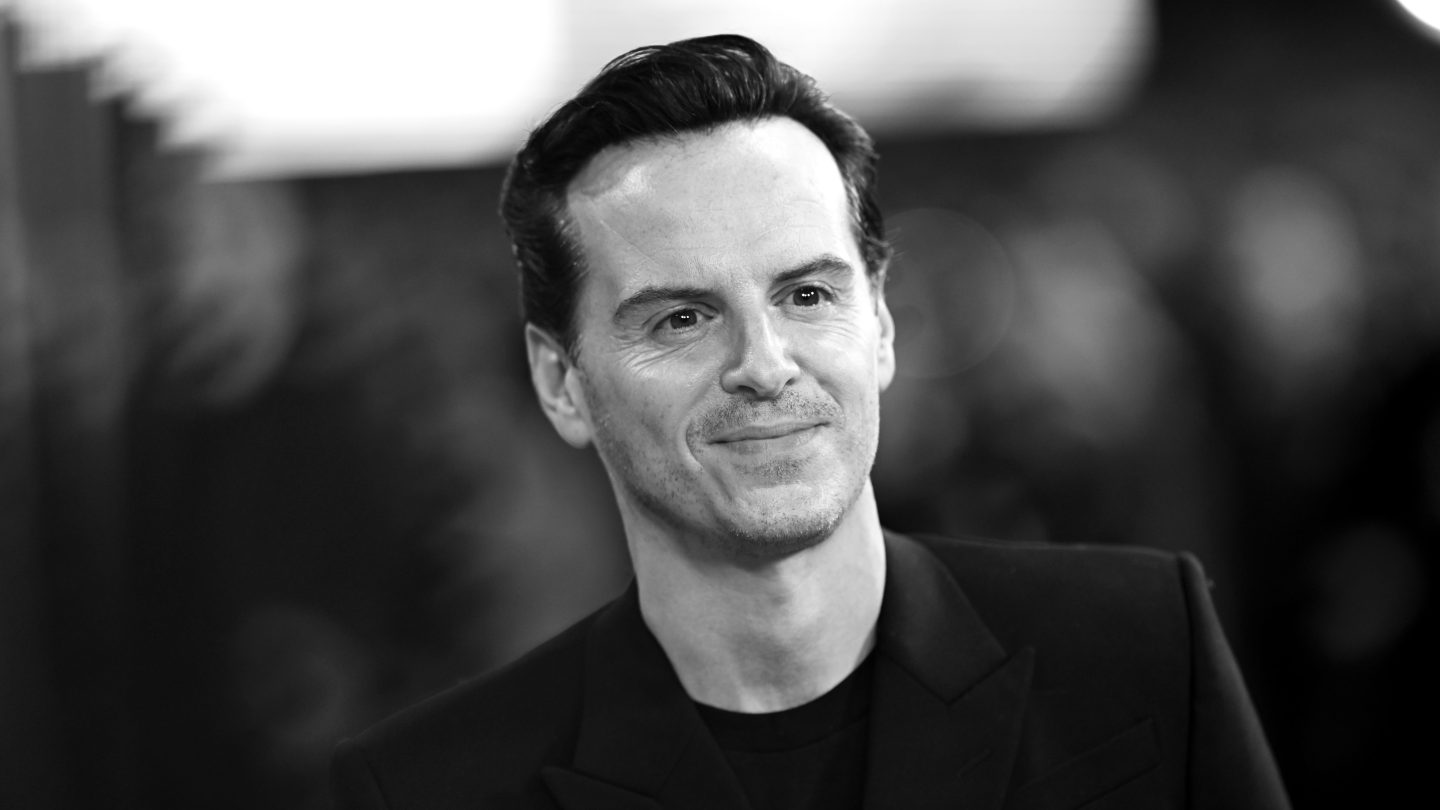
One of the first film roles Andrew Scott ever played, nearly 30 years ago, was “Soldier on the Beach” in Saving Private Ryan. He appeared in the Steven Spielberg drama’s legendary opening sequence, set during the Normandy Invasion at Omaha Beach on D-Day. “I had one line or something, and Tom Hanks rolled over me, and I was very happy to be there,” Scott recalls with a laugh. “It was an extraordinary thing — it was my first time being on a set of that enormity, and I feel very proud that I got to be a tiny part of that. It’s a sequence that’s gone down in movie history.”
Scott has built an impressive career since, between his Olivier-winning stage work and acclaimed performances across film and TV. But it’s something of a full-circle moment to see him back in a D-Day-set film, only this time as the main attraction: In Pressure (in theaters Friday), Scott portrays James Stagg, a meteorologist in the Royal Air Force called in to assess weather patterns for the planned Allied invasion of Europe — and the man ultimately responsible for convincing General Dwight D. Eisenhower (Brendan Fraser) to move the date by a day, amid significant pushback. For all the World War II dramatizations out there, it’s a true, fresh, surprisingly untold story.
Scott’s prickly, tightly controlled performance comes amid an impressive run for the Irish native, who took home the supporting-actor award out of the Berlin Film Festival last year for Richard Linklater’s Blue Moon and earned Golden Globe and Emmy nominations the year prior for his searing turn in Netflix’s Ripley. This is a very different character from those roles, with Stagg committed to his duty and his expertise — uninterested in emitting any kind of sugarcoating or warmth.
“I felt like I understood him — he had the professionalism to push the personal to one side. A lot of great men with great humility, that’s what they’re able to do,” Scott says. “Stagg doesn’t immediately make you feel comfortable, and that was important to me. I found that actually very, very, very challenging. It made me feel for him more rather than less.”
Pressure is directed by Hotel Mumbai’s Anthony Maras, and as adapted with David Haig from the latter’s stage play, it’s structured as a sharp ticking-clock thriller while surprisingly light on its feet with witty dialogue. Stagg and his counterpart, the American meteorologist Irving P. Krick (Chris Messina), present conflicting readings to Eisenhower and his team, with the difference between being right and wrong of enormous consequence — even as they’re ultimately, simply discussing weather patterns and rain forecasts.
“The weather is one of the most powerful influences over our lives — what we wear, where we go on holiday, how we work, how we instigate massive war efforts, huge political sports, events, concerts, just right down to what you’re going to do for your birthday barbecue. We look out constantly,” Scott says. “It’s almost arrogant to assume that the weather is something that we can disregard…. Nature is the biggest ruler of the world.”

Brendan Fraser and Andrew Scott in Pressure.
Alex Bailey/Focus Features/ STUDIOCANAL
Indeed, talking to Scott on an early May afternoon, more than a year since he shot Pressure, it’s clear how strongly the topic remains top of mind. In the film, he describes incredibly complex meteorological readings in a way that is both accurate to the historical scenario and digestible for an audience. He carries the weight of his forecast playing a part in the future of the world order. Most fascinatingly, he embodies Pressure’s punny title by tracing Stagg’s slow-burn emotional arc as if its own volatile weather system. His most wrenching scene, when Stagg receives a devastating personal call but cannot react amid the intense geopolitical stakes, captured this tension.
“I wanted it to correspond to barometric pressure — where with the pressure that he’s feeling and all the other characters are feeling, the more you expel the bigger it gets,” Scott says. “It’s an actor’s thing, isn’t it, to be able to try and convey that feeling, but without trying to express too much emotion? That’s what the name of the game was: What do I do here under this enormously pressurized situation?”
He adds, “In order to enjoy the film, you have to know exactly what psychological stage Stagg is at because he’s the person that we trust. He’s kind of like the James Cagney character — he’s us, in some ways.”
**
Scott says he’s in London “between gigs” as we chat, planning to come to the U.S. for Pressure press with a few more projects on the horizon, including the new film from Oscar winner Justine Triet (Anatomy of a Fall). “I’m a busy boy at the moment, for sure,” he says. “I feel it’s definitely time to regroup and have the sand between my toes for a little while and just make sure that the work life balance is working and all that kind of stuff…. I definitely need a little break this summer. You want to do your best job and you don’t want to make yourself sick. That’s my problem.”
You wouldn’t know the work was wearing on him. This past spring, Scott was a slithery wonder in the new season of The Comeback as the tech-boosting network head who commissions a new sitcom for Valerie Cherish (Lisa Kudrow) to star in, written entirely by AI. With the slightest vocal and physical modulations, he transformed into a chilling corporate weirdo, just slightly off in all the right ways. Scott actually pitched himself for the new iteration of the HBO cult hit. He’s a massive fan of the first two seasons that aired in 2005 and 2014, respectively; Kudrow and co-creator Michael Patrick King came back to him with the juicy supporting role.
“I was just thrilled to be there to watch Lisa do what she does — I genuinely think she’s a comedic genius, and I think that character is completely mesmerizing to watch,” he says.
And how does he feel about being the new face of AI in Hollywood? “Exactly which I’ve always wanted to be,” he cracks. “Dream come true!”

Andrew Scott in the series finale of The Comeback.
Photograph by Erin Simkin/HBO
Pressure isn’t the only big movie that Scott has in the can, either. He recently shot the devilish Christmas release A Place in Hell, opposite Michelle Williams and Daisy Edgar-Jones, and John Crowley’s new movie co-starring Emily Blunt. Then there’s arguably Scott’s most significant cinematic undertaking to date: Simon Stone’s Elsinore, the first film Scott has ever produced. He portrays the iconic Scottish actor Ian Charleson in his final days, as he prepares for his last stage performances as Hamlet while dying of AIDS.
Scott has played one of the more celebrated modern Hamlets on the London stage. He counts Charleson among his great inspirations. As his profile has grown over the last few years, this feels like the role he’s been working toward for his whole career.
“It’s the biggest acting challenge that I’ve ever had, there’s no doubt about it, because there’s the playing of this man who was going through this extraordinary time in his life, and also the Hamlet of it all,” he says. “Theater is a big passion in my life. It was an enormous physical challenge, and a big mental one.” He shares that he recently just watched an early cut of Elsinore: “To be transparent, I’m very excited about it…. I feel very, very, very passionate about it.”
Scott is driven these days by not repeating himself — and everything on that list certainly feels like uncharted territory for him. Take Pressure: Scott has appeared in several war movies between Saving Private Ryan and this one, including the Oscar-winning 1917. Tonally and in subject matter, though, he felt Pressure stood apart: “That sort of specificity was incredibly important to me.”
It helped having an actor like Brendan Fraser as a most unexpected sparring partner. “We come from very different cultures, are very different in stature, and we’ve got very different styles — it’s an unusual juxtaposition of actors in some ways,” Scott says. “And I absolutely loved it.” If there’s one thing Scott has got down, it’s keeping us off balance. This year, in that regard, he’s just getting started.

