


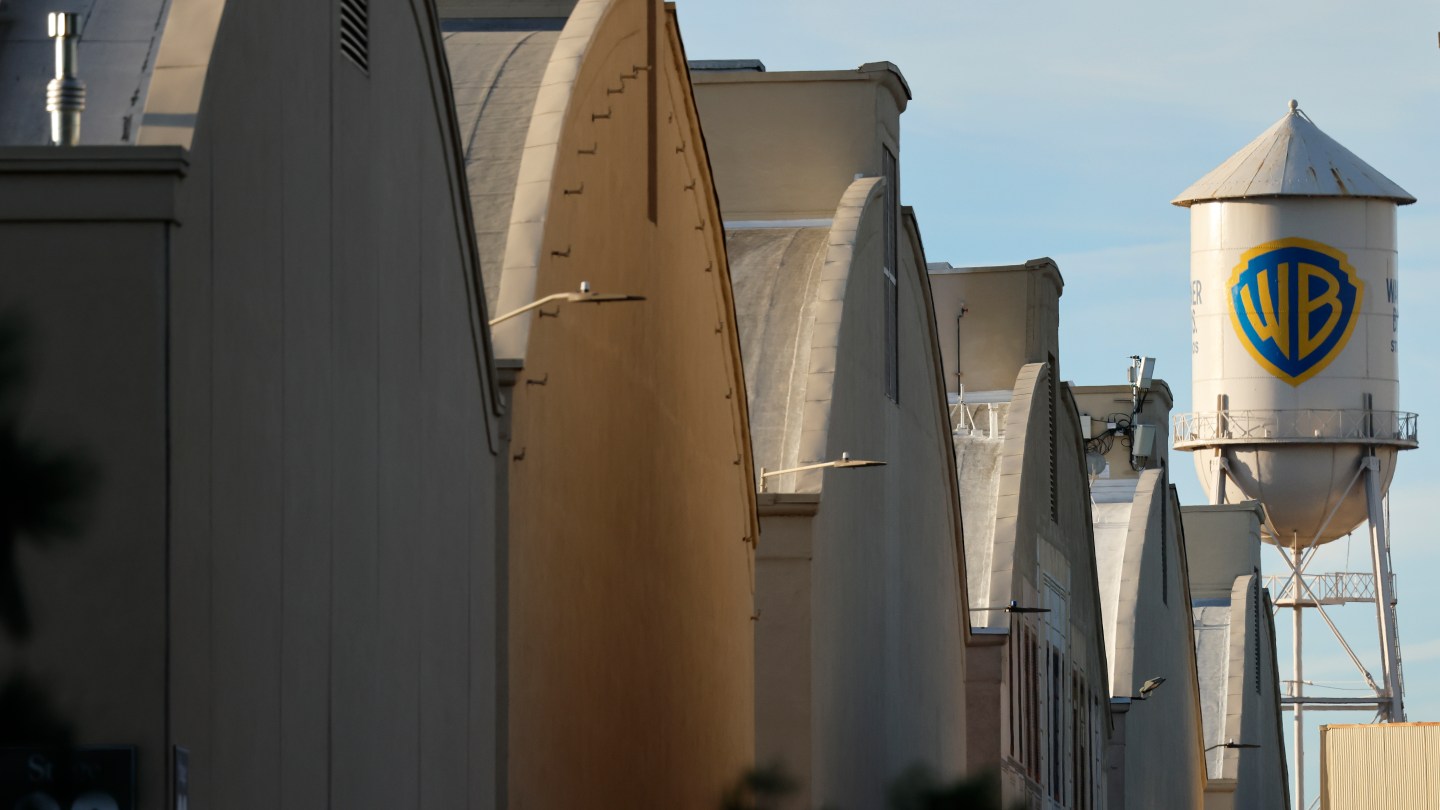
The proposed merger between Paramount and Warner Bros. Discovery is anti-competitive, will lay off thousands of workers, raise prices and create a debt-laden behemoth forced to slash costs aggressively to have any hope of servicing that debt. In short, the math doesn’t work — for anybody.
The combined company would begin life carrying roughly $79 billion in debt while generating only $3 billion in annual free cash flow. The deal is being sold by David Ellison and David Zaslav as a necessary answer to the modern streaming era: more scale, larger libraries, broader distribution and stronger franchises as Star Trek and Top Gun meets Game of Thrones, Superman and Harry Potter.
But scale only works when it is built on a solid financial footing. Scale in this deal will devastate both studios. Here, rather than economies of scale, the opposite would arguably happen. The merger risks producing a company so burdened by debt that it becomes less able to invest in films, television, streaming, sports, output deals and creative talent than either company is on its own. The sole mission of the new company will be to service its debt.
Hollywood has already spent the last decade chasing consolidation. The results haven’t been stellar. When The Walt Disney Company acquired 21st Century Fox in 2019, Disney’s leverage rose to roughly 2.8 times EBITDA (lower is better). When Discovery, Inc. merged with WarnerMedia in 2021, leverage climbed to about 4.3 times EBITDA. Both deals were heavily criticized as over-leveraged at the time. This proposed Paramount–Warner Bros. combination would begin at approximately 6.5 times EBITDA. That is an entirely different level of financial strain. Paramount recently said it plans to lower this to 3 times EBITDA by fiscal 2029, but that seems doubtful given the level of debt and lack of free cashflow.
The timing makes the situation even more concerning. Disney struck its deal when interest rates were low and capital was abundant. Discovery completed its transaction during an era of near-zero Treasury yields. Today’s environment is markedly different. Borrowing costs are materially higher, credit markets are tighter and Paramount’s debt has already been downgraded by two of the three major rating agencies. The company has an enormous short-term bridge loan — approximately $49 billion — that will need to be refinanced in approximately 10 months. That creates a dangerous dependency. If financing conditions worsen, the company could have few options.
The cash demands are enormous. Annual interest expense alone could reach $5 billion–$6 billion on the $79 billion of debt. That’s nearly half of the company’s projected $12 billion EBITDA. Add another $3 billion–$5 billion annually for film and television production, $3 billion–$4 billion for streaming content and technology, and roughly $2 billion–$3 billion in merger integration expenses. I’m not even counting here the massive chunk that the NFL will take when it renegotiates its lucrative sports rights deal with Paramount.
And that is all before meaningful debt repayment, which will become a matter of life-and-death for the company.
As a result, before realizing savings and paying down principal, the company might not be able to service existing debt and might need to go the other way and keep borrowing more and more simply to maintain operations and make interest payments. A plausible path is debt rising from roughly $79 billion at closing to $83 billion – $85 billion within the first year, potentially approaching or exceeding $90 billion within three years, because they cannot pay down principal, and even higher if cost savings arrive slowly or operating conditions weaken. This is the media leverage trap: a company merges to gain scale, but the cost of carrying the debt absorbs the cash flow that scale was supposed to create.
The impact on the industry will be damaging. In a leveraged buy out like this, the first two steps are to fire people and raise prices. With the indebted companies combining, the immediate ramifications will be greater job losses across both studios.
When Disney closed its $71.3 billion acquisition of Fox, there were about $2 billion in synergies. From that, based on the financial models I’ve run, total job losses I’d estimate to be around 14,000. Of those, 4,000 were direct employees and another 10,000-plus we’ll call indirect workers. Those are the people who support or work making films and television. Productions rely on these outside contractors and vendors, gig workers, security, caterers, VFX houses, soundstage owners, below-the-line workers and more.
When Ellison’s Skydance closed on a deal for Shari Redstone’s Paramount Global last August, the companies projected $2 billion in synergies, including 2,000 to 3,500 direct job cuts. That number will increase as Skydance keeps downsizing due to the next merger with Warner Bros.
Paramount’s potential acquisition of Warner Bros. Discovery is projected in public filings to have around $6 billion in synergies. The financial models that I’ve run are projecting 10,000-plus direct employees of the companies and tens of thousands more in indirect workers hit by the fallout of consolidation. And if it turns out that Ellison’s 30-movie-a-year pledge doesn’t work out and the movie theater chains lose product, the job reductions will only increase.
That projected $6 billion in synergies over three years from the Paramount acquisition of WBD is arguably unrealistic. In most leveraged buyouts, the acquirer doesn’t even reach half of the projected numbers. Savings of $6 billion are roughly equivalent to firing 10,000 low and mid-level workers.
Even if they somehow reached the $6 billion in synergies, it would not make a dent in their newly created debt problem. Again, the combined company would carry $79 billion in debt. To state the obvious, for a company the size of Paramount-Warner Bros. Discovery, potentially cutting 10,000 employees itself is a massive number. That’s not “trimming.” That’s cutting deep into operating capacity, nor is it standard and customary cuts and job reduction. At that level, you’re not just lowering costs — you’re inevitably reshaping output, slate size and how the company functions day to day.
Not only is this deal bad for the merging companies, but it creates broader problems for the industry as a whole. The traditional studio model already faces immense pressure from fragmented audiences, rising production costs, declining television economics and an increasingly brutal streaming market. In that environment, balance-sheet flexibility matters more than ever. Companies need room to invest, experiment, absorb failures, and support long-term creative development.
This merger moves in the opposite direction. It would create a company where preserving the capital structure could become more important than investing in the product itself. Fewer films will be greenlit. Fewer creative risks will be taken. Mid-budget productions will disappear. Creative decisions will be replaced with financial calculations designed to maximize short-term cash generation rather than long-term franchise-building or artistic quality.
The result is worse for the consumer and worse for the economy.
When Disney acquired Fox we went from six major studios to five. If the Paramount WBD transaction isn’t blocked, we would go to effectively to four majors, because two of them would be controlled by a single owner. Do we realistically think they will compete with each other? Does going from six to four major studios foster competition, or is it blatantly anticompetitive? The answers are obvious.
Supporters of the deal describe it as a bold attempt to build scale for the streaming era. But scale financed by extreme leverage is not strength. It is fragility disguised as ambition. And when two heavily indebted media companies combine into one even more indebted company, we know how this movie ends: years of massive layoffs, restructuring, reduced production, increased prices for the consumer, and financial retrenchment.
Gulf sovereign wealth funds recently pushed for significantly more attractive economics in exchange for providing needed capital, $24 billion. Now, with preferred pricing, caps on the price they pay, plus warrants provided as a sweetener, foreign sovereign wealth funds could end up owning approximately 50 percent of the two combined premier major studios and be the largest equity stakeholder.
What we’ll see if this deal goes through is fewer buyers for scripts. Fewer films greenlit. Less competition for talent (actors, directors, people). On the back end, a single company controlling a deeper library and two major streaming services — Paramount+ and HBO Max — can decide where titles go, how long they stay in theaters, and who else gets access.
There is an uncomfortable truth in this business that rarely gets said out loud: The company that controls distribution ultimately controls the market. I’ve watched more films succeed or fail in the margins of distribution strategy than in development rooms.
Greenlights matter. Budgets matter. But distribution — the ability to reach audiences at scale, on fair and open terms — is the oxygen of this industry. When a single company gains excessive leverage over theatrical booking, cable carriage, or streaming visibility, the system tilts. And once it tilts, it rarely tilts back.
