


For plenty of moviegoers who’ve now seen The Devil Wears Prada 2, it’s a pleasant exercise in nostalgia. Anne Hathaway and company wear very expensive clothing while again dodging Meryl Streep’s biting remarks, each delivered via her tongue-in-cheek take on Anna Wintour. For journalists, however, this comedy hits a tad too close to home.
Layoffs. Faustian bargains with social media. Whole industries in the hands of ambivalent billionaires. Being forced to book economy … on international flights. These aren’t just plot devices to get the gang back together. These are the realities of working in media in 2026, where the decline of old models demands agility from the legacy companies that want to thrive — while making room for new opportunities, platforms and breakout stars. The Fourth Estate is still flush with power, it’s just more scattered than ever. And that’s not necessarily a bad thing. “New paradigms take time to reveal themselves,” says Puck co-founder and editor-in-chief Jon Kelly. “The media industry has traditionally rewarded safety: playing by the rules, not screwing up and traditional ladder-climbing.”
To be clear, safety is not guaranteed. Broadcast and cable newsrooms work alongside the specter of Brendan Carr, the Trump-friendly FCC chair actively investigating or at least threatening someone new on the daily. And Silicon Valley, which once established clear parameters for digital success thanks to search engine optimization and Facebook favoritism, has AI overhauling the way readers consume news. And hanging on Amy Poehler’s podcast or making doe eyes with Amelia Dimoldenberg over a plate of chicken tenders are equally as appealing opportunities as a magazine cover profile.
But even amid the wild decentralization of power in media, THR‘s survey of its longtime epicenter reveals that New York City remains an unrivaled stronghold — one populated by more stars than ever before. When asked to define what power in journalism means today, those wielding the most influence (and, in some instances, the biggest budgets) offered plenty of different takes. Audience rapport, consumer trust and editorial independence rank among the most popular responses. Some, like A.G. Sulzberger, offered more nuanced analyses. The chair of the New York Times Co. and publisher of the Gray Lady says power is still in the hands of the reporters. “The internet is overflowing with aggregators and commentators, but there are fewer people doing actual original reporting than ever before,” says Sulzberger. “It’s easier to offer a take than to follow the facts or dig for new ones. But reporting is the greatest contribution news organizations make to the public and the essential ingredient that sustains the rest of the media ecosystem.”
Many simply offered jokes — there are quite a few comedians in this space, after all — that, like the Prada sequel, are funny and unnerving in equal measure. Tonight Show host Jimmy Fallon posits that power in media these days is just a matter of “how many times a day the president tweets about you.”
All of their answers are correct, which is why we’ve devoted this list to examining the influence and authority of these power players in a sprawling industry that, even when it makes us fly coach, is still a thrilling — and vital — arena in which to work.
-
Dan Abrams

Image Credit: Dia Dipasupil/Getty Images ABRAMS MEDIA NETWORK
Three decades after breaking out for his coverage of the O.J. Simpson trial on Court TV, the ABC News legal analyst acquired that very channel — folding it into his Law&Crime network in February. One of the most facile entrepreneurs in news media, Abrams hosts and produces the Reelz law enforcement love letter On Patrol: Live, maintains the reins at Mediaite and broadcasts daily on his own SiriusXM show.
Interview I want to book right now “Former FBI director Chris Wray.”
With two free hours in the city, I’d … “Go to the Bronx Zoo with my five-year-old daughter.”
-
Adam Baidawi, Mark Guiducci and Chloe Malle
Image Credit: Photographed by Emma Anderson CONDÉ NAST’S YOUNG GUN EDITORS
The most storied publishing house in American magazines made clear its plans for the future over the past year, entrusting three of its most influential legacy brands to the next-generation trio of Baidawi (GQ), Guiducci (Vanity Fair) and Malle (Vogue). They assumed editorial control of their respective titles and inherited a combined print circulation above 3 million subscribers and a slate of vital events including Men of the Year, the Met Gala and that Oscar afterparty. No pressure!
Interview I want to book right now
BAIDAWI “Ralph Lauren.”
MALLE “Taylor and Travis!”
My dream New York dinner party
GUIDUCCI “Marc Jacobs, Zohran Mamdani, Deeda Blair. Deeda would be smoking Virginia Slims, and Marc would be vaping. I don’t know what the mayor is into, but I’d love to find out.”
-
Drew Barrymore
Image Credit: CBS Media Ventures THE DREW BARRYMORE SHOW
Other syndicated star vehicles are either bowing out (Kelly Clarkson) or getting canned (Sherri Shepherd) but not Barrymore’s. CBS doubled down on her 6-year-old series, which is averaging 1.6 million viewers this season, by renewing her platform for positivity and celebrity pals through the 2027-28 season.
-
Joy Behar, Whoopi Goldberg, Alyssa Farah Griffin, Sara Haines, Sunny Hostin and Ana Navarro
THE VIEW
A leading case for media power in 2026 is pissing off the (far) right people. And few broadcasters court as much ire from Brendan Carr’s FCC as the sextet fronting The View. The chair’s ongoing investigation into whether or not Whoopi, Joy and the gals are beholden to the “Equal Time” rule only bolsters their influence heading into the midterms. And you’re all welcome to your own feelings about their grilling of Cheryl Hines, but that was damn entertaining TV.
Interview I want to book right now
GOLDBERG AND NAVARRO “Pope Leo.”
HOSTIN “A longform, unfiltered conversation with Bad Bunny in Puerto Rico.”
GRIFFIN “Timothée Chalamet.”
My dream New York dinner party
BEHAR “Mel Brooks, Albert Einstein and Gore Vidal.”
HAINES “Jesus, my cousin President John Adams and Tina Fey (for levity).”
Roy Rochlin/Getty Images; Roy Rochlin/Getty Images
-
Hannah Berner and Paige DeSorbo
Image Credit: David Urbanke; Chris White GIGGLY SQUAD
Summer House be damned. These two Bravo alums don’t need reality TV when they’ve got a budding empire. Berner and DeSorbo’s pop culture podcast and YouTube simulcast have courted a devoted audience (north of 50 million downloads), an exclusive advertising pact with ACast and, potentially, a scripted segue care of a deal to star as spoofs of themselves in a Netflix comedy.
Interview I want to book right now
BERNER “Serena Williams”
DESORBO “Anne Hathaway”
My dream New York dinner party
DESORBO “Anna Wintour, Jennifer Lawrence and Sarah Jessica Parker.”
My daily media diet
BERNER “Instagram, trying not to click on Threads and texts from my mom about world events I should know about.”
-
Michael Bloomberg
Image Credit: Kristina Bumphrey/Variety/Getty Images BLOOMBERG L.P.
The patron saint of financial software still owns a majority stake in the data and news outfit that bears his name, but these days he’s lending that name and considerable influence to another arena. Book launches hosted by the former mayor at his Bloomberg Philanthropies townhouse on the Upper East Side are among the hottest invites in town, with fetes for the likes of Bob Iger, Norah O’Donnell and Darren Walker. Watch out, Reese Witherspoon.
-
Rebecca Blumenstein and Cesar Conde
Image Credit: Courtesy of Subject (2) NBCUNIVERSAL NEWS GROUP
With 126 million monthly users across TV, digital and streaming, NBC News is America’s most watched news organization under News Group chair Conde, who notably oversaw the 2025 Nightly News transition from Lester Holt to Tom Llamas. As president of NBC News, editorial, Blumenstein saw her organization’s website overtake CNN’s for the first time ever in February. Their outfit also has emerged from the MSNBC exodus seemingly unscathed.
-
Mika Brzezinski and Joe Scarborough
Image Credit: Courtesy MORNING JOE
Regardless of their network’s name (RIP, MSNBC!), Scarborough and Brzezinski are still one of TV’s most influential forces in politics. Moments after a recent live interview with Iranian foreign minister Abbas Araghchi, the Trump administration again outed themselves as fans by issuing a response. For MS NOW, the couple’s a.m. show ranks as the most downloaded podcast and biggest driver to YouTube, with 227 million views in 2025.
Interview I want to book right now
BRZEZINSKI “Secretary of State Marco Rubio.”
SCARBOROUGH “As always, [Paul] McCartney. It ain’t happening.
Power in media in 2026 is defined by …
BRZEZINSKI “Reach, access, and historic perspective.”
SCARBOROUGH “Being able to separate the signal from the ground noise. (Most of it is ground noise).”
-
Gerry Cardinale and Jeff Zucker
Image Credit: Getty Images (2) REDBIRD
RedBird keeps making major media moves, with founder Cardinale, a private equity kingmaker, playing a key role (along with his company’s $2 billion stake) in Skydance’s acquisition of Paramount — as well as the pending Warner Bros. Discovery merger. Zucker, the former NBCUniversal chair and CNN boss, is making waves of his own. He most recently ushered that $8 billion megadeal between Banijay and All3Media to form what’s been billed as the world’s largest indie media company.
My dream New York dinner party
ZUCKER “Jalen Brunson, Jonathan Groff and Meredith Kopit Levien.”
With two free hours in the city, I’d …
ZUCKER “Go see Ragtime. It’s the best thing on Broadway this season. And maybe in a long time.”
-
Charlamagne tha God
Image Credit: Jamie McCarthy/Getty Images THE BREAKFAST CLUB
Perhaps one of the last truly relevant voices in radio, the Breakfast Club host is a firebrand, a perennial draw for newsmaking interviewers and a tea-slinging gossip. He’s also making bank, recently signing a $200 million contract extension with iHeartMedia and launching plans to turn his Black Effect network into a podcasting giant.
-
Andy Cohen, Stephen Colbert, Jimmy Fallon, Seth Meyers, John Oliver and Jon Stewart
Image Credit: NBC (3); CBS; HBO; Comedy Central NEW YORK’S LAST BOYS OF LATE NIGHT
If late night is dying — or already dead, depending on whom you ask — then why have its players dominated the news cycle for nearly a year? Colbert may be signing off against his will (read his exit interview here), but his New York fraternity remains a strong and entertaining reminder of the First Amendment’s necessity and fragility. And, hey, if David Ellison has yet to meddle with Stewart, maybe things will stay the same when he’s Oliver’s boss as well.
My daily media diet
FALLON “I’m doing Media Paleo right now. So I’m only consuming TV shows that a caveman would have watched.”
My daily screen time average
COHEN “It’s bad. I don’t want to be confronted with this figure.”
FALLON “Not enough. I really need to cut back on the time I spend with my family to get more.”
Power in media in 2026 is defined by …
COHEN “Your ability to tell the truth and not sell out to the current administration.” -
Joanna Coles
Image Credit: Cindy Ord/Getty Images THE DAILY BEAST
Two years into her gig as chief creative and content officer for the Daily Beast, the former Hearst exec has helped stem costs and lift traffic at the IAC-owned outlet while she’s personally leaned heavily into podcasting. She hosts The Daily Beast Podcast and Inside Trump’s Head with Michael Wolff — two of the fastest-growing podcasts on YouTube.
My dream New York dinner party
“Marjorie Taylor Greene, Tucker Carlson and Homer Simpson. All cartoon characters.”
Interview I want to book right now
“Usha Vance. I would love to speak to her not just as the wife of Vice President JD Vance but as the daughter of Radhakrishna and Lakshmi Chilukuri who emigrated from Andhra Pradesh, India in the late 1970s. She has two degrees from Yale, one from Cambridge University and is a former law clerk for Supreme Court Chief Justice John Roberts, so she must have some opinions about President Trump. And if she doesn’t have opinions, does she at least have feelings? And I’d like to inquire how JD’s efforts to convert his wife to Catholicism are going.” -
Mark Consuelos and Kelly Ripa
Image Credit: Dia Dipasupil/Getty Images LIVE WITH KELLY AND MARK
With the No. 1 syndicated talk show for three years running, they are New York’s first couple of entertainment chat. Consuelos and Ripa command an average 2.4 million viewers every day, outpacing the closest competition by more than 60 percent among daytime advertisers’ favored female audience. They remain a must-stop for every A-lister on a press tour and are best friends with basically half of the people on this list.
With two free hours in the city, I’d …
CONSUELOS “Go to a play, but I’d probably have to leave at intermission!”
RIPA “I’m definitely going back to see Death of a Salesman and Fallen Angels, obviously.”
My dream New York dinner party
RIPA “Andy Cohen, Anderson Cooper and Ellen Barkin.” -
Anderson Cooper
Image Credit: Michele Crowe/CBS ANDERSON COOPER 360°
As his longtime home network, CNN, prepares for a likely future under David Ellison’s supersized Paramount-Warner Bros. Discovery, Cooper has the benefit of anchoring the cable network’s most popular program — topping the platform in both total viewers and adults 25-54. At the moment, it’s his professional focus. He ended his two-decade tenure at 60 Minutes in February.
My dream New York dinner party “Stephen Colbert, Barry Diller and Andy Cohen.”
-
Carson Daly, Dylan Dreyer, Savannah Guthrie, Jenna Bush Hager, Sheinelle Jones, Craig Melvin and Al Roker
Image Credit: Photographed by OK McCausland TODAY
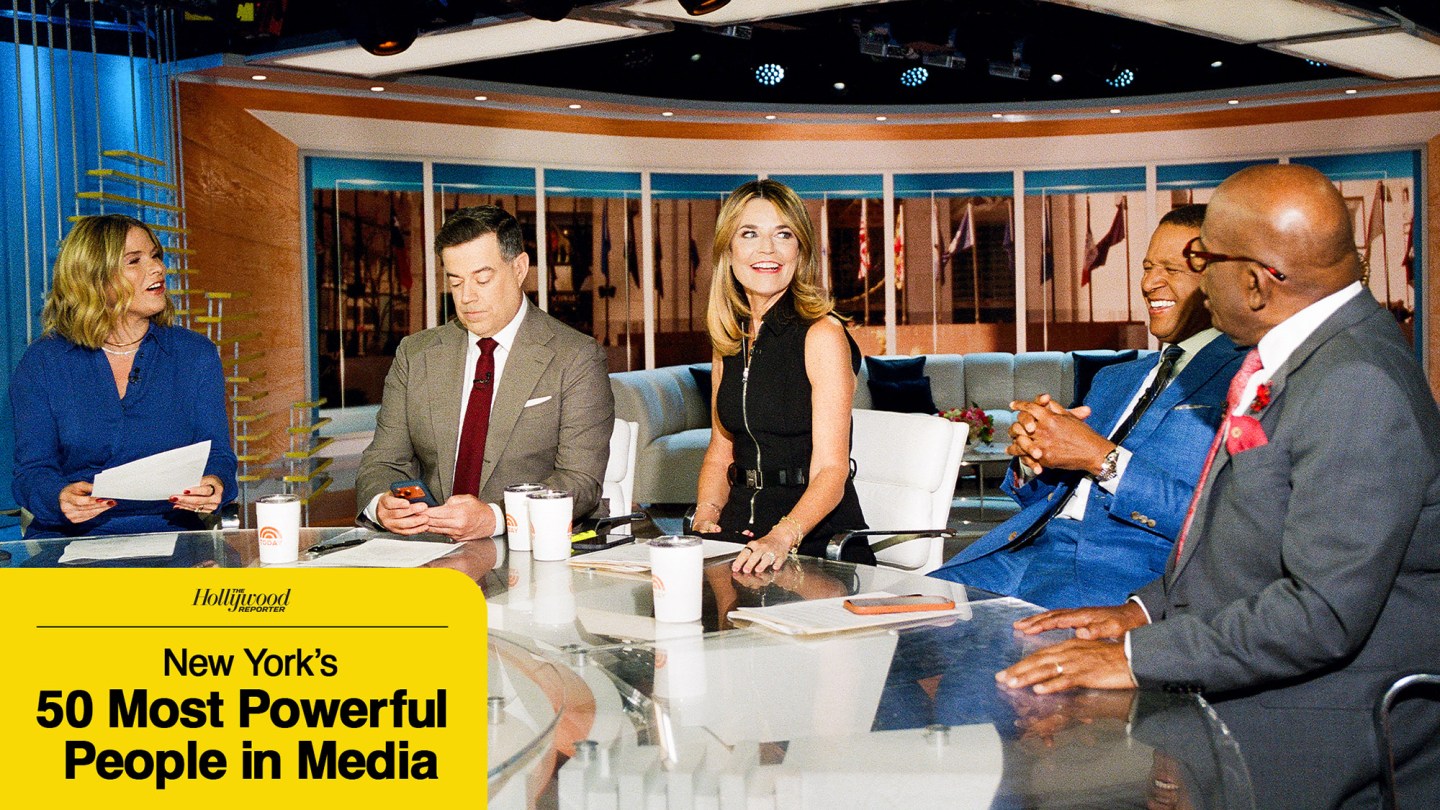
Enjoying its longest winning streak over Good Morning America since 2012 — that’s six months straight in total viewers and adults 25-54 — Today heads into its 75th year on the air with rare audience gains in daytime. But what most distinguished the weekday edition of NBC’s morning flagship is the incredible wagon-circling of its on-air talent when Guthrie, the show’s co-anchor, became the center of international news following the still-unsolved February kidnapping of her mother, Nancy. Daly, Dreyer, Hager, Jones, Melvin, Roker and even former co-host Hoda Kotb helped to fill the void when Guthrie stepped away from the show and welcomed her back during her emotional April return.
With two free hours in the city, I’d …
HAGER “Take a walk downtown … and take a book to a bar (a girl can dream!) until I met friends for a funny dinner at the Odeon.”
Interview I want to book right now
ROKER “Mel Brooks.”
HAGER “I’m like every Swiftie, Taylor always and forever.”
My dream New York dinner party
MELVIN “Shaquille O’Neal, because the conversation would be unlike anything else. He’s very good at pushing my buttons. Darius Rucke, he’s become a friend and it’s always fun to bond over our South Carolina roots. Plus, if he has his guitar, we might be able to get a rendition of “Wagon Wheel.” And my mom, Betty Jo Melvin. She would bring her famous mac and cheese to the table, and that energy is exactly what we need.”
ROKER “Misty Copeland, Mayor Mamdani and Mike Bloomberg.”
-
Barry Diller
Image Credit: Gilbert Flores/Variety/Getty Images PEOPLE INCORPORATED
A titan in transition, Diller released a reflective, revealing memoir in 2025 and, in late April, announced major changes for the holding company he founded 30 years ago. He’s segueing to executive chairman and ceding the CEO role to Neil Vogel as the company focuses on two core areas: People publishing and its stake in MGM Resorts. He’s also dropping the company’s longtime IAC moniker for “People Incorporated” — which definitely does not sound like a 1980s clothing chain.
-
Tony Dokoupil, Tom Llamas and David Muir
Image Credit: Getty Images (3) THE EVENING NEWS ANCHORS
What a difference a year makes. With only the dominant Muir still in place and besting his competition with an average 8.7 million viewers this season, the evening news race mixed it up dramatically in 2025 when Llamas filled Lester Holt’s vacant seat and then again at the top of 2026, when Dokoupil migrated from mornings to evenings mere months after John Dickerson and Maurice DuBois took the roost from Norah O’Donnell. It might sometimes seem like musical chairs, but these three posts remain among the most coveted and seen in all broadcast news.
My dream New York dinner party
LLAMAS “Olivia Dean, Aaron Judge and Conan O’Brien.”
MUIR “Diane Sawyer, Diane Sawyer and a martini.”
With two free hours in the city, I’d …
DOKOUPIL “Visit Central Park’s pine grove [the Arthur Ross Pinetum] and read a book.”
MUIR “See Death of Salesman or Fallen Angels on Broadway again. Both are tour de force performances in very different ways. Highly recommend.”
-
Sam Dolnick, Joe Kahn, Marc Lacy, Meredith Kopit Levien, Carolyn Ryan and A.G. Sulzberger
Image Credit: Getty Images (6) THE NEW YORK TIMES LEADERSHIP
You’re welcome to your own opinions on the opinion page, but, under these six, The New York Times continues to prove itself as the leader in print and digital news. The publication reported adding 1.4 million digital subscribers in 2025, growing the total to 12.8 million, with plans to hit 15 million by the end of 2027. Total revenue in the most recent quarter rose $802.3 million, up 10.4 percent from a year earlier, further widening the gap with operating costs. And where would any of us be without the vast recipe catalog of its Cooking app?
My daily media diet
LACY “I’m scrolling through videos in my spare time to see what’s going viral. I try to be as voracious as I can be.”
SULZBERGER “I spend about two hours a day with The New York Times alone with the hope of engaging with everything we’re publishing. For better and worse, that has become increasingly unrealistic — last year we produced 50,000 articles, 7,000 videos and 1,100 podcasts.”
Power in media in 2026 is defined by …
DOLNICK “Producing something that people seek out without an algorithm.”
LEVIEN “Independence, being uncompromised in the pursuit of truth wherever it may lead, even when it’s to uncomfortable places, even in the face of pressure to do otherwise.”
RYAN “Originality.”
-
Sean Evans
Image Credit: Mat Hayward/Getty Images HOT ONES
Sometimes it’s only a matter of time before Evans’ viral clips of celebrities volunteering to eat spicy chicken wings top 1 million views on his YouTube channel. A recent clip of the band BTS topped 13 million in less than a month. There’s a spinoff, Hot Ones Versus, where co-stars challenge one another to a fiery eat-off, and a whole line of hot sauces and merchandising deals. But the real power in Evans’ brand is in his ability to draw almost any guest he wants, oddly making him this decade’s closest approximation to Barbara Walters.
Interview I want to book right now “Tom Cruise.”
My dream New York dinner party “Derek Jeter, David Chang and Jay-Z”
-
Scott Galloway and Kara Swisher
Image Credit: Dimitrios Kambouris/Getty Images PIVOT
The NYU professor and the first lady of Silicon Valley journalism’s team-up podcast for Vox Media finds them opining on tech, business and politics. And, commercially, it’s a success. But where Galloway and Swisher really distinguish themselves from the many, many, many popular podcasts out there is in who’s listening: Everyone else on this list.
My dream New York dinner party
SWISHER “Tina Brown, Jen Welch and Aminatou Sow and Rachel Maddow. Scott Galloway will be the butler.”
Power in media in 2026 is defined by …
SWISHER “Expertise and reporting, facts and fairness, standards and ethics, refusal to tow the corporate line — same as it ever was. Also, a speaking cameo in The Devil Wears Prada 2. Wait, that would be me.”
-
Greg Gutfeld, Dana Perino, Jessica Tarlov and Jesse Watters
Image Credit: John Lamparski/Getty Images FOX NEWS TALENT
Together, this foursome holds down the most successful show on cable news — and, as individuals, several runners-up. The Five pulls nearly 4 million viewers daily, obliterating the rest of the competition. The No. 2 slot belongs to Watters’ solo vehicle and a not-so-distant No. 4 is Gutfeld’s hour. Perino also co-anchors America’s Newsroom, and, for her part, Fox News’ most powerful liberal voice moonlights as a podcaster with the abovementioned Professor Galloway on Raging Moderates.
My dream New York dinner party
PERINO “My husband, Peter McMahon, Paul Mauro and his wife, Joan McNaughton.”
Interview I want to book right now
GUTFELD “Either Azealia Banks or Clive Owen.”
WATTERS “Dude 44 Bravo, the pilot that was shot down and rescued in Iran.”
With two free hours in the city, I’d …
TARLOV “Go to Arthur Avenue to food shop.”
-
Sarah Harrelson
Image Credit: Jeremy Liebman CULTURED MAG
Founding a print magazine in the second decade of the 21st century is not for the faint of heart, but Harrelson has made an outsized impression with Cultured Mag. She’s courted a mix of established and up-and-coming talent and leaned into events in a way that makes people feel butt-hurt if they’re left off the guest list. The third annual CULT100 was celebrated at the Guggenheim at the end of April.
With two free hours in the city, I’d … “Go to Raphael at the Met or KuKu Spa in the East Village.”
Power in media in 2026 is defined by … “A paradoxical mix of speed and discernment”
-
David Haskell
Image Credit: Jamie McCarthy/Getty Images NEW YORK MAGAZINE
As editor-in-chief of the beloved biweekly, Haskell also oversees a digital portfolio that includes Intelligencer, The Cut, Vulture, The Strategist, Curbed and Grub Street, as well as many newsletters and podcasts. The magazine, which won the George Polk Award in photojournalism in 2026, continues to regularly churn out viral features — many of them ultimately landing on film and TV. (See Netflix’s Inventing Anna and The Watcher and Gloria Sanchez Productions’ Hustlers.)
Interview I want to book right now “Ghislaine Maxwell. We have been overwhelmed with Epstein coverage this year — and, at the same time, we are obviously still in the dark about so much..”
My dream New York dinner party “I’m always curious what it’s like to live a rich, interesting life and be a famous person’s mother. So I’d invite Mira Nair, Laurie Simmons and Nicole Flender.”
Astrid Stawiarz/Getty Images
-
Almin Karamehmedovic and Debra OConnell
Image Credit: Matt Winkelmeyer/GA/The Hollywood Reporter/Getty Images ABC NEWS
OConnell is going Hollywood, recently being named chair of Disney Entertainment TV in the parent company’s leadership reset. But the New York-based exec still oversees ABC News, where president Karamehmedovic presides over the most watched evening news telecast, the ever-competitive Good Morning America, the No. 1 Sunday public affairs program in This Week With George Stephanopoulos and the dominant Friday newsmagazine 20/20. In his spare time, he also oversees a slew of digital titles populating Disney’s streaming efforts.
My daily media diet
KARAMEHMEDOVIC “A mix of global headlines, real-time feeds, and longform when I can find the time… plus a lot of direct reporting from our teams. Nothing replaces original journalism.”
With two free hours in the city, I’d …
KARAMEHMEDOVIC “Walk the West Side, stop by the newsroom, and grab a quick coffee somewhere quiet. That’s as close to unplugging as it gets.”
-
Jon Kelly
Image Credit: Bryan Bedder/Getty Images PUCK
The newsletter boom may ultimately be a bust for some, but Kelly’s Puck appears especially well-positioned — catering to multiple niches (finance, politics, fashion, Hollywood) with a devoted number of subscribers and offering equity to its celebrity journo employees. In October, Puck eliminated some of the competition by acquiring one of the most high-profile newsletters to date in Graydon Carter’s Air Mail. (Carter’s subscribers were a welcome addition to Puck, but, much to his chagrin, Kelly’s former Vanity Fair mentor, was not.)
Interview I want to book right now “Kash Patel.”
With two free hours in the city, I’d … “If I couldn’t get Knicks playoff tickets, I’d want to visit Dalí: The Great Years, 1929-1939 at Di Donna Galleries on Madison. Or actually, just get a table at Hillstone’s and order the spinach artichoke dip.”
-
Megyn Kelly
Image Credit: Dimitrios Kambouris/Getty Images THE MEGYN KELLY SHOW
Sometimes it’s hard to pinpoint what audience the shape-shifting Kelly is targeting these days, but her brand of increasingly far-right opinion certainly has found one. Her video podcast has 4.2 million subscribers on YouTube, she boasts 1.9 million followers on Instagram and, via her new deal with SiriusXM, she’s got her own radio channel. That means you can now listen to her rational, calmly delivered takes in rental cars.
-
Gayle King
Image Credit: Michele Crowe/CBS News CBS NEWS
With all the change at CBS News being instituted by new editor-in-chief Bari Weiss, King has emerged as the unlikely and much-needed constant. Amid massive speculation about her future — some outlets prematurely announced she was leaving at the end of her most recent deal — King, who also serves as Oprah Daily Editor-at-Large, signed a new deal in March to stay put at the outfit and her CBS Mornings post. It was a major win for Weiss and David Ellison.
With two free hours in the city, I’d … “Go to a movie theater. I still like watching movies on the big screen, in the dark and uninterrupted.”
My dream New York dinner party “Chris Rock, Sarah Jessica Parker and Lin Manuel Miranda.”
-
Ezra Klein
Image Credit: Winni Wintermeyer/Guardian/eyevine/Redux She’s not about to weigh in on the filibuster, and you won’t see her hustling down the Promenade at the World Economic Forum, but Pema Chödrön, the 89-year-old Tibetan Buddhist nun, teacher and author, nonetheless has come to exercise a certain indirect sway on the American liberal elite.
The vector of her influence is Ezra Klein, the New York Times podcast host and op-ed columnist. A devoted practitioner of Buddhist meditation, Klein, 41, lately has been immersed in Chödrön’s work, in particular her 2002 book, Comfortable With Uncertainty: 108 Teachings on Cultivating Fearlessness and Compassion, which he has read several times in the past year. A hint of his approach as a journalist is right there on page 1: “May we dwell in the great equanimity, free from passion, aggression, and prejudice,” goes part of the Buddhist prayer, known as the Four Immeasurables, that serves as the book’s epigraph.
-
Rebecca Kutler
Image Credit: Courtesy MS NOW
When Comcast cut off its news division’s left hand to buy Peacock a little more time, MSNBC went with Versant and rebranded as MS NOW. With the exception of khaki-clad statistics nerd Steve Kornacki, network president Kutler retained all major talent. Her primetime lineup of Chris Hayes, Rachel Maddow, Jen Psaki and Lawrence O’Donnell may trail Fox News but, with an average 1.4 million viewers, still manages to topple CNN. And, as always, the coming midterms will likely be a boon to the liberal-skewing outlet.
My dream New York dinner party “My three kids. They are teenagers, and in between their sports and social activities, it’s nearly impossible to get us all around the same table at the same time.”
Power in media in 2026 is defined by … “Listening. We are successful when we listen to our audience.”
-
Peter Lattman
Image Credit: Larry Busacca/Getty Images EMERSON COLLECTIVE
Emerson Collective’s vice chair and managing director of media oversees investments and grants in media and journalism and serves on the boards of both the American Journalism Project and the Committee to Protect Journalists — important stuff given the current climate. But what makes the former reporter even more compelling is his seat as vice chair of The Atlantic — making him New York’s link to the influential D.C. monthly.
With two free hours in the city, I’d … “Visit the gargantuan new JPMorgan Chase tower at 270 Park Ave. and ask a friend who works there to show me around.”
My dream New York dinner party “John McEnroe, Paul Simon and Ralph Lauren. (Can I bring my wife too?)”
-
Roger Lynch, David Remnick and Anna Wintour
Image Credit: Getty Images (3) CONDé NAST LEADERSHIP
Taking an ever-so-small step back from Vogue in September — like, really small … she just graced its cover alongside Meryl Streep and hasn’t switched offices — Wintour’s primary focus is as the publishing house’s chief content officer. Alongside New Yorker editor Remnick (his is the only title she does not have some say in), the two are the creative stewards of CEO Lynch’s house of magazines that is now more brands than mere publications.
-
Rachel Maddow
Image Credit: Charles Sykes/Bravo/Getty Images THE RACHEL MADDOW SHOW
One of the only Americans still capable of both calming the struggling left and sending them into anxiety spirals in the same hour, Maddow’s position at MS NOW is a unique one. She has the only non-Fox News program in all of cable news to crack the top 10 — she does that with roughly 2.3 million viewers — and a deal that gives her more leeway than just about anybody in broadcasting. She often only tapes once a week, allowing her time to focus on burgeoning producing and podcasting efforts as well as a steady drumbeat of books.
Interview I want to book right now “Whoever told The Wall Street Journal that they have to keep the president out of the situation room because he’s too much of a mess.”
My daily media diet “A gigantic 60-page news note from my producers and everything else I can squeeze into my head.”
-
Lorne Michaels
Image Credit: Photo by Dia Dipasupil/Getty Images SATURDAY NIGHT LIVE
One of the most powerful people in New York, full stop, Michaels remains a particularly fascinating figure in media thanks to his enduring post atop Saturday Night Live — NBC’s highest-rated entertainment program and the nation’s home for political satire. He continues to moonlight by producing Jimmy Fallon’s Tonight Show and Seth Meyers’ more current events-focused Late Night. (For some insights into the famously inscrutable impresario, check out Morgan Neville’s new documentary about him.)
-
Sara Moonves
Image Credit: Stephanie Augello/WWD/Getty Images Sara Moonves loves to tell the story of how Brad Pitt split open the back of a pair of too-tight Celine pants and then did the rest of his W Magazine photo shoot with his butt out.
Pitt had been determined to squeeze into a sample-size pair of ultra-slim houndstooth trousers while posing as one of the nine cover stars for the venerated fashion magazine’s January 2020 Best Performances Issue. And Moonves, then 34 and newly appointed as the first woman editor-in-chief in the brand’s history, as well as the youngest person in that role — and, at the time, the youngest EIC of any fashion magazine by about a decade — had been afraid of insulting Pitt by suggesting that he might not fit in them.
But when the pants inevitably cracked down the seam and, well, nearly exposed his crack, she says, laughing, “It was, like, the best day of everyone’s life.”
-
Keith Poole and Emma Tucker
Image Credit: Getty Images (2) THE NEWS CORP NEWSMAKERS
Like the stars of a Murdoch-owned Patty Duke Show, Poole (The New York Post) and Tucker (The Wall Street Journal) are so alike yet … so very different. Tucker, WSJ editor-in-chief since 2023, has grown digital subscriptions by a third in her tenure — hitting 4.3 million. She’s also bolstered the daily’s reputation among the media set. Poole, whose publication caters to a less highbrow but extremely engaged online audience, recently shifted his focus west. He launched the California Post in January after dubbing the state “a news desert.” You sure know how to sweet talk a state, Keith!
-
Kareem Rahma
Image Credit: Bryan Bedder/Getty Images SUBWAYTAKES
Another playful, post-millennial riff on the talk show, SubwayTakes sees Rahma tackle man-on-the-street-style interviews — only underground. His brief encounters are biggest on Instagram (2 million followers), but he thrives on TikTok (1.3 million followers) and YouTube (900,000 followers) as well. He frequently offers up extended versions of his interviews with public figures on a podcast.
Interview I want to book right now “Ben Affleck.”
With two free hours in the city, I’d … “Go to Nitehawk Cinema”
-
Robin Roberts, George Stephanopoulos and Michael Strahan
Image Credit: Michael Loccisano/Getty Images GOOD MORNING AMERICA
Good Morning America and Today are so evenly matched these days that the ratings horse race of yore may seem like a silly pursuit, but the minor weekly back-and-forth only showcases how devoted so many people are to the dueling morning shows. Roberts, Stephanopoulos and Strahan are compelling on-air stewards to the ABC News flagship, pulling in just shy of 3 million daily viewers. On Sundays, Stephanopoulos boasts This Week on the network, while, come NFL season, Strahan works as a studio analyst for Fox.
My dream New York dinner party
ROBERTS “Mariska Hargitay, Michael B. Jordan and Leslie Jones.”
My daily media diet
STEPHANOPOULOS “NYT, WSJ, FT, CNBC, Bloomberg, Slate, Drudge, John Ellis’ News Items, The Atlantic, Rod Dreher.”
ROBERTS “World News Tonight with David Muir”
With two free hours in the city, I’d …
STRAHAN “Take a walk in Central Park. It’s great for clearing your head and people-watching. You can also blend in, which is nice.”
-
Matt Rogers and Bowen Yang
Image Credit: Griffin Nagel/Bravo LAS CULTURISTAS
As their comedy and acting careers have climbed, Rogers and Yang (the latter only just departed Saturday Night Live after seven seasons in December) were smart to keep their side gig. Las Culturistas is now its own cultural phenomenon, welcoming a parade of A-list guests like Lena Dunham, Hilary Duff, Nicole Kidman and Laura Dern, who all have stopped by in recent months. Renewing their exclusive podcasting partnership with iHeartMedia and Will Ferrell’s Big Money Players Podcast Network in March, they’ve also secured another TV deal with Bravo and Peacock for the awards show they continue to make up as they go along.
My daily media diet
YANG “A firehose of ads disguised as notifications.”
Interview I want to book right now
YANG “Celine Dion. I’ll retire and disappear afterwards in case that motivates any of my enemies.”
ROGERS “Facetiously, Cher, because can you imagine? But also genuinely, Cher. Because can you imagine?”
Power in media in 2026 is defined by …
ROGERS “How well you answer this very question, which is really nerve-racking: How did I do, on a scale of Alix Earle to David Ellison?”
YANG “Proximity to Celine Dion”
-
Andrew Schulz
Image Credit: Theo Wargo/Getty Images COMEDIAN & PODCASTER
A successful stand-up and actor, Schulz’s real power resides in the fact that he’s the lone “podcast bro” who operates out of New York. And, despite the fact that he’ll never admit that he, Theo Von and Joe Rogen softened Trump’s hard edges with pre-2024 election appearances on their respective podcasts, isn’t that what power does? Schulz, who boasts 4.5 million Instagram followers and anchors the Flagrant podcast, has since pulled a 180 on the president — meaning his interview choices will be just as closely followed in the future.
My daily media diet “Trying decide if every single post I look at is real or AI. Trying to decide if the trends on the internet are genuine or astroturfed with bots and clip-farm armies.”
My dream New York dinner party “Two experts in their respective fields that are great story tellers and a host that likes wine and doesn’t have a bedtime.”
-
Suzanne Scott and Jay Wallace
Image Credit: Fox Corporation FOX NEWS
There may be no more powerful posts in television news than those of Fox News CEO Scott and president Wallace. Their channel, which largely sets the national political discussion as the top-rated cable network for what now feels like time immemorial, is also just one of the only dominant things left in linear programming. Fox News ended April as the second-most-watched channel in primetime in all of American TV, trailing only CBS. That means more people were tuned in to Fox News than NBC or ABC, Monday through Friday. It’s also worth noting that, since taking the reins, Scott has stewarded the Fox News push into digital that’s helped lure younger audiences and, via various brand expansions, a reported deliver $500 million in non-cable revenue.
Interview I want (our networks) to book right now
SCOTT “The US Airmen rescued in Iran.”
With two free hours in the city, I’d …
WALLACE “Boating — as a passenger — around lower Manhattan never gets old: the city skylines, the bridges and the sound of lapping waves in exchange [for] the sound of horns, construction and yelling.”
My daily media diet
SCOTT “While I’m listening to our live broadcasts, I spend an hour on my drive into the office getting ‘read in’ via mobile devices before our morning editorial. Weekend mornings is much the same list at home or where traveling. My daily diet starts with: All FOX News Media platforms — this includes FOX News Channel, FOX Business Network, FOX News Digital, FOX Weather and FOX News Audio. The Wall Street Journal, The New York Post, The New York Times and curated and diverse list of X feeds and creators. Then I look at wide and diverse content based on news of the day and specific stories of interest. In the middle of this reading and absorbing information, I play FOX Games and Wordle. And if it’s tennis season, I check out the match scores of my favorite players.”
-
Ben Smith
Image Credit: Michael A. McCoy/Getty Images SEMAFOR
In the three years since Smith co-founded the news website, the editor-in-chief has made it a preferred destination for media connoisseurs, launched Middle East vertical Semafor Gulf and fostered a reputation for breaking stories that many larger, deeper-pocketed organizations miss. Not that its pockets are shallow. The company closed $30 million in new financing at the top of 2026, coinciding with news that it reached a full year of profitability with plans to further expand edit and grow its annual Semafor World Economy platform.
Interview I want to book right now “J.D. Vance.”
With two free hours in the city, I’d … “Go to Rockefeller Center, it’s so nice now!”
-
Stephen A. Smith
Image Credit: Savion Washington/Getty Images ESPN
Maybe he’ll run for president. Maybe he just loves to run his mouth. Actually, Smith really does love to talk. But for the verbose ESPN personality, his mouth is worth a lot of money. His protracted contract negotiations with the Disney-owned sports network saw him sign a new five-year pact in 2025 — one worth more than $100 million. (He knows how much money presidents are paid, right?) The new deal, which took a page out of the Maddow playbook, allows him to scale back on his screen time, but he can still be seen on First Take every morning.
My dream New York dinner party “Barack Obama, Oprah Winfrey and Jay Z”
Power in media in 2026 is defined by … “Personalities and social media; one’s authenticity and their ability to move culture in real time.”
-
Andrew Ross Sorkin
Image Credit: Mike Coppola/Getty Images CNBC/THE NEW YORK TIMES
Sorkin must not have much need for sleep. The co-anchor of CNBC’s Squawk Box and a financial columnist at The New York Times, his DealBook newsletter is a must-read across industries. Guiding the newspaper’s DealBook Summit, he’s made it one of the brand’s flagship events. And when his byline isn’t appearing in the Times, it’s showing up on the best-seller list. 1929, his follow-up to the hugely successful Too Big to Fail, is in its sixth month on the hardcover nonfiction charts.
Power in media in 2026 is defined by …
“Trust. Everyone has distribution now; trust is the reason the audience comes back.”
-
Emily Sundberg
Image Credit: Neilson Barnard/Getty Images FEED ME
A chronicler and subject of the media, Sundberg is arguably the most popular Substacker and sought-after party guest working in New York media right now. Feed Me, her daily newsletter “about the spirit of enterprise” that melds analysis, strong voice and helpful aggregation, has made her a kind of press industry darling that recalls peak Gawker. If you don’t know her, odds are you want to.
Interview I want to book right now “Talking to Michael Bloomberg about his fish tanks.”
Power in media in 2026 is defined by … “How much fun you’re having. Hard to compete with people having more fun than you.”
-
Mark Thompson
Image Credit: Ben Gabbe/Getty Images CNN
Listen, Thompson’s two and a half years at CNN have not exactly been a dream. He inherited a struggling brand from an unqualified predecessor, oversaw the history-altering Biden-Trump debate as one of his first big initiatives, and now the former president of the New York Times Co. has to deal with a new boss in David Ellison, whose acquisition of Warner Bros. Discovery doesn’t have anybody particularly high on the No. 3 cable news network’s prospects. But he’s been nimble, shifting the brand’s digital strategy and reviving prestige unscripted and documentary. And his future boss has said his channel will remain independent.
-
Robert Thomson
Image Credit: PATRICK T. FALLON/AFP/Getty Images NEWS CORP
As CEO of News Corp, Thomson commands a portfolio that includes such media assets as Dow Jones & Co. (which publishes The Wall Street Journal), News UK (which publishes The Sun and The Times), HarperCollins and the California Post … which has brought the cool, refreshing waters of journalism to our parched news desert.
-
Pablo S. Torre
Image Credit: Alberto Rodriguez/Variety/Getty Images PABLO TORRE FINDS OUT
Since shifting from ESPN to Dan Le Batard’s Meadowlark Media in 2023, one of the fresher voices in sports media has built a new podcast in Pablo Torre Finds Out, which boasts a video subscriber base of 230,000, recently joined The Athletic and fortified his reputation for breaking news. In September, he dropped an exclusive report that Los Angeles Clippers owner Steve Ballmer circumvented the NBA salary cap for small forward Kawhi Leonard — prompting a league investigation. (That piece just won Torre the Pulitzer Prize in Audio Reporting.)
My daily media diet “Scrolling the platform formerly known as Twitter despite absolutely knowing better.”
With two free hours in the city, I’d … “[Go to] the Tropic Zone at the Central Park Zoo.”
-
Bari Weiss
Image Credit: Noam Galai/Getty Images CBS NEWS
The current wild card of broadcast news — perhaps all of news media — is The Free Press founder, handpicked by David Ellison to reinvent CBS News as its new editor-in-chief. Viewed as a Trump-friendly pivot for the platform, her arrival, which included a clear vision, has been punctuated by tumult (see the aforementioned evening news shake-up and the diminished ratings that have followed), layoffs, resignations and rampant speculation of an impending shake-up at 60 Minutes. If Weiss can get some her ducks in a row before the Warner Bros. Discovery acquisition, perhaps the corporate pressure will shift elsewhere.
Interview I want to book right now “Xi Jinping. John Roberts. Mojtaba Khamenei and Ghislane Maxwell”
Power in media in 2026 is defined by … “Trust. Power belongs to whoever can look the audience in the eye and say: we’ll give you a fair shake, we respect you, we’re not going to lie to you. And then proving it, story after story.”
-
Jennifer Welch
Image Credit: Theo Wargo/Getty Images I’VE HAD IT
Many progressives have “had it” with President Trump and the perceived lackluster response of the Democratic Party, but Welch (alongside co-host Angie Sullivan) created a successful podcast out it. The former Bravo star has quickly made a name for herself as one of the city’s most high-profile leftists, courting 1.2 million Instagram followers and drawing the likes of Barack Obama, Elizabeth Warren and Alexandria Ocasio-Cortez for interviews. Her book, Not Today, Fascists, is out in October.
My daily media diet “Zeteo, Drop Site News and a personally curated list of journalists and political influencers I follow on Twitter.”
My dream New York dinner party “Zohran Mamdani, AOC and Letitia James.”
-
Ziwe
Image Credit: Dia Dipasupil/Getty Images ZIWE
“What’s your favorite subway stop to stop and frisk?” Ziwe has been baiting celebrities and fellow comedians with her satirical interviews for years, but she may have hit the apex of her power when she persuaded outgoing Mayor Eric Adams to sit down for a chat that played out like Frost-Nixon as an SNL sketch. It again proved that she is one of the most compelling conversationalists online. And if you weren’t among the 676,000 to tune in to YouTube alone, Adams’ answer to that question was “All of them.”
With two free hours in the city, I’d … “Go to the New York Public Library.”
My dream New York dinner party “Ida B. Wells, Toni Morrison and Beyoncé.”
METHODOLOGY We considered myriad variables and data in determining who made this year’s list: ratings, readership, listeners, revenue generated, acquisitions, stories broken, social followers, deals, awards, subscriber counts, spending power and leadership among them. Most importantly, they have to reside in the tri-state area. (Apologies to Tucker Carlson, who opts to spend his time in Maine.)
This story appeared in the May 6 issue of The Hollywood Reporter magazine. Click here to subscribe.


