


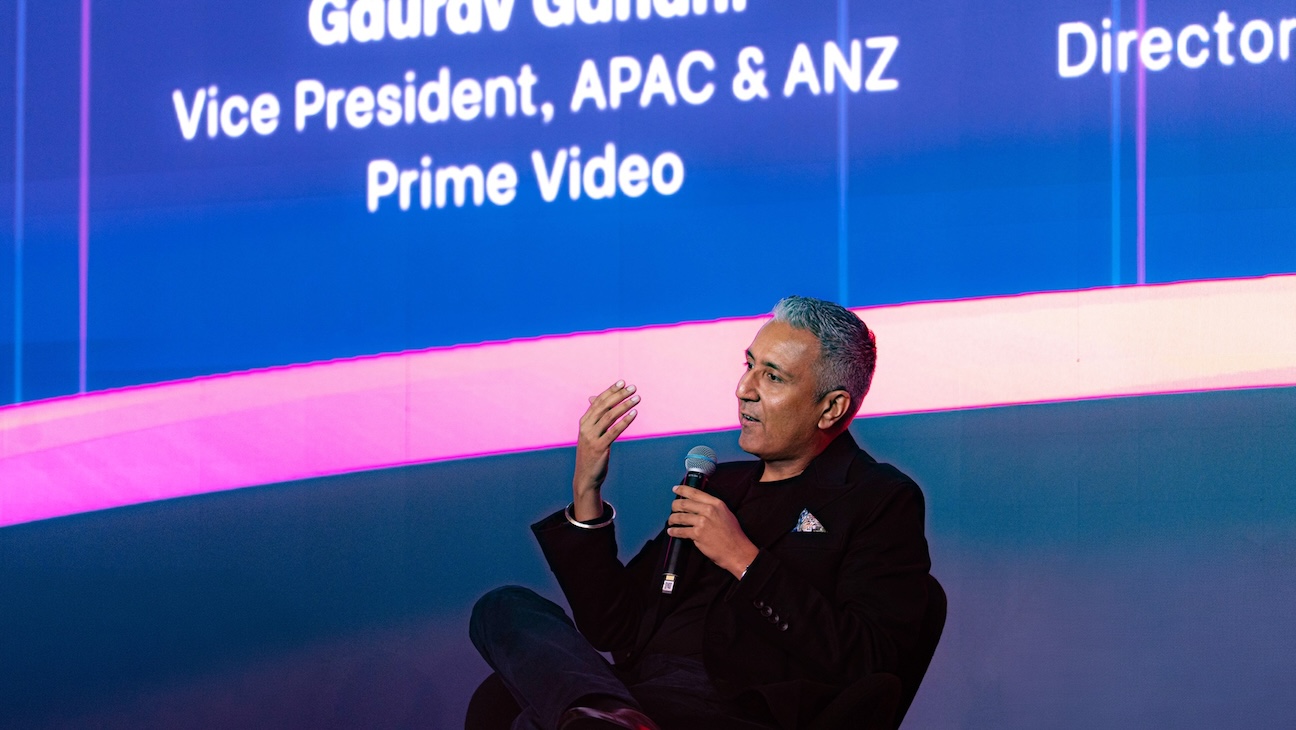
Amazon’s Prime Video used the APOS media conference in Bali to argue that the future of streaming in the Asia-Pacific region lies not in a single subscription but in an “entertainment hub” — a one-stop platform tying together its originals, partner channels, rentals and add-on subscriptions behind a single log-in. The vision, shared by the company’s regional leadership in a session titled “The APAC Playbook: How Prime Video Is Shaping Streaming’s Future,” follows the broader industry transition away from stand-alone apps toward aggregation and bundling, which has been a recurring theme throughout APOS this week.
Speaking alongside Media Partners Asia’s Vivek Couto, Gaurav Gandhi, Prime Video’s vice president for Asia-Pacific, Australia and New Zealand, framed the region as a patchwork that precludes any single approach.
“We operate a common business model, but we cannot have a common playbook for a diverse region like APAC,” he said. Across its core Asian markets, he added, just two things stay consistent: the service operates within Amazon’s Prime membership program, and it runs as a hub, layering add-on subscriptions and transactional rentals on top of the core subscription tier.
The hub, as Gandhi described it, is a push for scale on both sides of the transaction, with customers getting the “widest selection” through one app and one billing relationship, and content partners gaining distribution and a massive audience without having to build their own tech and payments stack. Prime Video now works with more than 600 content partners worldwide, he said, including 70-plus in Japan, 50-plus in Australia and 30-plus in India, many of which treat the platform as a primary route to market.
Prime’s strategy, which isn’t particularly new, nonetheless meets a moment when the streaming business across Asia is maturing, pushing players of every size toward bundling and aggregation rather than the head-to-head fight for subscribers that characterized the first phase of the streaming wars. The strategy has emerged as especially necessary given the crowded nature of the region’s developed markets, and the low-margin realities of the rest. Viu and iQIYI International unveiled a Southeast Asian bundle at APOS this week, and Disney+ teamed up with CJ ENM’s Tving in Japan late last year. Amazon, meanwhile, is seeking to cast itself as a central aggregator that others can simply plug into.
The strategy is most developed in India, Prime Video’s largest Asian market, where the company is folding a free, ad-supported tier into its paid service. Through its integration of Amazon MX Player, Prime Video now bills itself as India’s largest streaming service for exclusive originals, marrying its premium subscriber base with MX Player’s free reach — a combination it is selling to creators and advertisers as scale that only Reliance’s JioStar can realistically rival.
Shilangi Mukherji, who heads Prime Video India’s subscription business, marked the service’s 10 years in the country at APOS by highlighting the company’s multilingual, originals-first approach. More than 60 percent of its customers stream in four or more languages, and the platform programs in 10, with deep investment in Hindi, Tamil and Telugu, she said. India is now home to the largest slate of Prime Video originals outside the United States, she added, with 60 percent of its series renewed for further seasons, more than 100 titles launched and another 100-plus in the pipeline.
Mukherji also cited the recent arrival of Amazon MGM Studios’ local operations and rising demand for the platform’s movie rentals as evidence that Indian viewers are increasingly willing to pay for premium cinema at home.
In Japan, Prime Video’s second-largest APAC market, also marking a decade on the platform, country manager Keisuke Oishi recalled having to build a subscription-streaming habit almost from scratch in 2015, in a market still anchored to free-to-air television.
“We had to establish an entirely new category of subscription video,” he said, “in a locale where most of the customers were on free-to-air TV.”
Prime Video Japan has since broadened across four content pillars — anime, scripted entertainment, unscripted programming and live sports — among them a live boxing business that launched in 2022 and has grown to 15 events, plus a slate of manga adaptations that have connected with local audiences.
Gandhi described the Asia-Pacific region as central to Prime Video’s global plans — not just “a key driver of growth,” but a market where new ideas are generated, such as India’s tiered and mobile-first plans and its multilingual programming, some of which could eventually be rolled out elsewhere.

