


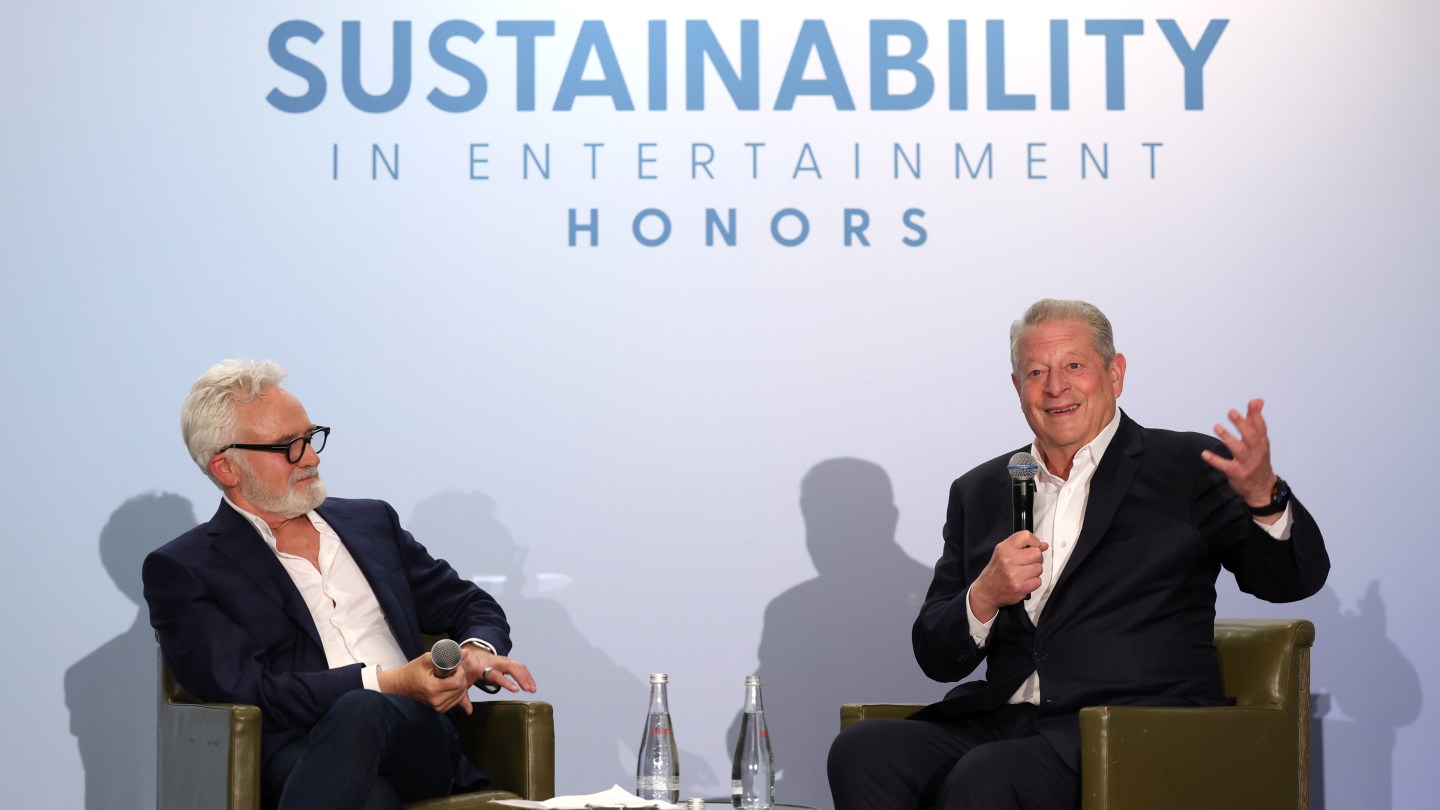
The Hollywood Reporter and the Sustainable Entertainment Alliance teamed up on Thursday for an inaugural celebration of Hollywood environmentalism, with a special appearance from former Vice President Al Gore.
The Sustainability in Entertainment Honors event, held at Hotel Bel-Air, was timed to THR‘s annual Sustainability Issue and was led by a keynote conversation between Gore and Bradley Whitford, in honor of the 20th anniversary of An Inconvenient Truth. The Oscar-winning documentary followed the former politician as he campaigned to raise public awareness of the dangers of global warming and called for immediate action to save the planet.
Whitford introduced Gore on stage by declaring him “the leader that all of our children deserved.” The VP started the conversation by looking back at the start of An Inconvenient Truth, which began with him developing an environmental slideshow while still in the White House (“Steve Jobs asked me to join the Apple board soon after that, and said, ‘You know, Al, we have these things called computers now,’” mocking his old-fashioned method.) He then agreed to promote 2004’s The Day After Tomorrow because of its climate change warnings, joking, “and the press said, ‘Well, isn’t this fictional?’ I said, ‘Well, it’s not as fictional as the Bush-Cheney account.’”
That connected him with Day After Tomorrow producer Laurie David, who told him his slideshow should be a movie. “I thought that was a crazy idea,” Gore admitted. Looking back now, he continued, “I’m so glad I was wrong, because the impact of the movie from my own personal experience — I travel around the country and in other countries, people still come up and talk about it and what the impression was.”
“I can’t think of another movie that puts an issue out there in a way that validated the public discussion. I can’t think of anything else that came close to this,” Whitford emphasized, noting the power of storytelling that he experienced personally with The West Wing, as he teased, “we did fix the Middle East in two episodes.”
Gore joked back, “And I was going to say about An Inconvenient Truth, if it hadn’t been for me, we might have a big problem right now.” But despite the escalating climate crisis, Gore said he still believes there are a lot of reasons for hope.

Bradley Whitford, Geena Davis, Al Gore and Ed Begley Jr.
John Sciulli/The Hollywood Reporter via Getty Images
“We’re in a climate policy recession right now because of the current U.S. president, mainly, and because of the massive spending and lobbying by the fossil fuel polluters. But the polls, just in the last week, confirmed that public opinion here in the U.S. is that it’s matching its highest record ever,” he explained. “People understand that we have to solve this. There’s a certain amount of what’s called ‘climate hushing’ going on now. That’s not climate denial; climate hushing is where business people who are scared of Trump or scared of one of the Broligarchs or something will kind of downplay the issue, but the underlying concern is very, very high, and so there is a lot of hope.”
He pointed specifically to the massive growth in solar power and electric vehicles over the last two decades and put much of the blame on the fossil fuel lobby, who have “spent billions and billions of dollars deceiving people” and have “captured enough of the politicians and policymakers to be in effective control of the policies that affect their business model.” Gore also admitted he was surprised that the politicalization around climate change has lasted so long, thinking it would become a bipartisan issue like fights against tobacco and healing the ozone layer.
The conversation ended with Whitford expressing his concerns about AI and the energy it uses, to which Gore responded, “It’s a serious concern; it is not a cause for panic. If you look at all of the generative AI data centers worldwide as it exists today, their emissions are less than half of what is coming from uncovered landfills … what we need is political will to start looking at the solutions in a very rational and prioritized way.” He did however note that when it comes to AI’s use, “I’ve never seen anything remotely like this. I go along with those who say this is by far the most important and significant scientific revolution in all of history.”
Along those lines, Gore urged, “We have to rekindle the spirit of America and revive the quality of our democratic discourse and bring democracy back to life, IRL — in real life — not by bots on the internet and thinking that’s going to do it,” while emphasizing how Hollywood storytelling could have a significant impact at this moment. “We have the biggest challenge that Americans have ever had in holding onto our democracy, holding onto American values.”

Paradise‘s John Hoberg, Sarah Shahi and Stephen Markley.
Joe Scarnici/The Hollywood Reporter via Getty Images
Elsewhere during the programming, THR editor-in-chief Maer Roshan and publisher Lori O’Connor delivered remarks, and several Hollywood productions were recognized for their sustainability efforts. Paradise received the Achievement in Sustainable Storytelling honor, presented by actress Sarah Shahi and accepted by writer-executive-producer John Hoberg and writer Stephen Markley.
In their speech, Markley called out the entertainment industry’s poor track record for telling environmental stories, saying, “In the past four years, the industry has collectively greenlit a handful of stories about the climate crisis and that silence has played a direct role in shaping the disregard we see in the public imagination. The world is 1.5 degrees hotter, with endless disaster befalling people on every continent, and every story we greenlight that does not reflect that reality is essentially science fiction. Denial continues to be a piss poor strategy, yet even after 16,000 homes in our home city burned to the ground, I can tell you from experience, it’s never been harder to get something greenlit about the climate crisis.”

The Boroughs creators Jeffrey Addiss and Will Matthews.
Joe Scarnici/The Hollywood Reporter via Getty Images
New Netflix series The Boroughs was honored with the Achievement in Sustainable Production award, presented by Netflix’s Jinny Howe to creators Jeffrey Addiss and Will Matthews; Grey’s Anatomy was recognized with the Legacy of Sustainable Storytelling honor, with actors Chandra Wilson and James Pickens Jr. presenting to showrunner Meg Marinis and Shondaland chief content officer Alison Eakle.

James Pickens Jr., Meg Marinis, Alison Eakle, Chandra Wilson and Caterina Scorsone of Grey’s Anatomy.
John Sciulli/The Hollywood Reporter via Getty Images
The event also featured a conversation on the state of Hollywood sustainability, moderated by Sustainable Entertainment Alliance executive director Sam Read with director Kat Coiro, Netflix sustainability officer Emma Stewart, Adam Umhoefer (executive, community & impact at CAA) and Gabriele Almon (senior director, advocacy at the Television Academy).
The chat touched on the need for more climate storylines, the push to normalize talking about sustainability on set and asking questions, the importance of talking to sustainability officers at Hollywood companies to help put plans in motion and the desire to change the way things have been done in the industry for decades, despite pushback.
“I remember starting out and feeling so proud of myself for having one of my first big jobs, and I walked out by a dumpster that was filled to the top with plastic bottles that had been used in one day of creating a story. It completely deflated me because I said, ‘I love my job, but I don’t want to be part of this huge problem,’” said Coiro, who recently directed You, Me & Tuscany. “And we are big; movies and television shows, there’s so many people working, there’s so many resources that need to come together to make a story. So how can we be responsible? That was the impetus for me: How can we tell great stories that are entertaining and also not be completely irresponsible?” She added, “I would love to walk away from a set and have created the minimal amount of waste and feel like I created the story, but not a big, giant pile of trash.”

Emma Stewart, Adam Umhoefer, Gabriele Almon, Kat Coiro and Sam Read.
Joe Scarnici/The Hollywood Reporter via Getty Images

