


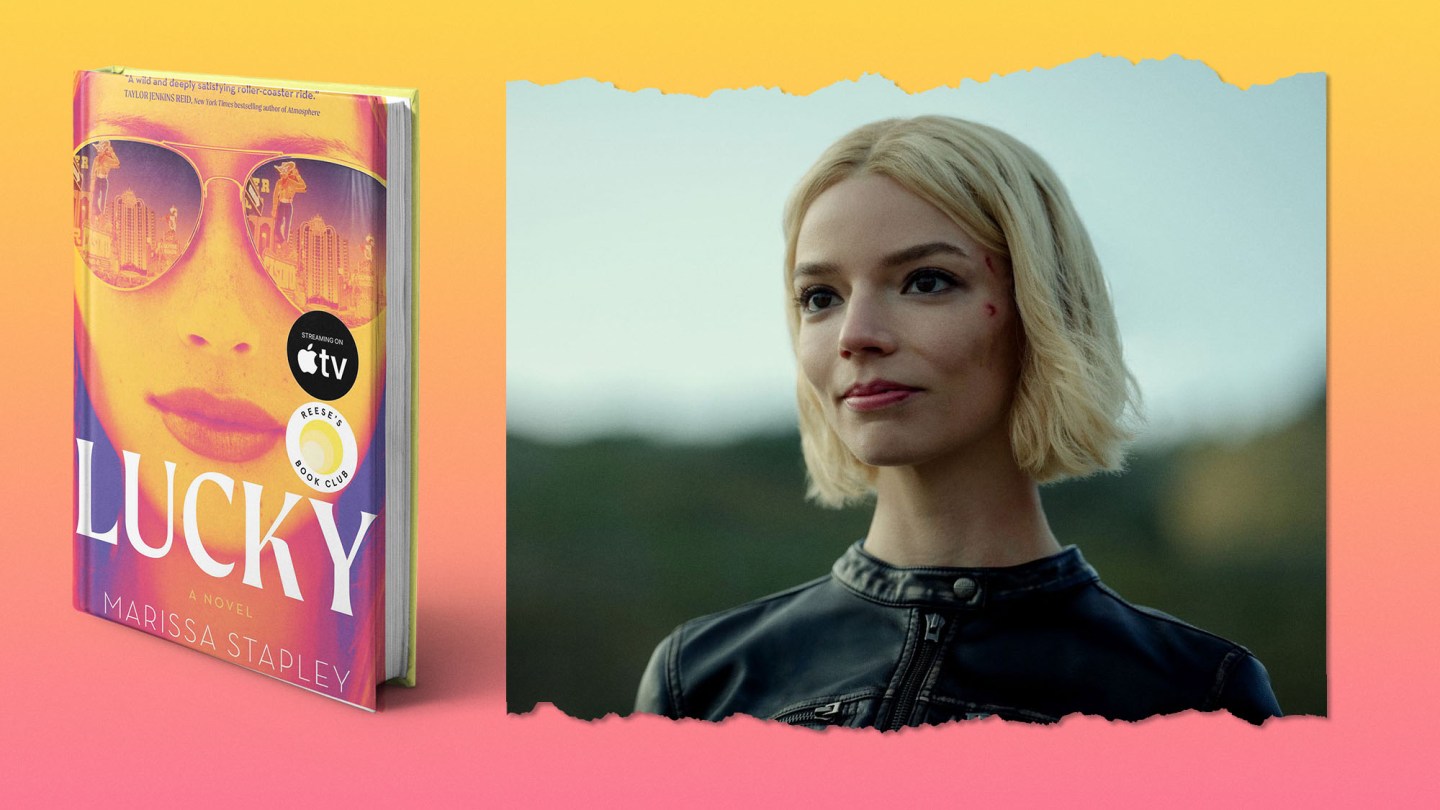
Some stories refuse to stay on the page. The Hollywood Reporter’s Beyond the Book column explores what happens when books make the leap to screen and beyond — unpacking what stayed, changed, how it was done and why it matters with the creatives who made it.
***
[Warning: This story contains spoilers for Apple TV‘s Lucky and Lucky by Marissa Stapley.]
“The fact that we like con artists so much is probably the greatest con of all time,” Tori Telfer writes in Confident Women: Swindlers, Grifters, and Shapeshifters of the Feminine Persuasion. “But perhaps there’s a darker reason we cheer on the con artist: secretly, we want to be her.”
Telfer’s book examines the history of how female-fronted true-crime suggests our society’s fascination with con artists is rooted in a desire to escape morality and social responsibility. For fellow author Marissa Stapley, Telfer’s book is key to understanding why con artists are seen as intriguing — an idea Stapley explored in her 2021 novel, Lucky.
“So often these characters are criminals, but you understand the reason,” she tells The Hollywood Reporter. “It’s a Robin Hood thing; they’re doing it to take back, and we can get behind that.”

Lucky by Marissa Stapley
Simon & Schuster
Stapley’s own fascination with the art of the con began after her mother was conned out of her life savings. That triggered an interest in real-life con artists, with her research leading her to uncover more about the lives and work of female heisters like Anna Delvey, Elizabeth Holmes and Rose Marks, a fake psychic whose victims included romance novelist Jude Deveraux. Now, in her own writing, the Lucky author has found herself fixated, but less on the mechanisms of a con, and more on the psychology of the artists. And with a book and Apple series adaptation, readers and viewers learn about the ways of swindler Lucky, “a con artist with a heart of gold.“
In the book and show, Lucky (Anya Taylor-Joy) grows up with a grifter father John (Timothy Olyphant) and a life of crime. Since scheming and being at trouble with the law are all she has ever known, Stapley’s novel and the series explore whether Lucky can truly outrun the life that shaped her. Despite wanting to find identity outside of being a con artist, the contradiction at Lucky’s core is that she has been taught to exploit human connection while still possessing a deeply human capacity for it.
There are moments where Lucky uses her scheming ways to her advantage and fabricating identities as a means of survival. In the show, she‘s seen pretending to seek shelter from an abusive partner and posing as a nanny among wealthy guests at a child’s birthday party, both disguises to evade the FBI and the henchmen of mob boss Priscilla (Annette Bening), from whom she and her husband Cary (Drew Starkey) stole the money. But viewers also see glimpses of Lucky’s humanity, including when she pays for a man’s food at a gas station and forms a connection with the young granddaughters of a woman who takes her in while she is stranded in the Mojave Desert.
“We’ve got different people making different interpretations, but I think we’re all on the same page in terms of who she is,” Stapley says of her novel‘s protagonist portrayal onscreen in the Apple series.
And who she is, according to Stapley, is born from Telfer’s description of con artists as people operating on “the inherent trust we all have in each other [and] as humans.” While “most of us are taking people and the world at face value,” which is “a beautiful thing about society,” that same quality is “the most broken thing about Lucky.”
“You see her in the book and in the show really grappling with the fact that what her father took away from her was being like anyone else [and] having that inherent trust,” the author explains. Lucky also makes a point to “not hurt people who don’t deserve it. She wants to make reparations, more so in the book, but you do see that in the show where she wants to try to undo some of the harm that she’s done.”
The show diverges from the book’s plot, with some of the storytelling mechanics shifting for the screen. The novel, for example, explores a dual timeline of Lucky’s past and present and includes Lucky searching for her mother, who is mentioned to be dead in the series. But the central question surrounding the protagonist remains: If the only life Lucky has ever known is one she no longer wants, who is she without it?
To fully understand Lucky requires understanding the relationship with her father John, which fuels the emotional engine of the Apple TV series. “The book and the show are such companions to each other. I feel like Lucky the book really provides the origin story of that emotional core of the show, which is the relationship with John,” the author says.
Timothy Olyphant and Anya Taylor-Joy in Lucky.
Apple TV+
In both the show and book, John recognizes Lucky’s talent for reading people at a young age, uses her own trust in him to his advantage in his schemes and exploits his daughter in order to exploit others.
“I feel like people who are raised by narcissists … it’s really hard when you’re so gaslit,” Stapley adds. “That person is also loving. It’s one thing if they’re abusive and awful in a very obvious way, but when it’s so psychological like that, and there is love there in his broken way — it’s the ultimate con.”
Lucky and John may seem like a united front, but their dynamic comes to a head in the season finale, which released on Wednesday. After Priscilla frees the father and daughter, John abandons Lucky at a motel and takes the teddy bear containing Cary‘s voice-recorded seed phrase needed to access the $10 million Cary converted to crypto. But Lucky has anticipated his betrayal. When John presses the bear, he hears not the codes but Lucky’s recorded goodbye.
When Lucky is shown recording the message, a childhood flashback is also shown, revealing that John once made a young Lucky, who didn‘t know how to swim, almost drown as part of a con to get a free hotel room. The harsh reality is despite his love for her, Lucky notes, he was “willing to risk my life for the con, and I’m not anymore.“
“I don’t remember a time where you weren’t working an angle,“ Lucky tells her father in the message. I’m not giving you your money, but I’m giving you your freedom. I hope you use it wisely. I love you, dad, but you won’t see me again.”
While closing the book on this chapter with her father may have affected Lucky, Stapley says she wrote her character to ultimately love her father, even if “it’s also a love that is born of being manipulated.” In the book, John, struggling with dementia, experiences a moment of spiritual and emotional reckoning, apologizes to Lucky for his deception and criminal lifestyle. In the show‘s finale, John addresses his failures as a father and admits that Lucky at her core is different from him, “I’ve always been proud of the ways you’re like me, but what makes me prouder than anything are the ways you’re not like me. You’re better in every way,“ he tells her.
But in the series John is “a scorpion. He’s like, ‘I had to sting you,’” Stapley adds, invoking the fable of the scorpion and the frog. Things also turned for John when he learned that Lucky helping the FBI at a time resulted in him being locked up.
“He [knew] he was always going to do this. He was not going to be like, ‘I did this and I did that, and I see she was trying to help me.’ He was just like, ‘No, she did this. She’s the reason I ended up in jail, and she wasn’t honest with me,’” the author continues. “He felt so betrayed, and I think in his messed up brain, this was what he had to do. She in a way deserved this.”
Stapley thinks the series‘ take on John offers a hard truth about people like him: “We’re all such a product of where we came from, and part of Lucky is me saying you can fight against that, and you should. Someone like John, in the book, I really wanted him to be redeemable. I do look at where my characters come from, [but] in the show, I think they probably are much more realistic about someone like him. That final twist that he does, it’s like he just cannot help it.”
“A lot of the writers in the writers’ room would say, ‘Lucky can see the Matrix.’ And once she realized that’s not how everybody else saw the world, she could not unsee that, and it really changed her,” Stapley says. “Love cons are the ones that work the best, and it’s so sad. All a child wants is to be loved and to feel safe, so to be tricked into thinking that love and safety is one thing when it’s really another?”
Olyphant and Taylor-Joy in Lucky.
Courtesy of Apple TV
Stapley points to a scene in which Lucky tells her father, “Do you know how many people hate me and they don’t even know me?” as a moment that encapsulates the differences between her and John. “He doesn’t see why that would be a problem. And for her, she doesn’t want that.”
While John’s journey in the series differ from in the book, Lucky ultimately reaches the place Stapley believes will give her a “healthy existence.” In the finale, after anticipating John’s attempt to run away with the money, Lucky sends Cary’s laptop and the seed phrase to the FBI, leaving her father empty-handed.
The move was her “final chance to break free,” Stapley says. “Completely stripping everything away from her life is really the only chance that she’s ever going to have at finding out who she is.”
Still, Stapley acknowledges “the odds are stacked against” Lucky for any potential second season. And as far as her own Lucky, Stapley adds that the show’s take on her 2021 novel has sparked some creative shifts in her writing as part of a sequel she’s setting up.
The author says she has a deal with Apple to use FBI agent Rand (Aunjanue Ellis-Taylor) and Priscilla’s right-hand man, Dutch (Clifton Collins Jr.) — two characters she didn’t create — in her sequel to Lucky. She also had to “strip the things that [Lucky] had been given in the novel away from her and have her in a position similar to the ending of the show — to create this pursuit situation again.” Her book ends with Lucky learning who her real mother is, avoiding jail time, claiming lottery winnings she won and starting a new life.
Should the show be renewed, Stapley notes the core question of who Lucky can be after walking away from her con artist ways would likely be explored.
“I would imagine in a second season we would see who is Lucky? Who does she become? We would have to explore her relationship with her father further and see what happens there,” she continues while discussing Lucky’s potential on the screen. “But I wonder if Lucky’s journey is actually OK. How does she take her gray moral compass and use the fact that she can see the matrix potentially for good? What would [it] be like for Lucky to have people in her life who genuinely love her and have not gaslit her. What would she do to preserve these relationships?”
Should the show not be picked for a second season, Stapley is happy with how the series ends with Lucky beginning a new life for herself. “I did always imagine Lucky as a TV show, and in many ways, that novel to me was like writing a season one. So I put her at the precipice of something. It’s a satisfying conclusion because I don’t love a cliffhanger or being open ended, but she’s at the beginning of something. In the book and in the show, that is definitely the case.”
Courtesy of Apple TV
Lucky is available to stream on Apple TV.
