


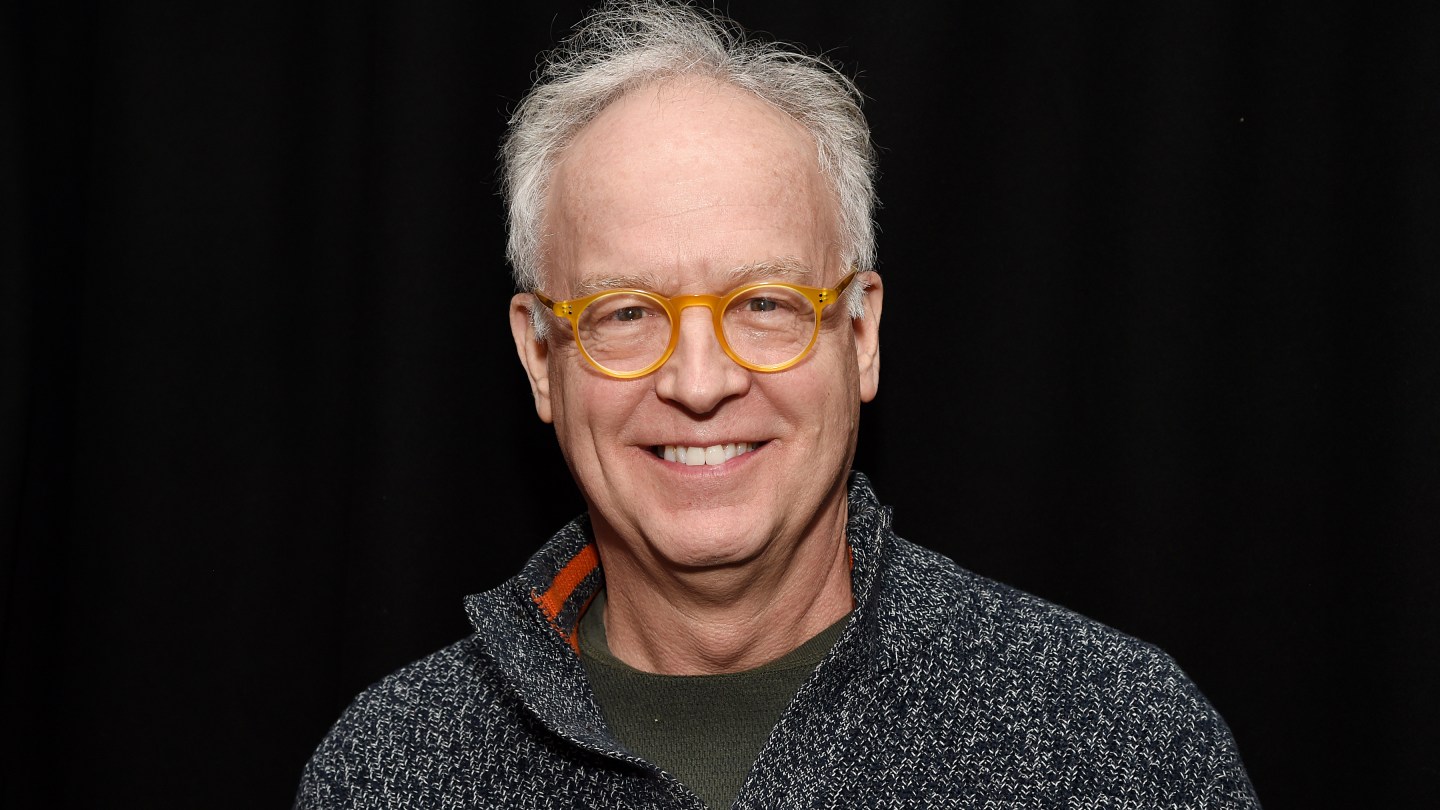
It’s rare that the biggest role of your life happens to also be the most controversial — especially when you’re 71 years old. But that’s the only way to describe the whirlwind of the last few months for Reed Birney, the esteemed character actor and Tony-winning Broadway regular who has wowed critics and shaken audiences with his turn in Blue Film, the debut feature helmed by Elliot Tuttle on a budget under $100,000.
Birney portrays Hank Grant, a former middle-school English teacher who spent seven years in prison for attempting to sexually assault one of his students. The movie opens with him hiring an adult sex worker who goes by Aaron Eagle (Kieron Moore), and who was actually another one of his students, named Alex, well over a decade ago. Hank has engineered their fraught evening together to confess he was in love with Alex back then, to explain himself and see what has come of his onetime pupil. What develops is a discomfiting, emotionally intense exploration of intimacy between the two men, rooted in the traumatic, troubled origins of their student-teacher bond.
It’s also as stark and frank a portrait of a pedophile as you’ll find in American movies, making for a meal of a role for Birney, who’s known onscreen mostly for small parts in big shows like House of Cards, The Blacklist and Gossip Girl. His performance here is fearless, committed to capturing the warped, mangled humanity in a man that many viewers would consider irredeemably monstrous. It’s overflowing with shame and regret, anchored by an uneasy genuineness. It’s the kind of work that would, or should, vault an actor as underrated and experienced as Birney firmly into the awards conversation, were the film not as intently disturbing as Tuttle’s final product.

Reed Birney and Kieron Moore in ‘Blue Film.’
“I have such a huge emotional investment in the movie, not only because I am playing this difficult role and I feel it’s the best film work I’ve ever done, but I also really collaborated with Elliot on it,” says Birney, who also serves as an executive producer on Blue Film. “We worked for several months on the script together.”
Blue Film shot back in 2024 and went through waves of rejections from various festivals as Tuttle completed postproduction. The movie was divisive, radioactive even, before a single public screening. “I guess I’m not as smart as I think I am, but I wasn’t prepared for the divisiveness, honestly,” Birney says. “I never for a second thought it would be controversial. I never for a second thought of Hank as a monster. I never thought of him as a manipulator or a groomer. Isn’t that weird? I mean, I guess it’s true, but I never thought of it. I just thought he was a sad and broken man.”
After finally launching to critical acclaim last summer at the Edinburgh Film Festival, Blue Film struggled to secure a buyer. The Hollywood Reporter’s review from October said it “crawls directly under the skin, burrowing deep and drawing blood,” while also noting it was still without distribution some three months after the premiere. The nascent distributor Obscured Releasing ultimately picked the movie up earlier this year, and dropped it in select theaters in May. It’s now available for rental or purchase on digital platforms.
Birney has sat through several screenings with audiences and admits to closely tracking reactions online. He’s heard the praise, from people who’ve felt seen by the movie and understood the value of its bold provocations. “Other people are like, ‘This movie should never have been made, it’s irresponsible to tell this story,’” Birney says. “You meet the movie where you can, and so if you’ve had trauma or sexual abuse, you’re not going to be generous towards Hank. You’re just not. You can’t be. It’s too loaded.”
The risk of the role would be obvious — and immense — for any actor. For Birney, well-regarded if hardly widely known, an unexpected secondary issue has arisen as more people encounter Blue Film. “Because I’m not famous and this feels like a fair amount of people’s first exposure to me, they’re not able to separate the performance from the character — which in a weird way is a compliment, I guess, that I was able to accomplish something in that I am in fact acting,” he says. “I am very grateful for the people that are able to separate the performance from the character.”
**
Birney’s stage career in New York began in the 1970s, but his breakout film was Arthur Penn’s 1981 dramedy Four Friends. “I was the fifth friend — story of my life,” Birney cracks. In the lead-up to release, Oscar buzz trailed his turn as a disabled, dying college student. Critics admired it, but the movie flopped. His next feature role didn’t come until four years later, in another promising project: Sam Raimi’s The Evil Dead follow-up, 1985’s Crimewave, co-written by the Coen Brothers. Birney even nabbed the lead role. “That failed too,” Birney says. In this case, the production company Embassy Pictures wrested control of Crimewave away from Raimi after a challenging shoot, leading the director to disavow the film.
“Anyway, that was my big starring thing,” Birney says. “And then my film career went into a weird non-existence.” He did not appear in another movie for 13 long years — at which point he was “Merchant Prince #1” in A Perfect Murder, toplined by Michael Douglas and Gwyneth Paltrow. “All that’s in the movie is the back of my head at a poker table. I thought, ‘Oh wow, it didn’t work out — that’s a pity,’” Birney says with a rueful laugh. “As I’m telling you this story, it seems like I have really had a cursed film career.”
Birney winning his Tony Award for ‘The Humans.’
Theo Wargo/Getty Images for Tony Awards Productions
His fortunes started to change in his mid-50s, when he was cast in the 2008, off-Broadway revival of Sarah Kane’s audacious Blasted, as a bigoted and predatory tabloid writer. In conversation, Birney is affable, warm and mild-mannered, so it’s understandable he was shocked to get offered that kind of character. “I thought they’d made a terrible mistake,” he says. “It was as if someone had asked me to play Stanley Kowalski. It was all wrong.”
But he earned raves and, after decades of strong work on the New York stage, had finally made his stamp on the community. A string of Broadway roles followed, including his Tony-winning work in The Humans, and then the movies started coming back, too. (Though not the 2021 screen adaptation of The Humans — Birney’s part was recast with relative movie star Richard Jenkins.) He earned a Gotham nom for his searing work in 2021’s Mass, another uncompromising drama — this one about two sets of parents meeting after a deadly school shooting.
Running through his credits, key aspects of Birney’s career come into focus. He’s used to setbacks and waiting around for the plum jobs to come around. He’s not only unafraid of challenging and polarizing material, but has achieved his biggest career breakthroughs by taking it on. And he defies the conventional wisdom that the older actors get, the smaller the roles become.
“I want to play rich, complicated people who are maybe at a crossroads — it’s weird to be at a crossroads at my age, but certainly we are,” Birney says. “My career in film has been, and I expect will be, a lot of supporting roles. The best friend or the awful senator or whatever. So it was very gratifying to see, ‘Yeah, Reed, you can play a big part. You can carry a movie.’ I hope other people see it too and realize that.” Birney isn’t especially confident that will happen after Blue FIlm, however: “I don’t think there are a lot of wonderful parts for a 71-year-old man…. I would like to be in the middle of the story instead of on the side of the story.”
Blue Film being what it is — a kind of arthouse hot-potato, neither widely seen nor universally embraced — further complicates that equation. Birney beams with pride whenever he speaks about the project, but he acknowledges it’s a complex starring vehicle. “It’s the biggest thing that’s ever happened to me professionally, but it may be just a blip somewhere,” he says. “I know it’s not for everybody. I wish it were. It’s not Call Me by Your Name — we don’t have a beautiful Italian travelogue with it. That movie is also about a pedophile, which nobody seemed to care about at the time. I sat there thinking, ‘This is so wrong,’ but everybody’s like, ‘It’s so beautiful!’”
Blue Film offers no easy way in for the viewer. It’s messy, claustrophobic, speaking to the darker corners of humanity with a determination not to look away for a second. With that in mind, Birney sees even having this conversation, two months out of release, as a substantial victory for the kind of radical cinema that’s harder than ever to get made and seen — and the kind of work on which he continues to build a singular career.
“It’s already done so much more than it ever should have — look, a $50,000 movie about a pedophile should never have been seen by anybody, honestly,” Birney says. “This movie is so one of a kind and so beautifully made and so smart, I believe it will find its way. It’s already finding its way. It’s already done so much more than anybody ever dreamed. And if it’s the biggest part I ever play, and it’s the last big part I ever play — that’s not so bad, either.”
