

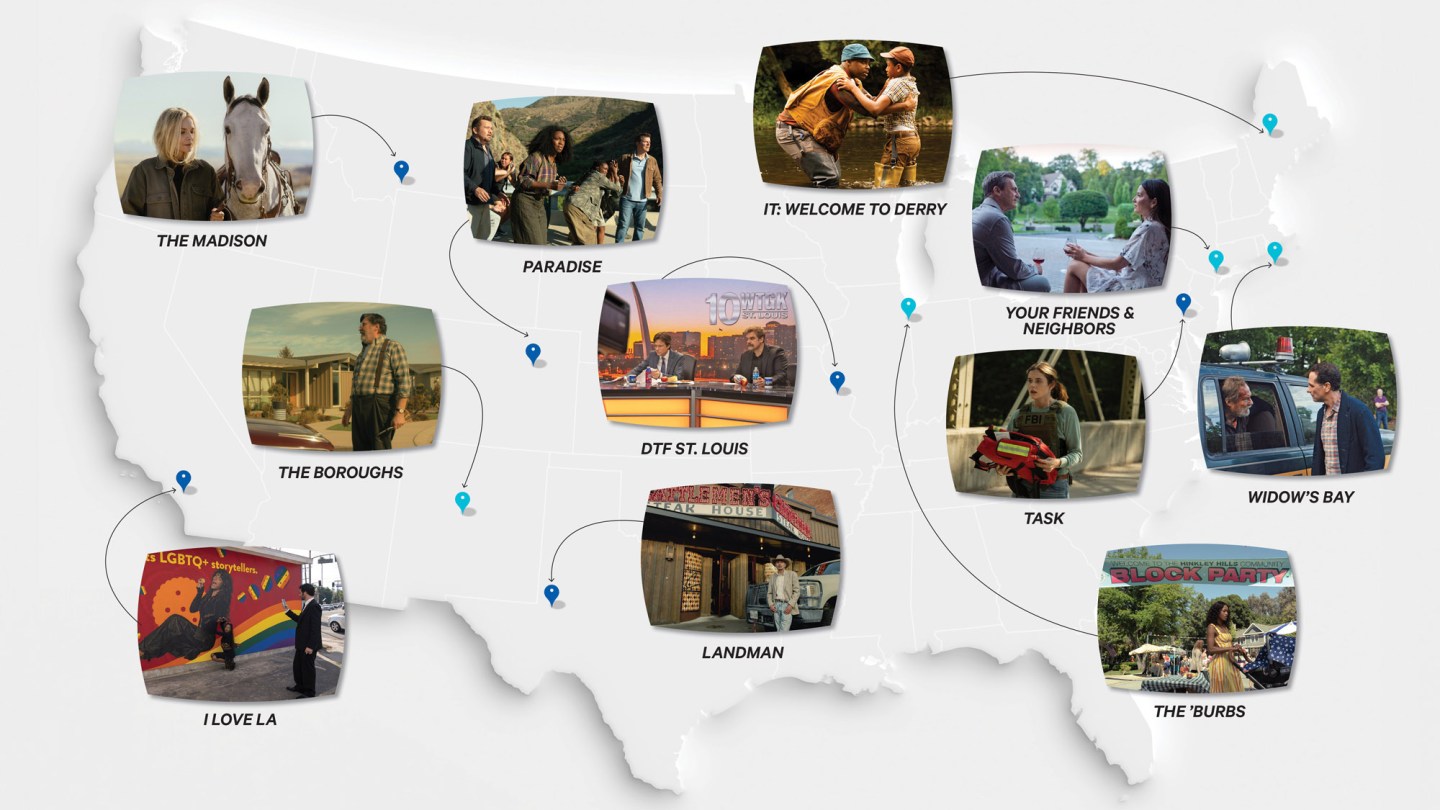
The creators behind ‘The Burbs,’ ‘Widow’s Bay’ and ‘The Boroughs’ explain why stories on the fringes are an award season hit: “People are inherently weird.”

Courtesy of HBO (3); Emerson Miller/Paramount+ (2); Courtesy of Netflix; Disney/Ser Baffo; Brooke Palmer/HBO; Elizabeth Morris/Peacock; Courtesy of Apple Tv+ (2)
Hacks, The Bear and Only Murders in the Building aside, metropolises like Vegas, Chicago and New York aren’t the epicenter of storytelling on TV this Emmy season. Instead, it’s shows exploring the unneighborly — and oft-otherworldly — disputes within rural and remote cities that are dominating screens. Here, the creators and producers behind 10 such series relay the fun of centering life on the outskirts — “people are inherently weird” — and how doing so undoes a familiar narrative: “Too often, we attribute tragedy to the rich or highly placed.”
-
‘The Madison’


Image Credit: Emerson Miller/Paramount+ Madison River Valley, Montana
The Clyburn family, led by matriarch Stacy (Michelle Pfeiffer, left) relocates from NYC to the Madison River Valley of Southwest Montana following the death of her husband in Taylor Sheridan’s Paramount+ drama. “In a story about grief, and the way it changes us, it was important for these characters to be both broken and unbreakable,” says director Christina Alexandra Voros. As for shooting in Three Forks, Montana, she adds: “The physical landscape of The Madison was both our greatest gift and our greatest adversary. We were up against the weather, terrain, river currents and even the shortening daylight of Montana’s indecisive autumn. When the geography is a main character — the main character in ways — doing that landscape justice was as imperative as finding the heartbeat of every scene.”
-
‘The Boroughs’
Image Credit: Courtesy of Netflix Near Albuquerque/Santa Fe, New Mexico
“The Boroughs is about a specific town that doesn’t actually exist, so we had to build it,” series creators Jeffrey Addiss and Will Matthews say of their Netflix series in which residents of a New Mexico retirement village face off with its owners, who want to drain their brains to feed a vampiric creature whose blood keeps them young. “The main challenge was it had to be a place you’d want to live if it weren’t for the monster problem.” Production designer Ruth Ammon crafted the idyllic community in the middle of the desert, the co-creators noting that “the Boroughs had to feel like a bubble — beautiful, but precarious. Far enough away from the next town over that you felt the isolation, but in a believable way.” As for the cast, led by Alfred Molina, they add: “It was very important to us that these retirees were first and foremost seen as heroes. … While they may have sad or funny moments, they were never to be pitied or made the butt of the joke.”
-
‘Paradise’
Image Credit: Disney/Ser Baffo Colorado
Season one of Paradise was all about the underground bunker city built into the Colorado mountains (and filmed on the Warner Bros. lot), but season two of Dan Fogelman’s postapocalyptic Hulu thriller moves aboveground. “It was important we showed a world coming back to life but also a world that had gone through a great tragedy,” says EP John Hoberg. “We wanted that sense of traveling through Americana but seeing it through different eyes.” That also meant distinguishing between the trauma of the people above- and below ground, including Teri Rogers-Collins (Enuka Okuma). “You can feel the presence of loss and trauma in the bunker; it’s always lurking,” says Hoberg. “When we went aboveground, we needed to feel something different — a feeling of people who survived. They had to learn to thrive in a dangerous, complicated world where they ultimately found community, kindness and love.”
-
‘I Love LA’
Image Credit: Courtesy of HBO Yes, of course Los Angeles is a sprawling metropolis but one whose drama is often powered by transplants from small-town America. With shoot days for TV productions in L.A. declining 28 percent quarter-over-quarter in the first four months of 2026, you can’t overlook this show shot in the City of Angels that so accurately — and hilariously — captures the struggle of newcomers trying to make it in the entertainment biz. “What was so exciting about building out our world for I Love LA was getting to lean into the hyper-specificity of this group of friends and the world they inhabit,” say co-showrunners, writers and EPs Rachel Sennott and Emma Barrie. Sennott, who created the show, also stars as an aspiring talent manager struggling to rein in wild-child client and friend Tallulah Stiel (Odessa A’zion, pictured in the mural). “There’s an easy trap to fall into when portraying the world of influencers where the characters aren’t grounded or feel over-the-top. Even though our characters are comedy characters, we wanted to keep the emotional stakes real, and our actors helped do this by asking questions and finding motivation behind everything they did,” the writers add. “L.A. is such a big and vibrant city, and it means something different to everyone. ”
-
‘Landman’
Image Credit: Emerson Miller/Paramount+ Midland/Odessa, Texas
In portraying the many cogs in the wheel that is the billion-dollar Texas oil business, Christian Wallace, who created the series with Sheridan, says, “It’s important that we do justice to the roughnecks and blue-collar workers of West Texas who do the tough, dangerous jobs that power modern society.” The cast and crew had to rough it out just the same while filming the Paramount+ drama led by Billy Bob Thornton. “The Permian Basin oil fields of West Texas and New Mexico are massive and remote, roughly the size of the U.K. and nearly five hours west of our production base in Fort Worth,” explains Wallace. “The elements are stacked against you out there: rough dust storms, desert heat, hailstorms, rattlesnakes and dangerous machinery pretty much everywhere. But all that feeds into the visual language of the show. There’s a rugged beauty to the Permian that’s unlike any place in the country — if you squint hard enough to see it.”
-
‘It: Welcome to Derry’
Image Credit: Brooke Palmer/HBO Maine
The fictional town of Derry is well established in Stephen King’s 1986 novel It and the subsequent films, so when it came to the HBO series, “It’s more than the space that we were portraying; it’s the time when the season happened, which is in 1962,” says Barbara Muschietti, who co-developed the prequel with brother Andy Muschietti. “This was a year of huge upheaval in the U.S. and in the world. We’re still relatively close to the terrible effects of the Second World War when we’re transitioning into a world that wants peace and is understanding the need for equality. But it’s still in a town that is stuck in time and is weaponized with fear.” It’s the latter that makes the townspeople (including Jovan Adepo, and Blake Cameron James) an easy target for the titular bogeyman Pennywise, adds Andy. “He is weaponizing all these things that are so relevant in what’s going on in today’s reality in America, and in the world. The division targets race and the desire to divide and conquer, and that was an opportunity to revisit those themes.”
-
‘Your Friends & Neighbors’
Image Credit: Courtesy of Apple TV+ Westmont Village, New York
While viewers might be impressed by the display of wealth in the fictional affluent, suburban town where this Apple TV series takes place, it’s the real residents of Westchester, New York, where the show is filmed, who needed persuading of its validity. “Chances are, anyone who owns the kind of home we want to shoot in has no need for our location fee,” says creator Jonathan Tropper, who quips of the “complex scouting process to find homeowners who were artistically minded” to let them film in their homes multiple times per season — “A photo with Jon Hamm only gets you so far.” But it’s Hamm (right, with Amanda Peet) who manages to make audiences somehow feel sorry for a financier who begins robbing his neighbors when he loses his job. “When it comes to the wealthy, there’s a danger in defaulting to stereotype and caricature. But no one invests emotionally in characters like that,” adds Tropper. “We take great pains in the writing and casting of the show to make sure our characters are three-dimensional, flawed, redeemable and, above all, relatable, even if sometimes their lifestyles are not.”
-
‘DTF St. Louis’
Image Credit: Courtesy of HBO St. Louis, Missouri
“Placing unusual tension in what at first should seem to audiences like safe and familiar suburban atmospheres was our biggest challenge and opportunity,” says creator Steven Conrad of his HBO drama, in which a love triangle of three middle-aged adults — Jason Bateman, above left; Linda Cardellini; and David Harbour, above right — who connect via a dating app called DTF St. Louis ends in murder. Though filmed in Atlanta, the settings in the series, like the local community pool where Floyd’s (Harbour) body is found and the baseball field where Carol (Cardellini) picks up a side job as a little league umpire, condense the characters’ environment into the trappings from which they want to escape. “The cast did extraordinary work conveying dangerous impulses in a way that always seemed human and recognizable among people with settled ambitions and family life,” adds Conrad. “They always felt like the world around me.”
-
‘The ’Burbs’
Image Credit: Elizabeth Morris/PEACOCK Hinkley Hills
Shooting on the iconic Colonial Street at Universal Studios, the same location as the original 1989 Tom Hanks feature, creator Celeste Hughey says when writing the Peacock comedy, “I wanted to avoid populating our neighborhood with suburban caricatures but also wanted to portray familiar archetypes — the busybody, the rule stickler, the enigma, etc. — in a way that felt specific and relatable. Having neighbors is a universal reality, and people are inherently weird, so we put together this group of oddballs who range in age, race and life experience,” she says of the cast led by Keke Palmer, who tries to uncover the history of a mysterious house in the Ashfield Place cul-de-sac. “Our core [characters] wouldn’t necessarily be friends outside of their proximity, and yet they find community through their shared weirdness, need for connection and love of wine.”
-
‘Task’
Image Credit: Courtesy of HBO Delaware County, Pennsylvania
Show creator Brad Ingelsby had a clear goal in mind when crafting this crime thriller in which a Philly FBI agent (Mark Ruffalo) leads a task force investigating a string of stash house robberies: “Giving working-class characters complexity,” he says. “Too often, we attribute tragedy to the rich or highly placed — CEOs and kings. I wanted to feel the dreams, regrets, desires, failures and betrayals of a trash man and a priest. Because I know they exist.” To ensure the actors relayed that feeling onscreen, filming in Delco, where the HBO series is set, was a must, adds Ingelsby. “They visit coffee shops, bars and restaurants. They interact with the people and overhear conversations. They see what the locals are wearing, driving, listening to. It seeps into an actor’s bloodstream, and it translates to the screen. They have an authority over their character they wouldn’t have if we were shooting somewhere else.”
-
‘Widow’s Bay’
Image Credit: Courtesy of Apple TV+ New England
“We wanted to build a world that felt small enough to believe you’d never heard of it but large enough to suggest there were countless nooks and crannies still left to explore on this strange little island,” says creator Katie Dippold of the fictional New England town where the Apple TV comedy horror is set. That meant “large stages for the elaborate builds — the inn, town hall, the Salty Whale, their homes, even a water tank,” she adds of filming in coastal Massachusetts towns, noting, “The feeling of being on an island, slightly cut off from the rest of the world, is central to the show.” Matthew Rhys’ Mayor Tom Loftis (above right, with Stephen Root) wants to change the remote reputation of the island and turn it into a tourist destination against the will of locals who are convinced the land is haunted — the type of superstition you only get in a small, tight-knit community — which added yet another layer to the world-building on set. “Most importantly, we wanted an atmosphere that felt cozy and lived-in,” adds Dippold. “The kind of place you’d want to wander around and get lost in — even if it meant you might die there.”
This story appeared in the June 10 issue of The Hollywood Reporter magazine. Click here to subscribe.
