


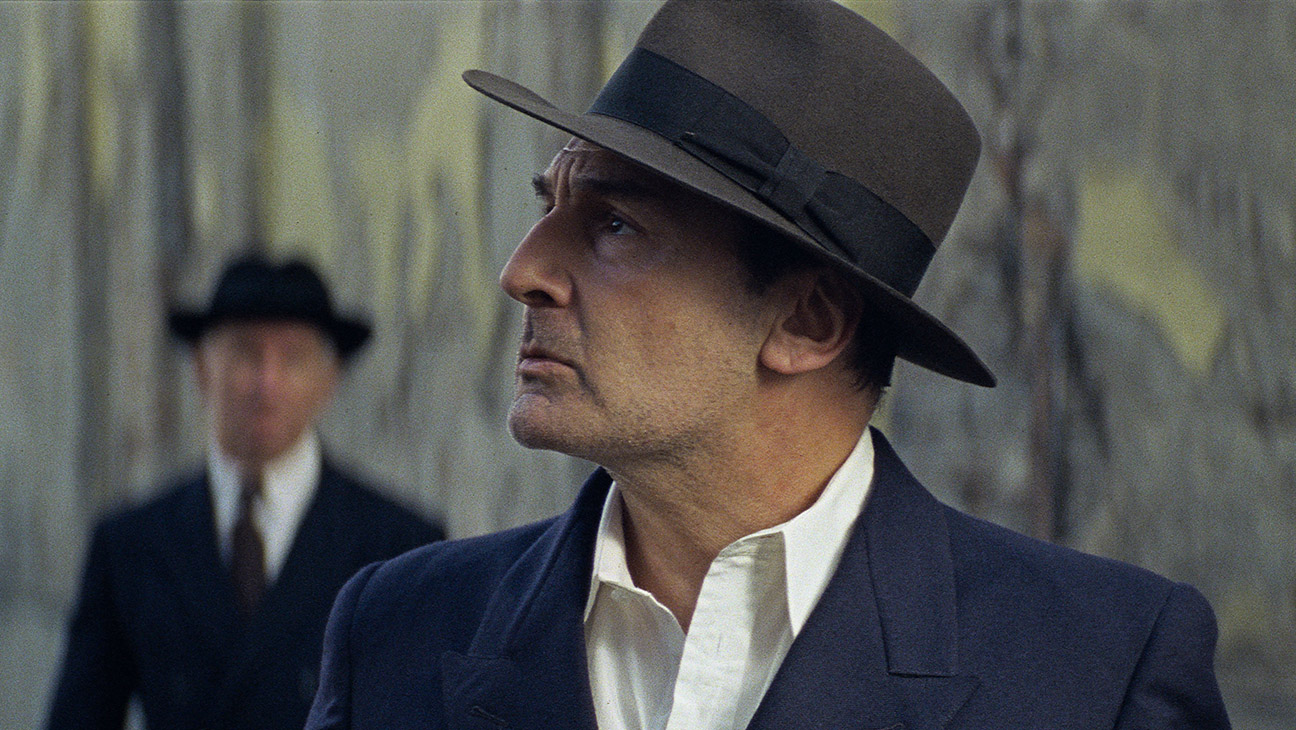
The French Resistance hero Jean Moulin was 44 when he was captured by the Gestapo in Lyon and tortured until his death, in July of 1943. He has since become a national symbol of France’s fight against the Nazis, perhaps a figure of some renewed relevance now that various far-right factions are making inroads in French elections, and around the world. It thus may be an apt time for the biopic Moulin, a grim portrait of Moulin’s last days directed by Hungarian Oscar-winner László Nemes.
Nemes is something of a specialist in this strain of historical drama. His past films have covered the Hungarian Uprising, the fraught lead-up to WWI and, in 2015’s excruciating Son of Saul, life and death in a Nazi concentration camp. His serious, sometimes ponderous style is most vividly on display in Son of Saul, which uses the nervy technique of keeping the camera very close on one prisoner as hell is unleashed in the periphery. Moulin, by contrast, has no real gimmick; it is stolid and straightforward, shot in hues of black and pallid yellow, like an old newspaper. It’s a handsomely mounted film, full of precise period detail, but is otherwise undistinguished from many solemn, exacting biopics that have come before it.
Moulin
The Bottom Line
A grueling depiction of unyielding principle.
Venue: Cannes Film Festival (Competition)
Cast: Gilles Lellouche, Lars Eidinger, Louise Bourgoin, Marcin Czarnik
Director: László Nemes
Writer: Olivier Demangel
2 hours 10 minutes
At the film’s outset, it seems we are to be served a tense, lo-fi espionage thriller. Parachutes twirl out of an inky night sky, one carrying Moulin (Gilles Lellouche), who is about to become the first president of the National Council of the Resistance. We see him go about his clandestine work, meeting with various members of the underground and making split-second decisions in the wake of a close ally’s arrest. With its dark cobbled streets, its curls of cigarette smoke, its furtive glances, Moulin effectively evokes past spy noirs. Nemes does not give us any time to figure out who’s who and, really, what’s happening, but watching all this furtive tradecraft is compelling enough.
When an emergency meeting with Moulin’s deputies is raided by the Gestapo, though, the film takes on a different shape. It becomes a grueling procedural about Moulin’s imprisonment and torture, during which Moulin steadfastly — and quite courageously — refuses to give his interrogators the information they’re after. (Specifically, they want to know where the impending Allied invasion is going to take place. So, it’s pretty important intel.) Nemes stages all this awfulness with a formal dispassion; we get no swelling music to underpin Moulin’s heroism, there are no rousing speeches. It is only murk and pain, though Nemes does blessedly spare us many of the gorier bits. (We only hear the sounds of someone being killed by dogs, for example.)
Lellouche, who is about ten years older than Moulin was at the time, is mostly steely and stony-faced. Toward the end of Moulin’s ordeal, a little more emotion seeps out — a “Do it for France” plea for a fellow prisoner to kill him, a bit of tenderness toward his brutalized cellmate, an anthem sung in the face of a firing squad — but otherwise Lellouche is asked to be collected and impassive, a memorial statue come to life.
The film picks up some dreadful energy whenever notorious Gestapo official Klaus Barbie enters the frame. Barbie, played with frightening calm by Lars Eidinger, was the overseer of Moulin’s interrogation, a duty we see him carry out with chilling determination. Eidinger brings sorely needed spark to these miserable proceedings; his profile of sociopathic villainy is, unfortunately or not, the most electric aspect of the film. We have seen some version of this rendering of haughty, cruel, petulant Nazi pathology before, perhaps most notably from Ralph Fiennes in Schindler’s List. Eidinger is maybe not quite that terrifying, but he ably serves as a locus of our anger and disgust. One then gets even angrier upon recalling that the good ol’ US of A helped Barbie avoid imprisonment for three decades after the war.
Nemes is not interested in such broader context. He and screenwriter Olivier Demangel keep the film tight and focused, marching the audience through the grinding paces of Moulin’s resistance and then reaching an abrupt conclusion. No title cards summing up Moulin’s noble deeds greet us at the end; there is no misty coda. Nemes doesn’t even do much speculating about who might have betrayed Moulin and his compatriots, which remains a matter of some debate in France. (The film points mostly to the long-suspected René Hardy, but doesn’t spend much time on that.)
I’m sure Moulin will stir patriotic sentiment in some French people who see it, but otherwise it is difficult to feel a real sense of purpose animating the film, which is so blunt and un-editorialized that we might as well be watching a just-the-facts documentary. Though, there is no archival footage of Moulin’s bloody crucible, and Nemes apparently had some interest in filming that. Which makes one a little queasy, just as Son of Saul did for many viewers a decade ago. Nemes seems to believe that to graphically depict is to remember and honor. Maybe there is some truth to that. But it is nonetheless too easy to question the film’s motives, and its approach — would Moulin want to be remembered for the mechanics of his slow and painful death, or for what he died trying to save?
