


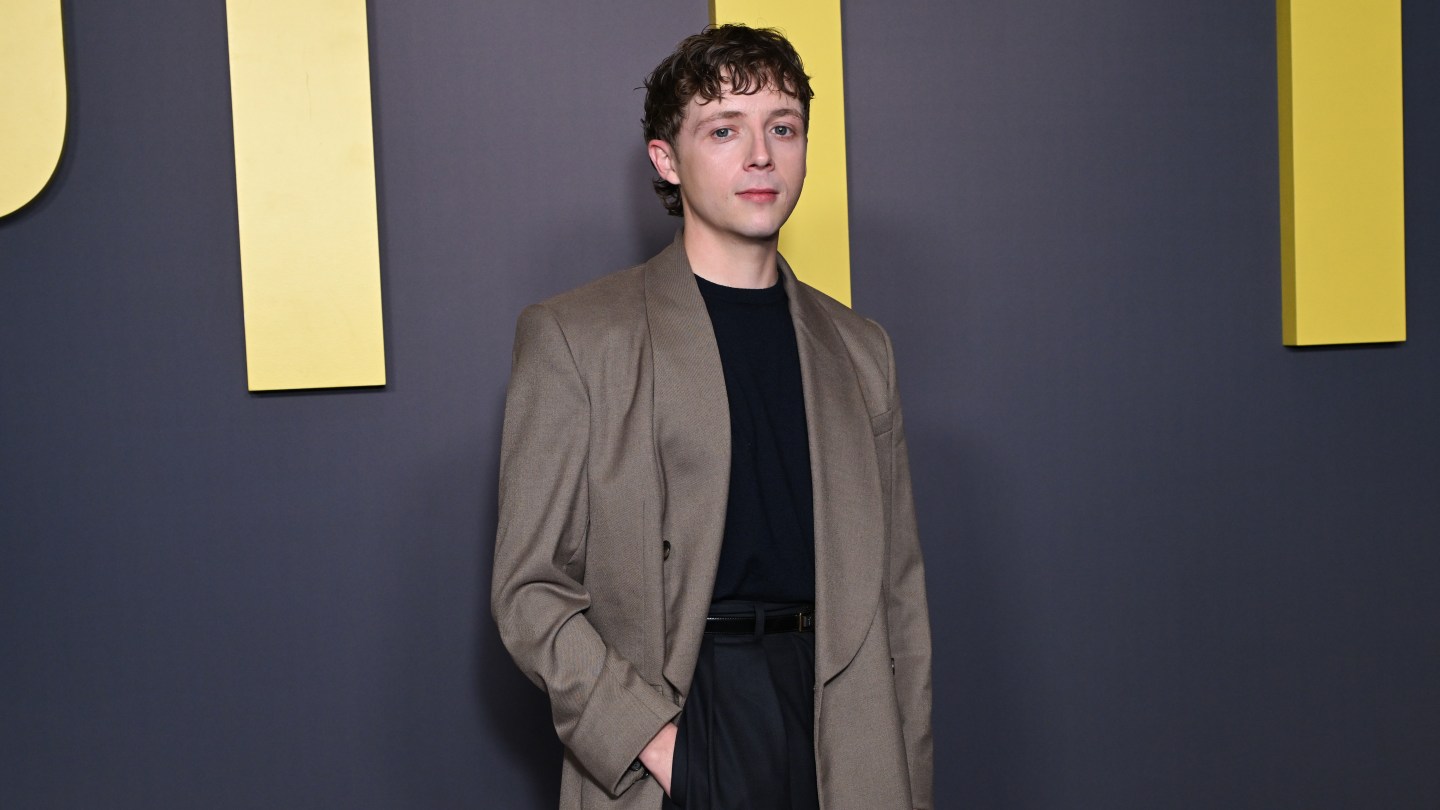
The Pitt star Gerran Howell is seemingly proud of his character Dr. Whitaker’s newfound self-assurance.
The 35-year-old Welsh actor has gone from a “wide-eyed farm boy,” as he puts it, in season one, to coming into his own during the show’s second season, which just wrapped last week. The HBO Max medical drama has found its biggest audience yet, drawing in 9.7 million viewers throughout the weekend.
It’s also become an awards darling since its season one premiere in 2025. Howell recalls a day on set where all of the actors were given time to take photos with the awards, but the fanfare didn’t last long. Much like the hospital setting of the show, The Pitt gets right back to business. “Everyone is obviously psyched about it that it’s getting the recognition it is, but yeah, it’s honestly back to work,” he says.
“Of course there’s pressure now. There’s pressure to keep people tuning in every week and keep onto the magic that has got us this far,” the actor continues. “But The Pitt is a machine that just doesn’t stop, and we’re all in it together. Everyone’s very humble about it, to be honest. It’s just back to work.”
Below, the actor digs into The Pitt’s second season, Whitaker’s evolution and what he’s looking forward to next.
How are you feeling about these last few episodes?
Amazing. It feels like there’s been a lot of building to these episodes. I’ve been watching back home in the U.K., which feels a little bit different. Obviously, U.K. viewers only have season one, and I think a little bit of season two now, so I kind of feel away from it all in quite a strange way. Kind of disconnected from it. But it’s exciting and I hope people like how it wraps up.

THR exclusive photo of Gerran Howell.
JJ Geiger
Whitaker has certainly seen growth since last season. How was that for you to tackle as an actor?
I think I had a very easy job in season one of just letting things hit metaphorically and physically. I was a wide-eyed, naive farm boy [who was] overwhelmed. That was very easy to tap into, to be honest. Very fun to not necessarily be appearing like I know what I’m doing all the time, because I don’t.
What about coming into this season?
I was very excited that I got to shed that for season two. It’s 10 months on. You do need to show a lot of growth there, otherwise Whitaker wouldn’t be there, let’s be honest. You have to find him in season two a lot more comfortable. He’s taking up more space now. That was really fun for me to do. It was just about getting rid of all that fear that I was relying on — those instincts that come quite naturally to actors, letting it run its course in season one. It was really fun and therapeutic, but getting rid of that slowly was interesting. I really root for Whitaker. He’s really found his place now, he’s taking up space. I think he’s in a mindset now where he knows all I have to do is to be useful and I’m kind of good at that. I can make myself useful. So he’s kind of thriving a little bit when we find him, I think. Yeah.
Weekly episode releases can make viewers feel like they have more time to grow with these characters. How do you feel about the model for this show?
We spend a lot of time with these characters, and you are drip fed their lives, which is different from a lot of shows. It’s interesting because it is in one shift, so it can be tough to capture a full character in that format. But I think they really achieve it. You have no option but to spend time with these people, and you slowly see their cracks and their little quirks, but it’s not immediately obvious. The characters aren’t laid out in front of you immediately. I think it’s great. How do you think it differs?
I think when a show drops all at once — you’re still with the characters and watching them — but I do think you tend to forget more quickly. It’s out of your mind in a way a show that comes back every week isn’t. That can make you invested in their lives in real time.
Absolutely, and I think it’s shot very intimately. It’s all kind of documentary style in a way. But I think it’s a slow burn every time. The beginning of every season, there’s a time jump where you’re like, what has happened to these people? You really get to discover it slowly, and I think it’s great. You feel really connected to them. It gives audiences agency to spend the time to work out these people. It’s nice.
Gerran Howell in The Pitt.
Warrick Page/HBO Max
Looking at where Whitaker started the season and where he ends this shift. What do you think comes next?
When we first see him, he’s thriving. He’s being very useful. He’s got a lot of responsibility, he’s teaching. He’s doing a very good job and thriving in his work. But I think this particular shift, he’s finding out that he can also be useful emotionally to people. This kind of weird thing with this shift of everything that’s happened, Langdon turning up for Santos. He seems to attract people who are spiraling on this shift.
He’s working out that people are leaning on him for that emotionally now. By the end of the season, he’s shifted from someone who needs support and [to someone who’s] now providing it. Going forward, I don’t think … He’s a very internal person, so he’s taking on all this emotional stuff and I think there’s only so much someone can hold onto. It’s got to come to a head there. Robbie’s relying on him so much. When he says goodbye to him, I think he’s just … I don’t know.
It’s all kind of cumulative for Whitaker. On the surface, it looks like he’s having the best shift compared to a lot of people. He’s kind of blissfully unaware of a lot of the things that are going on on the surface. But he’s taking on a lot of people’s problems, along with his own. I’m wondering if that is potentially a downfall for him. If he finds his ability to lean on other people — because right now he’s not showing anything — but I think he’s taking on a lot from everyone.
What do you think it is about him that attracts that energy to him?
Maybe because he can be a bit of a blank canvas to people. He’s helpful, and it seems like everything is going well for him, so he seems like someone who can take on all these problems. But that might not be the case. I don’t think anyone can take on everyone else’s problems.
What makes you interested in a role as an actor?
You go for a challenge, of course, as an actor. For me, the medical profession was something I was just wholly unfamiliar with and immediately intimidated by. But those are the best ones. You have to follow the challenges, I think, but it’s lovely when characters mirror your own experiences a little bit — give you a little bit of an opportunity to explore little parts of yourself, little archetypes within yourself and let them run rampant a little bit. You can come away from playing a character and selfishly hope that you learn something about yourself. I definitely did with Whitaker.
In what way?
Season one, it was all my fears and anxieties. There was a lot of strange synchronicities and mirroring that went on with my social anxiety and stuff like that. Now, having to play him more confident, it was an interesting learning experience of how social dynamics work. But I just like characters where you can explore parts of yourself that maybe you’re familiar with or maybe you’re not. I think that’s fun.
Gerran Howell in The Pitt.
Warrick Page/HBO MAX
When you sign onto a show like this, people can conflate you with your character. Do you ever have any anxieties around people only seeing you in that way?
A hundred percent. I’ve got a bit of a history of playing very socially anxious, fish out of water, overwhelmed, wide-eyed people. To be honest, it’s something I’m comfortable doing. Some might say a crutch, but I’m working, so I’m happy about that. I’m excited to show anyone with the vision what I can provide and enhance it. You don’t have too much control over it, do you? You try.
Is there something that you are dying to try that you haven’t yet?
Something that terrifies me is theater. It’s is something I did when I was a kid and feel like that muscle was completely atrophied, at least in my anxious mind. Maybe that’s saying that I should maybe do some theater. I love independent film, I love film. Film is why I got into acting, but I love working on a really passionate team. I think that’s the big thing. The Pitt is just, they came in with such a vision and invited us to be a part of it. I’m sure you’ve heard from other people, Noah [Wyle] gave the letter to everyone prepping us and saying it’s going to be intense and all this stuff. That’s really exciting as an actor because someone’s got a vision you can contribute, and not to sound like Whitaker, but be useful. You know what I mean? Within that. It’s already there.
