


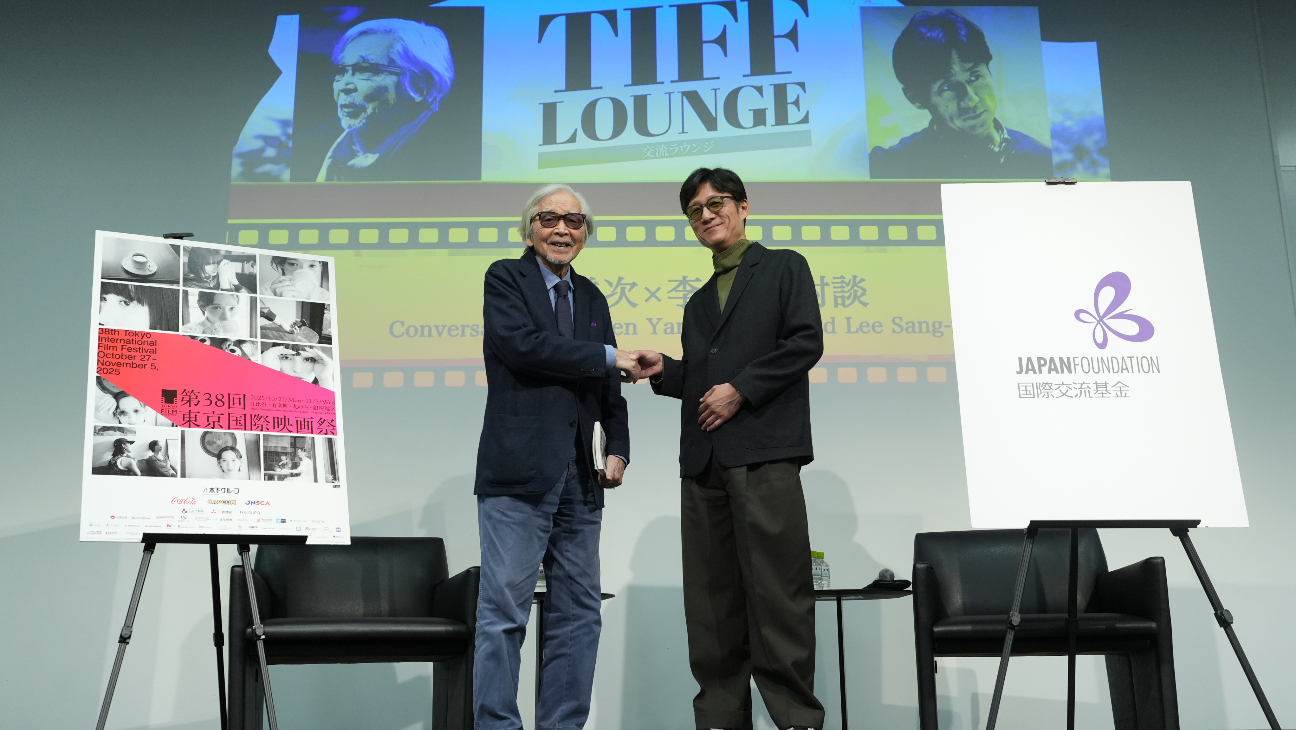
Two generational talents of Japanese cinema shared the stage to discuss each other’s work at Tokyo International Film Festival, where each has been celebrated with an award. Yōji Yamada, 91, has more than 90 directing credits to his name, while Lee Sang-il’s Kokuho is the biggest Japanese live-action box office hit in decades, having passed 16 billion yen ($105 million), and is Japan’s entry for the best international film Oscar.
Mutual respect was more than evident, and the conversation flowed through analysis of their craft to gentle teasing, mostly from Yamada, at the standing-room only event.
The veteran director was the first recipient of the festival’s Akira Kurosawa Award in 2004, along with Steven Spielberg. This year, it was Lee’s turn to receive it, with Yamada given the Lifetime Achievement Award the previous day.
“They’ve introduced our films side by side, but compared with his grand epic, mine feels like quite a lightweight. I’m almost embarrassed to see them together,” said Yamada of his Tokyo Taxi, his reimagining of Christian Carion’s Driving Madeliene (2022).
Lee, whose film Kokuho translates as national treasure, replied: “If there is such a thing as a living national treasure in filmmaking, Yamada-sensei is definitely one. I just hope to absorb even a little of his dedication.”
Though there was a moderator on stage, Yamada effectively took his role for the opening stretch of the talk, asking questioning Lee on how he had portrayed Japan’s traditional kabuki theater, and the human drama between two of its practitioners, so vividly and convincingly onscreen.
Yamada began by probing into the “dramatic structure” of Kokuho, the story of two kabuki actors whose lives are bound by artistry, desire, and fate.
“Usually, when you have two male leads, a woman is between them in some sort of triangle. But here, something entirely different lies between them: homosexuality. It’s this irrational romantic force that becomes the very theme of the story. That’s what makes this film extraordinary,” said Yamada.
That dynamic tension had been created by Shuichi Yoshida, the author of the 2018 novel on which the film is based, noted Lee. The director previously adapted Yoshida’s Akunin (Villain) in 2010 and Ikari (Rage) in 2016, both to acclaim.
“The tension between bloodline and sexuality creates a fascinating duality. I didn’t want jealousy or rivalry like in Amadeus. Since both men devote themselves to the same suffering, I hoped a kind of transcendent beauty would emerge by the end,” explained Lee.
For Yamada, that avoidance of conventional melodrama was one of the keys to the film’s power.
The two leads trained for about a year and a half in total to portray the male kabuki performers of female roles, known as onnagata, noted Lee: “They even practiced on days off during shooting. Their persistence and dedication were incredible.”
Tanaka Min, who plays the elderly kabuki master in Kokuho, was cast in his first major film role by Yamada in The Twilight Samurai in 2002 (the film won a record 12 Japan Academy Awards and was nominated for the then best foreign language film Oscar).
“He’s a butoh dancer [postwar avant-garde theater] not an actor, and at first he was terrible,” laughed Yamada. “Completely wooden. But his physicality and voice had such presence that it didn’t matter. Even now he hasn’t really ‘improved’, but that’s what makes him special, like a Noh actor. You don’t need him to act; his just being there is enough.”
Pushing back against Yamada’s playful ribbing about his reputation as a demanding director, Lee said, “That presence, combined with his movement, gives him a kind of magic. I wasn’t harsh in directing him. He doesn’t change no matter what you say, so instead of forcing it, I’d suggest small adjustments in tone or gesture. His stillness speaks volumes.”
Aside from its setting in the niche world of highbrow traditional theater, another reason Kokuho’s commercial success has been a surprise is its nearly three-hour runtime. Lee revealed that his initial cut was actually four and a half hours. “All the kabuki scenes were about twice as long; That alone was an extra half hour; we had to trim a lot.”
Despite Yamada’s best efforts, after an offstage prompt, talk turned to Tokyo Taxi, and how he approached the remake.
“I simply asked myself, if it were Japan, how would it go? A Japanese taxi driver and an elderly Japanese woman, their relationship would of course be different,” said Yamada.
Scenes with the taxi driver (Takuya Kimura) at home with his family, which were not part of the original, were singled out for praise by Lee for adding domestic realism.
“I really wanted to make that breakfast scene,” said Yamada. “The year before, he [Kimura] played a top Paris-trained chef. This time, he’s eating natto [fermented soybeans]. But he’s very earnest and sincere. Always early on set: a true professional.”
Next it was time for Lee to tease Yamada, asking why he always stands right beside the “Because the actors need to know I’m watching,” replied Yamada. “They can feel the director’s gaze. I don’t understand how some directors give directions from a monitor, sometimes from another room.”
camera on set.
Smiling as he did so, Yamada steered the conversation back to Kokuho, asking Lee about the numbers of extras in the kabuki scenes (500), and how he had broken multiple cinematic conventions in creating his tour de force.
Answering an audience question about the potential for Japanese live-action filmmaking to emulate the international success of anime, Yamada made an impassioned plea for more government backing.
“Japanese animation is a huge global success, while our live-action films barely register. When I entered the industry 70 years ago, Japanese cinema was vibrant and internationally respected — Kurosawa’s Seven Samurai, Ozu’s Tokyo Story, Mizoguchi’s Ugetsu. Now, Korea and China have surged ahead. It’s painful to watch,” Yamada said. “We need not just filmmakers’ effort but national support. The Korean government truly backs its film industry. Japan should do the same. It’s a matter of cultural policy.”
