


Damaged people navigating the push-pull struggle between isolation and connection, between emotional lockdown and empathy have been central to the work of Samuel D. Hunter, a MacArthur Genius Grant recipient and one of contemporary American drama’s foremost humanists. The playwright makes his Broadway debut with Little Bear Ridge Road, a singularly beautiful piece that shifts almost imperceptibly from acerbic comedy to searing pathos before an ending whose bleakness is broken by a slender but luminous beam of hope.
Commissioned by Chicago’s Steppenwolf Theatre Company, where it premiered under Joe Mantello‘s exacting direction, the production brings the reliably brilliant Laurie Metcalf back to Broadway in a role that dovetails neatly with her strengths. Playing Sarah, a flinty nurse involuntarily nearing retirement and living in Northern Idaho as far from other people as she can get, Metcalf exercises her usual peerless comic timing, tossing off line readings in a blunt deadpan that never misses. Only gradually does she allow reluctant glimpses of the fragility forced on her by the betrayal of her body.
The welcome surprise here is that Micah Stock matches Metcalf beat for beat as Sarah’s semi-estranged nephew, Ethan, in a performance steeped in raw feeling, self-flagellation and his own distinctive way with a tart-tongued barb. Stock’s previous Broadway appearances have been in the farcical backstage comedy It’s Only a Play and the rapid-fire journalism satire The Front Page. Here, he’s working in an entirely different vein, mining humor from what might seem at first to be a sad-sack character in a dead-end life as his arc builds steadily toward a stunning emotional catharsis.
At the risk of treading into spoiler territory for people able to see the play, that lacerating moment climaxes — after a heated back and forth of bruising truths with his aunt — in Ethan’s desperate cry of anger and anguish: “I don’t know how to be a person in this terrible fucking nightmarish world!”
Many of us have had variations on that thought in these anxiety-inducing times and this viciously divided country, worsened by lingering pandemic hangover. Hunter is a master of tapping us into that kind of existential terror, even if our lives are nothing like that of a stalled writer hiding out in remote Idaho. Which probably makes this play sound dour and downbeat, neither of which it is.
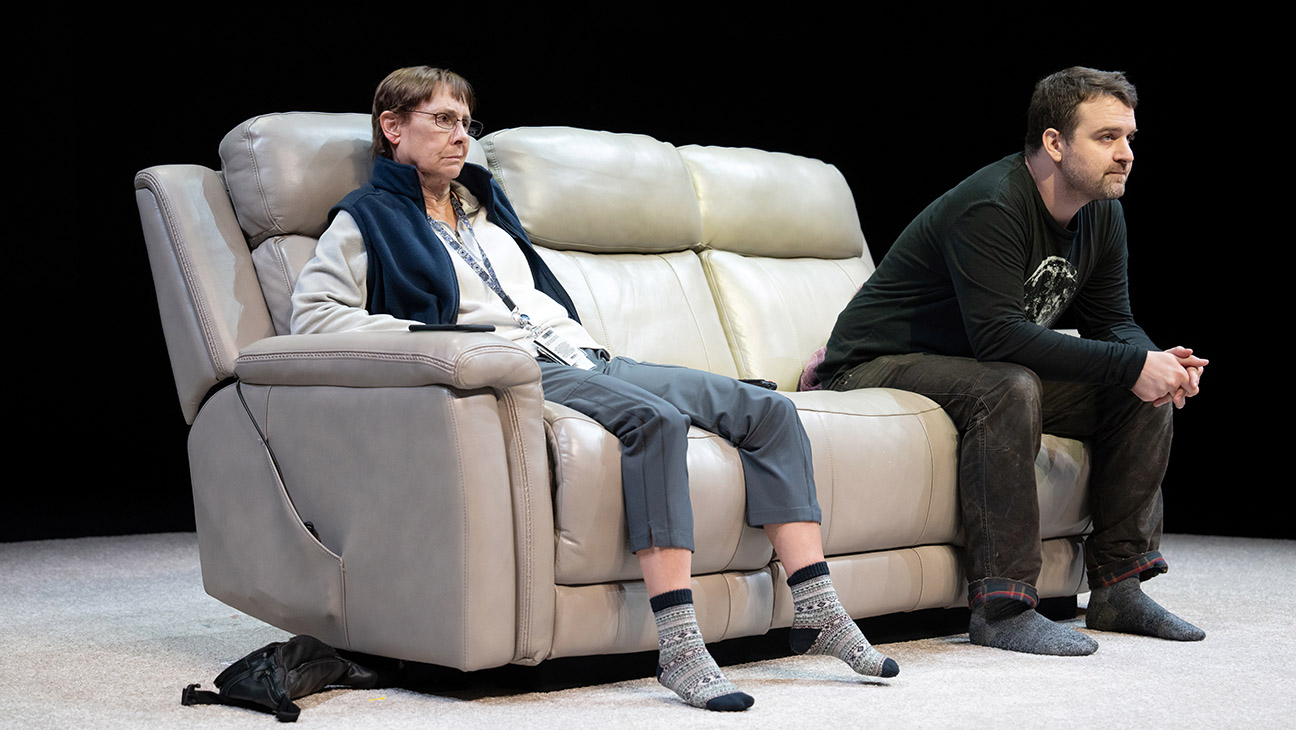
Ethan turns up soon after the death of his meth-addict father in 2020 at his aunt’s house about a half-hour outside of Moscow (where the playwright grew up), his face half-hidden by a mask in the early days of COVID. There’s no warmth from either side in his reunion with curmudgeonly Sarah, from whom Ethan just needs the deed to his father’s home so he can sell it and get out of there. Their initial exchanges are terse and distant, negotiating each other from opposite sides of an ugly gray leather (or more likely vinyl) reclining couch that’s pretty much the extent of designer Scott Pask’s austere set.
The sofa sits on a gray-carpeted circular turntable, which shifts to suggest the play’s handful of different locations. It’s surrounded by a void of blackness that hints at the vast expanse of starry sky, discussed but never seen, a sharp contrast to the night skies over Seattle, where Ethan has been living. Though there’s no evidence of a thaw, Sarah eventually mumbles a begrudging “I’m sorry about your dad.” Ethan replies with an equally affectless, “I’m sorry about your brother.”
When his childhood experiences of being the bullied queer kid in school come up, Ethan nervously wonders if his aunt minds him discussing his sexuality, given his assumption that she’s religious. Sarah quickly sets him straight on her atheism, adding, “All this time you’ve thought I had an issue with you being gay? That’s the most interesting thing about you.”
Metcalf handles that kind of unfiltered stinger like a soldier lobbing grenades with casual disregard. Sarah’s appearance matches her demeanor, from her utilitarian workwear to hair that looks like it’s been cut with a knife. But despite her intimidating manner, she insists Ethan stay in her spare room, observing that his car appears to be packed with everything he owns.
Hunter has an unerring command of the character-driven play in which very little happens that could be called conventional drama. Sarah prods Ethan as to why he studied writing in college but has produced nothing. He admits he was focusing on auto-fiction, reflecting different aspects of himself. His aunt asks: “But you don’t write anymore?” He replies, “Yeah, I guess — I realized I didn’t like my main characters.” He also reveals that his relationship in Seattle with a cokehead corporate lawyer came to a messy end.
Days stretch into weeks, months and ultimately two years in which the most consistent common ground between Sarah and Ethan is an inane TV series about a family of possible aliens, which they low-key hate-watch together. The closest things to concrete developments are Ethan learning of his secretive aunt’s medical issues via hospital bills left out in the kitchen; and acquiring a boyfriend after an awkward first encounter in a Moscow bar.
That third significant character, James (John Drea, excellent), shifts the play’s energy in subtle ways, breaking through with Ethan and even to some extent with Sarah despite the walls they have constructed around themselves. When James mentions his worry that the head of his college department hates him, Sarah replies without malice: “You strike me as the kind of person who assumes people hate you until they tell you otherwise.” “Yeah, probably,” responds James with a shrug.
Easygoing James is Ethan’s polar opposite — he’s getting his Masters in physics, with a specialization in astrophysics that he plans to continue in a PhD program. He resists his father’s wish for him to take over the family dry cleaning chain in upscale Coeur d’Alene where he grew up (Metcalf’s throwaway reaction to that piece of information is priceless). James is uncomplicated, kind and open whereas Ethan is wary, sullen and often prickly. The connection between them seems unlikely, but it’s played with such naturalness by Stock and Drea that you never question the blossoming relationship.
Ethan is astonished by the mere fact that James comes from a stable family — even more so by the news that James’ father is giving him a sizeable amount of money from the sale of his lake house. Ethan’s mother fled when he was young, leaving him to be raised by his abusive father, whose drug habit consumed just about any money coming into the household. In a blowup argument, Ethan resentfully calls James’ privilege a deficiency that prevents him from understanding more difficult lives.
A less delicate craftsman might have made James a schematic solution to glum Ethan’s problems, a saintly boyfriend to jolt him out of his stasis and motivate him to move out of his aunt’s place and forward with his life. That possibility is dangled during a lovely interlude midway when Sarah is startled by James wandering into the living room after spending the night, and Ethan follows, half-dressed and almost oblivious to his aunt’s sharp edges.
But Hunter is more interested in the finer nuances of how people come to care for one another — even when they lack the skills to show it or concede that they need help — and how even the most muted compassion can bring about change.
This is a gorgeous play — unassuming and concise but emotionally expansive, attentive to its characters’ interior lives as much as their quotidian routines. Mantello, with his customary economy and laser focus, is similarly alert to every detail, spoken or unspoken. Watching Metcalf vacuuming in angry silence after a tense conversation with Ethan is both darkly funny and poignant. Their bits of business with the reclining couch and its elevated footrests and tray table are a comedy of accidental domesticity.
Since he first turned heads in New York with A Bright New Boise in 2010, Hunter has been continually refining his exploration of the unexpected pockets of tenderness in environments that might seem antithetical to it.
He remains best known for The Whale, which worked better as a play than a movie, and as a writer on the beloved FX series, Baskets. His 2022 drama, A Case for the Existence of God, is a devastating example of a writer summoning hope out of sadness and disappointment. His 2018 play Clarkston — which played on a double-bill with its companion piece Lewiston, with a communal dinner in between — is an exquisite portrait of modern frontier disenfranchisement and as close to a masterpiece as anything to come out of 21st century American drama.
Hunter’s work is deceptively modest and Little Bear Ridge Road is no exception, which might make it seem small-scaled for Broadway. But its rewards are as immense as the Idaho night skies.
Venue: Booth Theatre, New York
Cast: Laurie Metcalf, Micah Stock, John Drea, Meighan Gerachis
Director: Joe Mantello
Playwright: Samuel D. Hunter
Set designer: Scott Pask
Costume designer: Jessica Pabst
Lighting designer: Heather Gilbert
Sound designer: Mikhail Fiksel
Presented by Scott Rudin, Barry Diller
