


New Delhi:
Astronomers from India have made an intriguing discovery in a unique tri-star solar system located 489 light years from Earth. The discovery will help astrophysicists get a better understanding of planetary formations.
Astronomers from the National Institute of Science Education and Research or NISER in Odisha have made the discovery using the advanced radio telescope in Chile’s Atacama Desert. Their observations, sustained over a period of time, reveal fascinating insights into the complexities of planetary formation.
The three-star system that was being observed was the ‘GG Tau A’ solar system which is in its nascent stage of planetary formations. The system is believed to be around 5 million years old. What makes it unique is that there are three ‘Suns’ with a massive protoplanetary disk – a rotating disk of gas and dust that forms around a young star and provides the materials for new planets to form.
Because the three stars orbit each other, the giant ring of gas and dust, which over time will form planets, get significantly altered due to the gravity of the stars in their orbiting pattern, giving scientists fascinating insights.
WHAT THE INDIAN ASTRONOMERS HAVE DISCOVERED
The team of astronomers from NISER was led by scientist Liton Majumdar, who is also a visiting scientist at NASA. His area of specialisation is star and planetary formations, astrochemistry, and exoplanet studies.
His team and he have detected molecular emissions from the protoplanetary disk which are the fundamental building blocks of planets. These emissions were found to originate in the coldest and most dense regions of the star system.
The team of researchers carried out their research in these coldest parts of the tri-star system, where temperatures are believed to be as low as 16 Kelvin or -257.15 degrees Celsius – well below the freezing point of carbon monoxide – key for scientists to trace the mass of gas during the formation of planets. The chemical composition of carbon monoxide – CO – carries carbon and oxygen, and reacts with other gases to form compounds like CH4 (methane). Its bright color helps astronomers model protoplanetary disks.
INSIGHTS FROM THE DISCOVERY
While scientists have been studying single star solar systems like our own, and also binary star systems like Alpha Centauri, understanding the complexities of a tri-star system is unique, and with the GG Tau A star system being as close to our solar system helps answer key questions in astrophysics.
It also helps understand the fundamental nature of planetary formation under the complications caused due to the gravity of three host stars.
Gravity, temperature, mass (energy), pressure and frequency are key aspects of physics and studying these in a three-star system gives scientists a challenge and an opportunity to make groundbreaking discoveries in such complex conditions.
THE RADIO TELESCOPE IN ATACAMA DESERT, CHILE
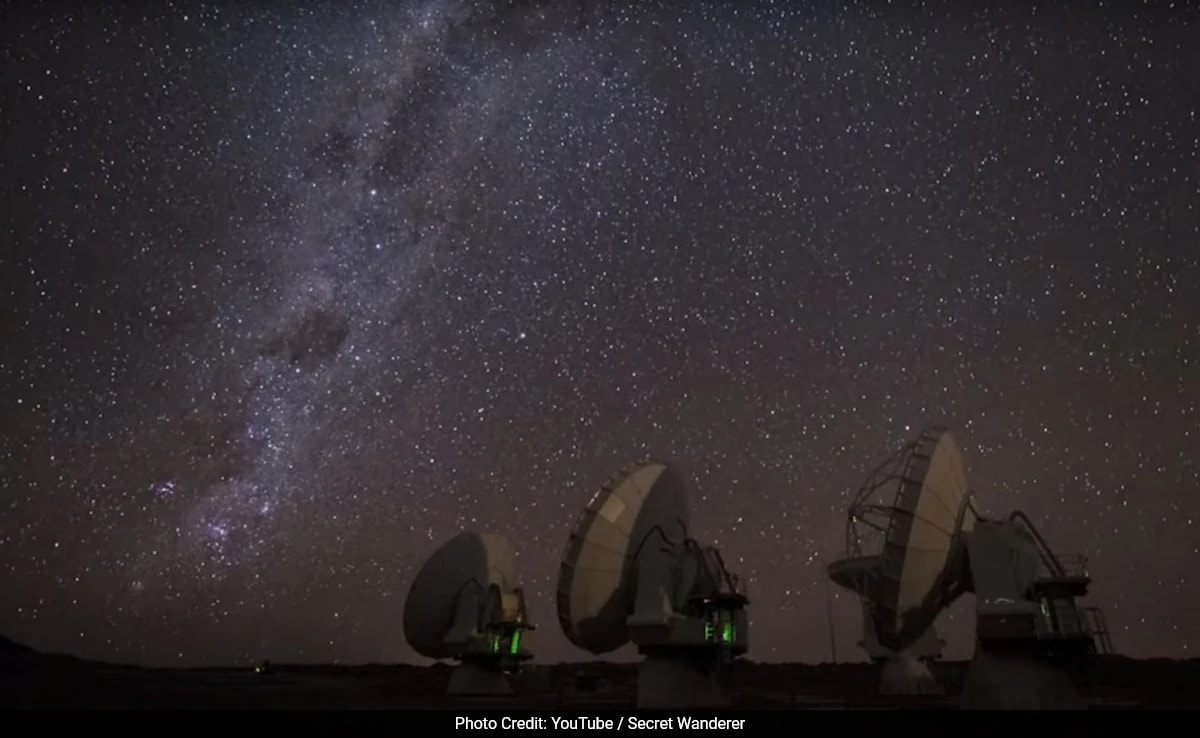
The astronomers from India used the Atacama Pathfinder Experiment or APEX radio telescope – one of the highest telescopes on Earth – located at a height of 5,064 meters above sea level in the Atacama desert in Chile.
The facility is built and operated by three European research institutes – The European Southern Observatory, The Max Planck Institute for Radio Astronomy, and The Onsala Space Observatory.
The APEX telescope is a modified ALMA (Atacama Large Millimeter Array) prototype antenna and is at the site of the ALMA observatory.
The ALMA telescope, also located in the Atacama Desert in Chile, is an astronomical interferometer of 66 radio telescopes which observe the electromagnetic radiation from space at millimeter and submillimeter wavelengths.
